
An amorphous group takes on “fascists”
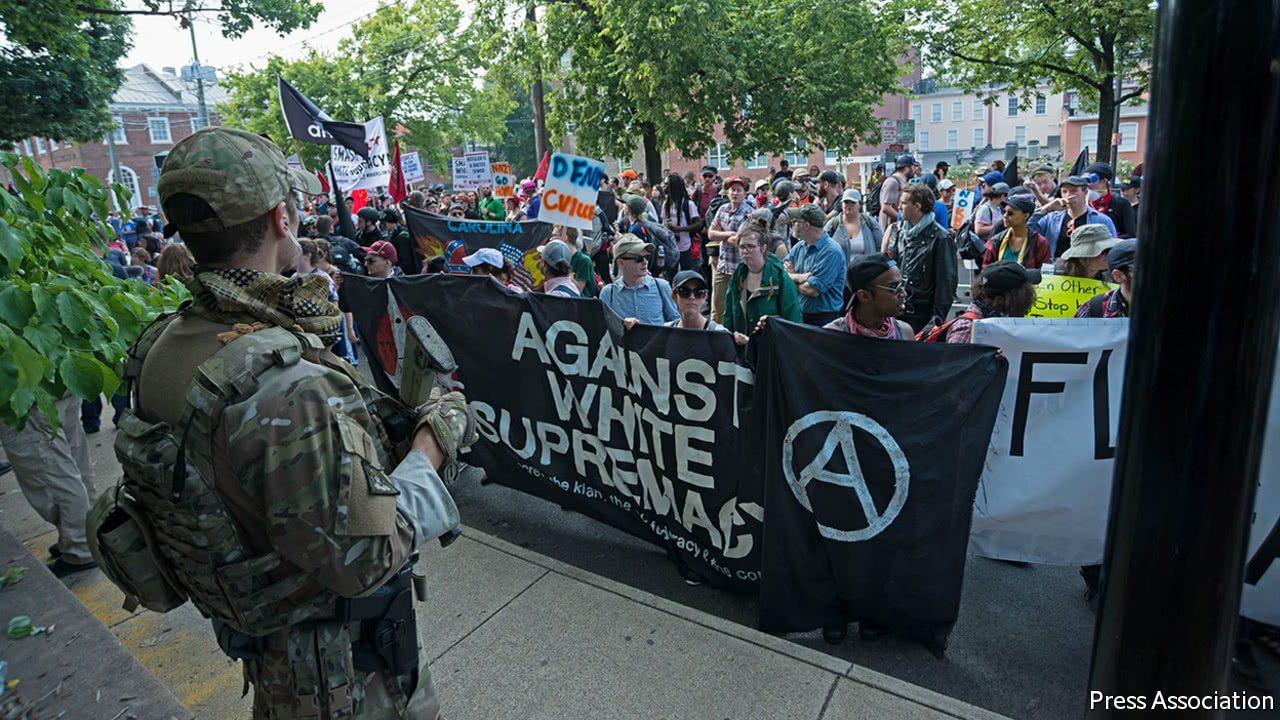
THIS weekend in Charlottesville, Virginia neo-Nazi groups protesting the removal of a statue of Robert Lee, a Confederate general, clashed with a coalition of counter-protestors comprising liberals, activists and “Antifa” groups. The last of these is perhaps the least understood. Who are the Antifa and where do they come from?
The word Antifa has its roots in Anti-Fascist Action, a name taken up by European political movements in the 1930s. These groups, especially in Germany, were a failed attempt by the left to unite against the threats of fascism and nazism. The end of the second world war and the chaos of occupied Germany briefly revived them as organised alliances of socialists and communists who went after prominent Nazis and engaged in political activism, before being shut down by occupying powers. Antifa resurfaced in the late 1980s in Europe, particularly in East Germany, as loose networks of radical activists came together in reaction to neo-Nazi and right-wing skinhead movements. The decade also marked the Antifa’s entrance onto the American stage in the form of the Anti-Racist Action, a network which originated in 1987 with the Baldies, a multi-racial crew in Minneapolis, leading to the creation of other groups across the country to fight neo-Nazis. Where the first iteration of Antifa groups based their actions on rhetoric and political activism, the later groups organised to fight on the streets.
Antifa’s organisation (or lack thereof) is reminiscent of Anonymous: there is no hierarchy or central platform, and anyone can claim the title and set up a local branch. The decentralised character of Antifa and lack of theoretical basis ensure appeal to all “anti-fascists”, but also make it difficult to pin down what exactly it is they oppose. They usually condemn racism, sexism, homophobia and often capitalism. Some are anarchists. But a defining characteristic of Antifa is that they aim to oppose fascism “by any means necessary”, including the use of violence. This leads to violent protests and altercations with the police or with right-wing extremists. (There is no evidence that Antifa protesters initiated violence in Charlottesville this weekend.) They also engage in their own form of online activism, notably adopting the practice of “doxxing”: publishing the personal details of whoever they deem fascist. These practices recall tactics adopted by the alt-right in America.
Antifa groups are not as widespread as they might seem. Their lack of co-ordination and endorsement of violence hinders their appeal as a mass movement. In America, their ongoing guerrilla war with the alt-right has helped bring more publicity to white supremacists and nationalists while doing little to advance their (somewhat unclear) cause. The biggest impact of American Antifa groups has been to stir up the debate on free speech through their insistence on preventing so-called fascists from expressing themselves, such as at Berkeley in February, where Antifa groups staged violent protests against Milo Yiannopoulos, an alt-right provocateur. Shutting down speech is hardly anti-fascist. Yet without Antifa, and their liberal allies, alt-right and neo-Nazi groups would march through the streets of Europe and America unmolested.
Further reading
The Economist explains: What is the alt-right? (Sept 2016)
The word Antifa has its roots in Anti-Fascist Action, a name taken up by European political movements in the 1930s. These groups, especially in Germany, were a failed attempt by the left to unite against the threats of fascism and nazism. The end of the second world war and the chaos of occupied Germany briefly revived them as organised alliances of socialists and communists who went after prominent Nazis and engaged in political activism, before being shut down by occupying powers. Antifa resurfaced in the late 1980s in Europe, particularly in East Germany, as loose networks of radical activists came together in reaction to neo-Nazi and right-wing skinhead movements. The decade also marked the Antifa’s entrance onto the American stage in the form of the Anti-Racist Action, a network which originated in 1987 with the Baldies, a multi-racial crew in Minneapolis, leading to the creation of other groups across the country to fight neo-Nazis. Where the first iteration of Antifa groups based their actions on rhetoric and political activism, the later groups organised to fight on the streets.
Latest updates
Antifa groups are not as widespread as they might seem. Their lack of co-ordination and endorsement of violence hinders their appeal as a mass movement. In America, their ongoing guerrilla war with the alt-right has helped bring more publicity to white supremacists and nationalists while doing little to advance their (somewhat unclear) cause. The biggest impact of American Antifa groups has been to stir up the debate on free speech through their insistence on preventing so-called fascists from expressing themselves, such as at Berkeley in February, where Antifa groups staged violent protests against Milo Yiannopoulos, an alt-right provocateur. Shutting down speech is hardly anti-fascist. Yet without Antifa, and their liberal allies, alt-right and neo-Nazi groups would march through the streets of Europe and America unmolested.
Further reading
The Economist explains: What is the alt-right? (Sept 2016)


