Biodun Iginla, BBC News

Biodun Iginla, BBC News
Showing posts with label coco jiang. Show all posts

Tuesday, August 28, 2018

North Korea tells U.S. denuclearization talks may fall apart

August 28, 2018  13H:32 GMT/UTC/ZULU TIME
WASHINGTON/PYONGYANG - North Korean officials have warned in a letter to the United States that denuclearization talks were “again at stake and may fall apart”, CNN reported on Tuesday, citing people familiar with the matter.
The letter was delivered directly to U.S Secretary of State Mike Pompeo, and stated that North Korean leader Kim Jong Un’s government felt that the process could not move forward.
"The U.S. is still not ready to meet (North Korean) expectations in terms of taking a step forward to sign a peace treaty," CNN reported, citing sources. cnn.it/2MAI9AT
SPONSORED
ADVERTISING
The 1950-1953 Korean War ended in an armistice rather than a peace treaty, leaving U.S.-led U.N. forces technically still at war with North Korea.
The North has long made clear that it sees an official end to the state of war as crucial to lowering tensions on the Korean peninsula.
The United States has been reluctant to declare an end to the Korean War until after North Korea abandons its nuclear weapons program.
The Washington Post reported on Monday that U.S. President Donald Trump called off a visit to North Korea by Pompeo after the latter received a belligerent letter from a senior North Korean official just hours after the trip was announced last week.
FILE PHOTO: U.S. President Donald Trump and North Korea's leader Kim Jong Un leave after signing documents that acknowledge the progress of the talks and pledge to keep momentum going, after their summit at the Capella Hotel on Sentosa island in Singapore June 12, 2018. REUTERS/Jonathan Ernst/File Photo
CNN reported that the letter was sent by the former head of North Korea’s spy agency, Kim Yong Chol, but it was not known how it was sent. The Washington Post said North Korea had been increasingly communicating through its U.N. mission.
CNN reported that the letter also mentioned that if a compromise could not be reached and the nascent talks crumbles, North Korea could resume “nuclear and missile activities”.
On Sunday, North Korea’s state media accused the United States of “double-dealing” and “hatching a criminal plot” but did not mention Pompeo’s canceled visit.
The Washington Post said the exact contents of the message were unclear, but it was sufficiently belligerent that Trump and Pompeo decided to call off the planned trip.
The trip had been announced the previous day for this week and Pompeo had intended to introduce a newly named special envoy, Stephen Biegun, to his North Korean counterparts.
The White House referred queries on the Washington Post report to the State Department, which did not immediately respond to a request for comment.
In cancelling Pompeo’s trip, Trump publicly acknowledged for the first time that his effort to get North Korea to denuclearize had stalled since his June 12 summit with its leader, Kim Jong Un {nL2N1VF10N]
U.S. intelligence and defense officials have repeatedly expressed doubts about North Korea’s willingness to give up its nuclear weapons and did not expect Pompeo’s trip to yield positive results.

Monday, July 30, 2018

BREAKING: U.S. spy satellites have detected renewed activity at the North Korean factory

July 31, 2018 06H:00  GMT/UTC/ZULU TIME
WASHINGTON - U.S. spy satellites have detected renewed activity at the North Korean factory that produced the country’s first intercontinental ballistic missiles capable of reaching the United States, a senior U.S. official said on Monday, in the midst of talks to compel Pyongyang to give up its nuclear arms.

A satellite image shows the Sanumdong missile production site in North Korea on July 29, 2018. Planet Labs Inc/Handout via REUTERS
Photos and infrared imaging indicate vehicles moving in and out of the facility at Sanumdong, but do not show how advanced any missile construction might be, the official told us at Reuters on condition of anonymity because the intelligence is classified.
The Washington Post reported on Monday that North Korea appeared to be building one or two new liquid-fueled intercontinental ballistic missiles at the large research facility on the outskirts of Pyongyang, citing unidentified officials familiar with intelligence reporting.
According to the U.S. official who spoke to us at Reuters, one photo showed a truck and covered trailer similar to those the North has used to move its ICBMs. Since the trailer was covered, it was not possible to know what, if anything, it was carrying.
SPONSORED
ADVERTISING
The White House said it did not comment on intelligence.
The evidence obtained this month is the latest to suggest ongoing activity in North Korea’s nuclear and missile facilities despite talks with the United States and a June summit between North Korean leader Kim Jong Un and U.S. President Donald Trump.
Trump declared soon afterward that North Korea no longer posed a nuclear threat. Kim committed in a broad summit statement to work toward denuclearization, but Pyongyang has offered no details as to how it might go about that and subsequent talks have not gone smoothly.
It was not the first time U.S. intelligence clashed with the president’s optimism.
In late June, U.S. officials told U.S. media outlets that intelligence agencies believed North Korea had increased production of fuel for nuclear weapons and that it did not intend to fully give up its nuclear arsenal.
U.S. Secretary of State Mike Pompeo told the U.S. Senate Foreign Relations Committee last week that North Korea was continuing to produce fuel for nuclear bombs despite its pledge to denuclearize. But he insisted the Trump administration was still making progress in its talks with Pyongyang.
Joel Wit, a former State Department negotiator and founder of 38 North, a North Korea monitoring project, said it was unrealistic to expect North Korea to stop its programs “until the ink is dry on an agreement.”
That was the case with U.S. negotiations with the Soviet Union during the Cold War, and more recently with Iran, “which continued to build more centrifuges capable of producing nuclear material even as it negotiated with the United States to limit those capabilities,” Wit said.
The Sanumdong factory produced two Hwasong-15 ICBMs, North Korea’s longest-range missiles, but the U.S. official noted that Pyongyang still had not tested a reliable re-entry vehicle capable of surviving a high-velocity trip through the Earth’s atmosphere and delivering a nuclear warhead.
It is possible, the official said, that any new missiles the North is building may be for further testing of such vehicles and of more accurate guidance systems.
“They seem to have figured out the engines, but not all the higher-tech stuff, and that might be what this is about,” the official said.
“What’s more, a liquid-fueled ICBM doesn’t pose nearly the threat that a solid-fueled one would because they take so long to fuel, and that’s something we almost certainly could see in time to abort a launch, given our assets in the vicinity.”

Thursday, May 17, 2018

BREAKING: North Korea summit: Trump contradicts Bolton on 'Libya model'


Media captionTrump on Kim meeting: 'North Korea would be very rich'
by Suzanne Gould, Coco Jiang, and Biodun Iginla, BBC News, Washington DC/Pyongyang. Coco Jiang is working undercover in Pyongyang.
US President Donald Trump has contradicted his own national security adviser, saying the so-called "Libya model" for denuclearisation is not being pursued with North Korea.
The suggestion by John Bolton angered the North, which threatened to pull out of a summit with Mr Trump next month.
Mr Trump said he still thought a summit would happen.
In 2003, Libya's leader Muammar Gaddafi agreed to give up his nuclear programme in exchange for a lifting of sanctions.
However, he was killed by Western-backed rebels years later - a comparison that appears to have alarmed North Korean leader Kim Jong-un.
Pyongyang warned on Wednesday that it might not attend the talks, due to take place in Singapore on 12 June.

What did President Trump say?

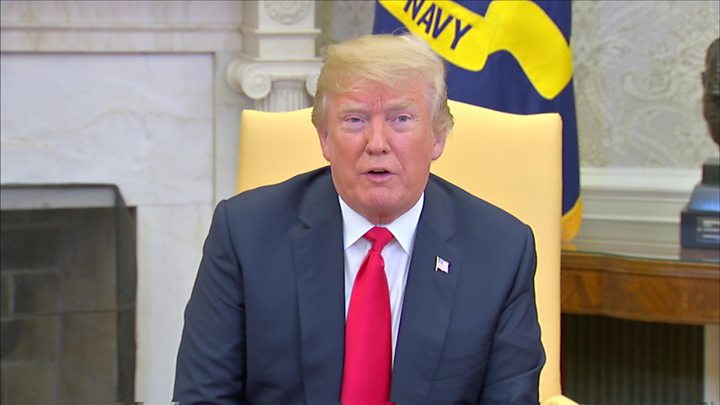
As Mr Bolton looked on, the US president said: "The Libyan model isn't a model that we have at all when we're thinking of North Korea."
The deal Mr Trump was considering with Kim Jong-un would be "something where he'd be there, he'd be in his country, he'd be running his country, his country would be very rich.
"If you look at South Korea, this would be really a South Korean model in terms of their industry… They're hard-working, incredible people."
On the planned summit, Mr Trump said: "Nothing has changed on North Korea that we know of. We have not been told anything.
"And if it does that's fine and if it doesn't I think we'll probably have a very successful meeting."
John Bolton, national security adviser, listens as President Trump speaks during a meeting in the Oval Office of the White House May 17, 2018Image copyrightGETTY IMAGES
Image captionJohn Bolton looked on as President Trump made his feelings clear

How does North Korea see it?

Also on Thursday, North Korea said it would not resume talks with the South until issues between the two are resolved.
Pyongyang has been angered by continuing US-South Korea joint military exercises which it sees as a rehearsal for invasion. It cancelled planned high-level talks with South Korea earlier this week.
In a statement, chief negotiator Ri Son-gwon reverted to the angry language the North has used before, describing South Korean authorities as incompetent and senseless in comments reported by state news agency KCNA.
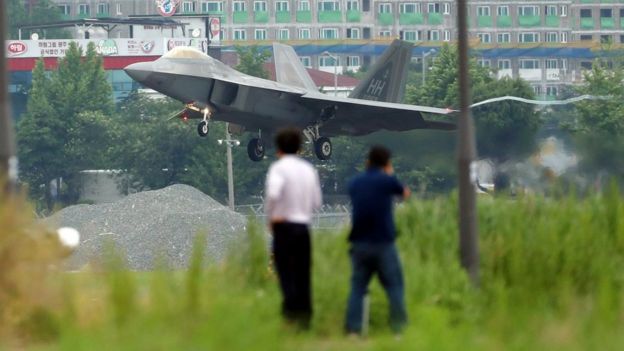
A US Air Force F-22 Raptor lands at Gwangju Air Base in the south-western city of Gwangju, S Korea, on May 16, 2018Image copyrightAFP
Image captionJoint military drills between the US and South Korea have angered the North
He also criticised the South Korea for allowing "human scum" (a reference to a North Korean defector) to speak at the Seoul National Assembly.
Thursday's criticism of South Korea marks yet another shift in tone from Pyongyang just weeks before the planned US summit, the BBC's Laura Bicker in Seoul says.
Pyongyang appears to be putting pressure on both the US and South Korea and refusing to talk until some concessions are made, she adds.

What has Libya got to do with this?

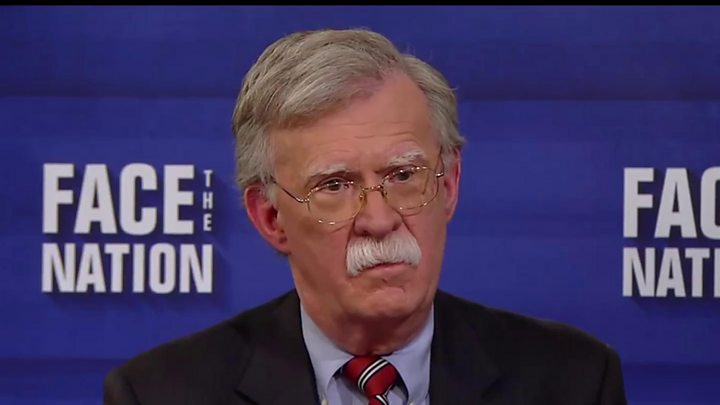
North Korea's suggestion that it might pull out of the US summit pointed the finger squarely at US National Security Adviser John Bolton.
"We do not hide our feeling of repugnance towards him," said Wednesday's statement, which was written by Vice-Foreign Minister Kim Kye-gwan.
Media captionWhy North Korea is angry at this man
North Korea was apparently referencing an interview Mr Bolton gave comparing it to "the Libya model" of denuclearisation.
In 2003, Libya's Colonel Muammar Gaddafi agreed to give up his country's programmes of weapons of mass destruction in an announcement that surprised the world.
Most US sanctions on Libya were lifted within a few months and diplomatic ties between the countries restored. The North African country came in from the cold.
But in 2011 the authoritarian leader was toppled by rebels and militiamen backed by Nato. He was later captured and killed by rebel forces.

What does this mean for the nuclear issue?

At the summit between the leaders of North and South Korea on 27 April both sides agreed to work to rid the Korean peninsula of nuclear weapons.
But Pyongyang's professed commitment to "denuclearisation" is likely to differ from Washington's demand for "comprehensive, verifiable and irreversible" nuclear disarmament.
South Korea's Foreign Minister Kang Kyung-wha told MPs on Thursday there was a gap between North Korea and the US on "how to pull off denuclearisation",according to South Korea's Yonhap news agency.
North Korea said last week it would begin dismantling its nuclear test site at Punggye-ri between 23-25 May, but there was no mention of allowing foreign experts access to the site.
On a recent visit to North Korea, US Secretary of State Mike Pompeo stressed that any claim of denuclearisation by the North would require a "robust verification" programme by the US and other nations.