PYONYANG - North Korea will make an announcement at 0330 GMT, following the launch of what appeared to an intercontinental ballistic missile that landed close to Japan.
North Korean leader Kim Jong Un hosted a massive celebration to congratulate his nuclear scientists and technicians who steered the country’s sixth and largest nuclear test a week ago, its official news agency said on Sunday.
The United States and its allies had been bracing for another long-range missile launch in time for the 69th anniversary of North Korea’s founding on Saturday, but no fresh provocations were spotted while the North held numerous events to mark the holiday.
Throughout last week, South Korean officials had warned the North could launch another intercontinental ballistic missile in defiance of U.N. sanctions and amid an escalating standoff with the United States.
Washington told the U.N. Security Council on Friday to call a meeting on Monday to vote on a draft resolution establishing additional sanctions on North Korea for its missile and nuclear program.
Japanese Defense Minister Itsunori Onodera said it was vital to put pressure on North Korea through additional sanctions, including blocking or slowing its fuel supplies.
“If we put firm pressure on North Korea such that it realizes it cannot develop missiles, it will accept dialogue and we can progress with diplomatic efforts,” Onodera told public broadcaster NHK on Sunday. “Unless we firmly apply pressure, North Korea will not change its direction.”
KCNA said Kim threw a banquet to laud the nuclear scientists and other top military and party officials who contributed to the nuclear bomb test last Sunday, topped with an art performance and a photo session with the leader himself.
KCNA did not specify when the banquet had been held, but analysts said it had likely been on Saturday.
North Korean leader Kim Jong Un reacts during a celebration for nuclear scientists and engineers who contributed to a hydrogen bomb test, in this undated photo released by North Korea's Korean Central News Agency (KCNA) in Pyongyang on September 10, 2017. KCNA via REUTERS
Photos released on Sunday by KCNA showed the young leader breaking into a broad smile at the People’s Theater with two prominent scientists: Ri Hong Sop, head of North Korea’s Nuclear Weapons Institute, and Hong Sung Mu, deputy director of the ruling Workers’ Party of Korea’s munitions industry department.
Ri and Hong have played vital roles in the North’s nuclear program, appearing at close distance to Kim during field inspections and weapons tests, including the latest nuclear test. Ri is a former director of Yongbyon Nuclear Research Center, North Korea’s main nuclear facility north of Pyongyang, where Hong also worked as a chief engineer.
North Korea had said the latest test was an advanced hydrogen bomb. There was no independent confirmation but some Western experts said there was enough strong evidence to suggest the reclusive state has either developed a hydrogen bomb or was getting very close.
Slideshow (7 Images)
KCNA said on Sunday the scientists and technicians “brought the great auspicious event of the national history, an extra-large event through the perfect success in the test of H-bomb”.
Kim praised the developers in his own remarks as “taking the lead” in attaining the “final goal of completing the state nuclear force” in line with his parallel pursuit of nuclear and economic development.
“The recent test of the H-bomb is the great victory won by the Korean people at the cost of their blood while tightening their belts in the arduous period,” Kim was quoted as saying.
Ri and Hong’s roles have also been noted overseas, prompting the United Nations, the United States or South Korea to blacklist them.
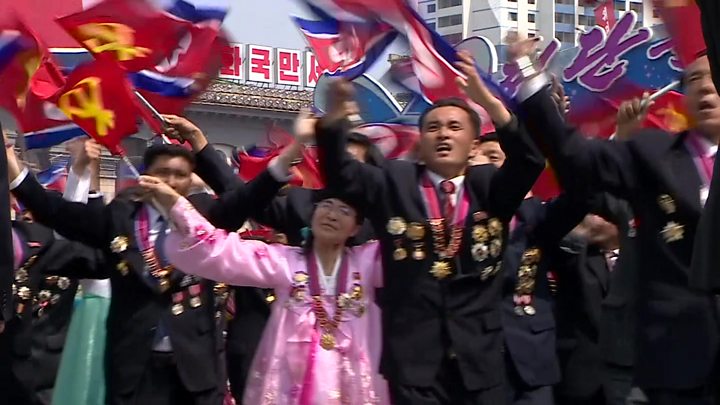
Aside from the elite, rank-and-file North Koreans also commemorated the anniversary on Saturday by visiting the Kumsusan Palace of the Sun, which houses the embalmed bodies of founding father Kim Il Sung and his son and successor Kim Jong Il.
KCNA said service personnel and civilians, including children, laid floral baskets and bouquets at the statues of the deceased leaders across the country, while enjoying art performances and dancing parties.
US intelligence believes North Korea has now built a nuclear weapon small enough to fit onto a ballistic missile, making it a potent threat against neighbors and possibly the United States, the Washington Post reported Tuesday.
The country's nuclear advances have proceeded much more quickly than expected, but experts say North Korea still needs significant technological gains in order to become a full-fledged nuclear threat.
- Where does the North Korean nuclear capability stand? -
Pyongyang has conducted five nuclear bomb tests, with the last one, on September 9, 2016, roughly the size of the nuclear bomb the United States dropped on Nagasaki in 1945: 20-30 kilotons. That device, North Korea said, was going to be miniaturized and "standardized" for use on its ballistic missiles.
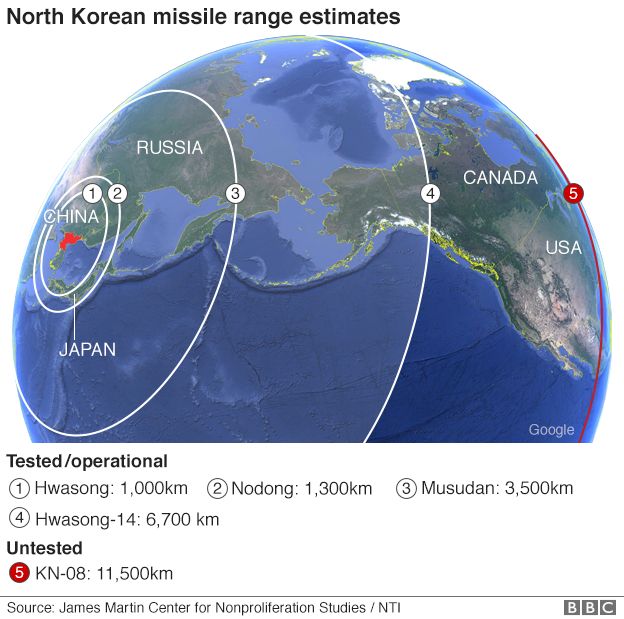
This year it demonstrated an ability to launch an intercontinental ballistic missile (ICBM) in two tests. The most recent of them, on July 28, showed a missile with a theoretical range of 10,000 kilometers (6,200 miles), meaning it could hit much of the United States and Europe, including population centers like New York and Paris.
- Is that enough to constitute an immediate threat? -
Besides reliable missiles with accurate targeting technology, Pyongyang needs to make sure its bombs would survive a 16,000 mile per hour (25,800 kilometer per hour) reentry from high in the atmosphere on an ICBM. It is possible their warheads are currently robust enough to survive the slower speeds of a shorter range missile that could strike Japan, but unlikely with an ICBM.
According to Michael Elleman, of the International Institute for Strategic Studies, the re-entry vehicle on the July 28 test likely broke into pieces and disintegrated.
Siegfried Hecker, a Stanford University nuclear expert, said it could be another five years before North Korea has an adequately robust reentry vehicle.
"I don't believe they have sufficient missile or nuclear test experience to field a nuclear warhead that is sufficiently small, light and robust to survive an ICBM delivery," Hecker told us at France24.
- What other technical hurdles does NK face?-
Hecker, who has visited North Korea several times to view its nuclear activities, said its weapons program is deeply constrained by its small supply of uranium and plutonium, especially plutonium, which is preferable in an ICBM-mounted weapon. Combined, he said, its uranium and plutonium supplies are likely enough for 20-25 nuclear weapons.
But according to the Washington Post report, the US Defense Intelligence Agency believes the country already has up to 60 nuclear weapons in its stockpile.
IT IS odd that North Korea causes so much trouble. It is not exactly a superpower. Its economy is only a fiftieth as big as that of its democratic capitalist cousin, South Korea. Americans spend twice its total GDP on their pets. Yet Kim Jong Un’s backward little dictatorship has grabbed the attention of the whole world, and even of America’s president, with its nuclear brinkmanship. On July 28th it tested an intercontinental ballistic missile that could hit Los Angeles. Before long, it will be able to mount nuclear warheads on such missiles, as it already can on missiles aimed at South Korea and Japan. In charge of this terrifying arsenal is a man who was brought up as a demigod and cares nothing for human life—witness the innocents beaten to death with hammers in his gigantic gulag. Last week his foreign ministry vowed that if the regime’s “supreme dignity” is threatened, it will “pre-emptively annihilate” the countries that threaten it, with all means “including the nuclear ones”. Only a fool could fail to be alarmed.
What another Korean war might look like
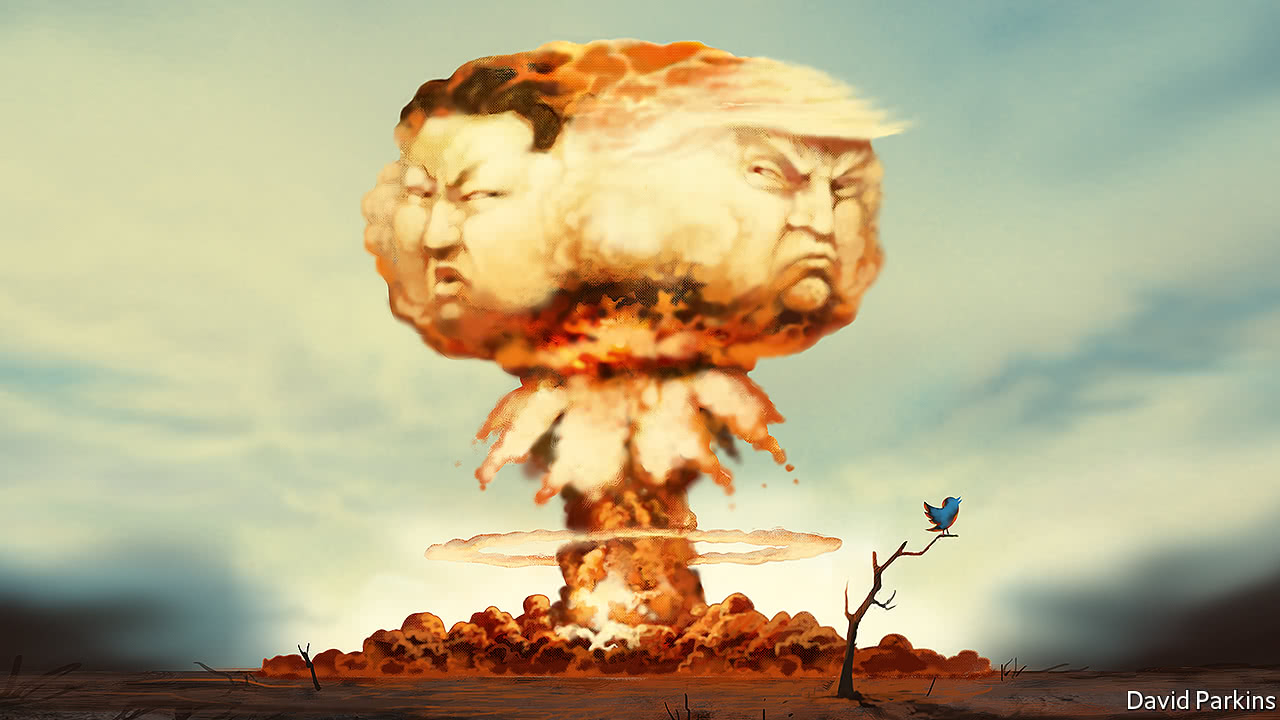
Yet the most serious danger is not that one side will suddenly try to devastate the other. It is that both sides will miscalculate, and that a spiral of escalation will lead to a catastrophe that no one wants. Our briefing this week lays out, step by step, one way that America and North Korea might blunder into a nuclear war (see article). It also lists some of the likely consequences. These include: for North Korea, the destruction of its regime and the death of hundreds of thousands of people. For South Korea, the destruction of Seoul, a city of 10m within easy range of 1,000 of the North’s conventional artillery pieces. For America, the possibility of a nuclear attack on one of its garrisons in East Asia, or even on an American city. And don’t forget the danger of an armed confrontation between America and China, the North’s neighbour and grudging ally. It seems distasteful to mention the economic effects of another Korean war, but they would of course be awful, too.
President Donald Trump has vowed to stop North Korea from perfecting a nuclear warhead that could threaten the American mainland, tweeting that “it won’t happen!” Some pundits suggest shooting down future test missiles on the launchpad or, improbably, in the air. Others suggest using force to overthrow the regime or pre-emptive strikes to destroy Mr Kim’s nuclear arsenal before he has a chance to use it.
Yet it is just this sort of military action that risks a ruinous escalation. Mr Kim’s bombs and missile-launchers are scattered and well hidden. America’s armed forces, for all their might, cannot reliably neutralise the North Korean nuclear threat before Mr Kim has a chance to retaliate. The task would be difficult even if the Pentagon had good intelligence about North Korea; it does not. The only justification for a pre-emptive strike would be to prevent an imminent nuclear attack on America or one of its allies.
Can Mr Kim be cajoled or bribed into giving up his nuclear ambitions? It is worth trying, but has little chance of success. In 1994 President Bill Clinton secured a deal whereby Kim Jong Il (the current despot’s father) agreed to stop producing the raw material for nuclear bombs in return for a huge injection of aid. Kim took the money and technical help, but immediately started cheating. Another deal in 2005 failed, for the same reason. The younger Kim, like his father, sees nuclear weapons as the only way to guarantee the survival of his regime. It is hard to imagine circumstances in which he would voluntarily give up what he calls his “treasured sword of justice”.
If military action is reckless and diplomacy insufficient, the only remaining option is to deter and contain Mr Kim. Mr Trump should make clear—in a scripted speech, not a tweet or via his secretary of state—that America is not about to start a war, nuclear or conventional. However, he should reaffirm that a nuclear attack by North Korea on America or one of its allies will immediately be matched. Mr Kim cares about his own skin. He enjoys the life of a dissolute deity, living in a palace and with the power to kill or bed any of his subjects. If he were to unleash a nuclear weapon, he would lose his luxuries and his life. So would his cronies. That means they can be deterred.
To contain Mr Kim, America and its allies should apply pressure that cannot be misconstrued as a declaration of war. They should ramp up economic sanctions not only against the North Korean regime but also against the Chinese companies that trade with it or handle its money. America should formally extend its nuclear guarantee to South Korea and Japan, and boost the missile defences that protect both countries. This would help ensure that they do not build nuclear weapons of their own. America should convince the South Koreans, who will suffer greatly if war breaks out, that it will not act without consulting them. China is fed up with the Kim regime, but fears that if it were to collapse, a reunified Korea would mean American troops on China’s border. Mr Trump’s team should guarantee that this will not happen, and try to persuade China that in the long run it is better off with a united, prosperous neighbour than a poor, violent and unpredictable one.
Everyone stay calm
All the options for dealing with the North are bad. Although America should not recognise it as a legitimate nuclear power, it must base its policy on the reality that it is already an illegitimate one. Mr Kim may gamble that his nukes give him the freedom to behave more provocatively, perhaps sponsoring terrorism in the South. He may also sell weapons to other cruel regimes or terrorist groups. The world must do what it can to thwart such plots, though some will doubtless succeed.
It is worth recalling that America has been here before. When Stalin and Mao were building their first atom bombs, some in the West urged pre-emptive strikes to stop them. Happily, cooler heads prevailed. Since then, the logic of deterrence has ensured that these terrible weapons have never been used. Some day, perhaps by coup or popular uprising, North Koreans will be rid of their repulsive ruler, and the peninsula will reunite as a democracy, like Germany. Until then, the world must keep calm and contain Mr Kim.
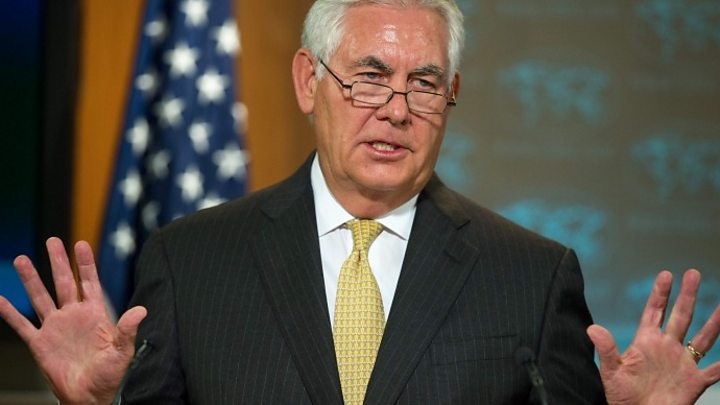
The US government is not seeking a regime change in North Korea, the secretary of state says, amid tensions over Pyongyang's weapons programme.
"We're not your enemy," Rex Tillerson said, adding that the US wanted a dialogue at some point.
Meanwhile, a senior Republican senator said President Trump considered going to war with North Korea as an option.
Pyongyang claimed that its latest missile test could hit the US west coast and beyond.
"We do not seek a regime change, we do not seek the collapse of the regime, we do not seek an accelerated reunification of the peninsula, we do not seek an excuse to send our military north of the 38th parallel," said Mr Tillerson, referring to the border between the Koreas.
"We're not your enemy, we're not your threat but you're presenting an unacceptable threat to us and we have to respond."
The second test of an intercontinental ballistic missile (ICBM) on Friday, celebrated by North Korean leader Kim Jong-un, was the latest to be conducted in defiance of a UN ban.
Barbara Plett Usher, State Department Correspondent
North Korea's recent long-range missile tests have deepened concern about the threat Pyongyang poses to the US mainland, and strengthened determination here to prevent any strike. That's what the president had in mind in his war talk with Senator Lindsey Graham.
The Pentagon has updated military options, but at the same time says a confrontation would be catastrophic. In light of that, Mr Tillerson repeated at length that the US wasn't seeking regime change and said the goal was dialogue, but one not based on the assumption that North Korea could keep its nuclear weapons.
Pyongyang has categorically refused such terms.
The strategy, said Mr Tillerson, is a sustained campaign of peaceful but intensifying economic pressure to change its mind. But given the advances in ballistic technology demonstrated by the recent ICBM tests, there's growing doubt that denuclearisation is a realistic possibility.
As always, there are no good options when it comes to North Korea, but less time to pursue them.
President Trump has repeatedly criticised China, which shares a land border with North Korea and is its closest economic ally, for not doing enough to stop Pyongyang's weapons programme.
However, Mr Tillerson took a more diplomatic approach, saying that "only the North Koreans are to blame for this situation".
"But," he added, "we do believe China has a special and unique relationship, because of this significant economic activity, to influence the North Korean regime in ways that no one else can."
Media captionWhy does North Korea need nukes?
In a separate development, Republican Senator Lindsey Graham said that Mr Trump told him that there would be a war between the two countries if Pyongyang continued with its aim to develop a missile programme with the US in its range.
"He has told me that. I believe him," Mr Graham said of his conversations with the president in an interview with NBC's Today programme.
"If there's going to be a war to stop [North Korea], it will be over there. If thousands die, they're going to die over there. They're not going to die here. And he [Mr Trump] has told me that to my face."
Despite the ongoing tests, most experts believe Pyongyang does not yet have the capability to miniaturise a nuclear warhead, fit it on to a long-range missile, and ensure it is protected until delivery to the target.
They say many of North Korea's missiles cannot accurately hit targets.
Others, however, believe that at the rate it is going, Pyongyang may overcome these challenges and develop a nuclear weapon within five to 10 years that could strike the US.