
by Coco Jiang and Biodun Iginla, News Analysts, The Economist Intelligence Unit, Pyongyang/Washington DC . Coco Jiang has been working undercover in Pyongyang.
There are no good options to curb Kim Jong Un. But blundering into war would be the worst
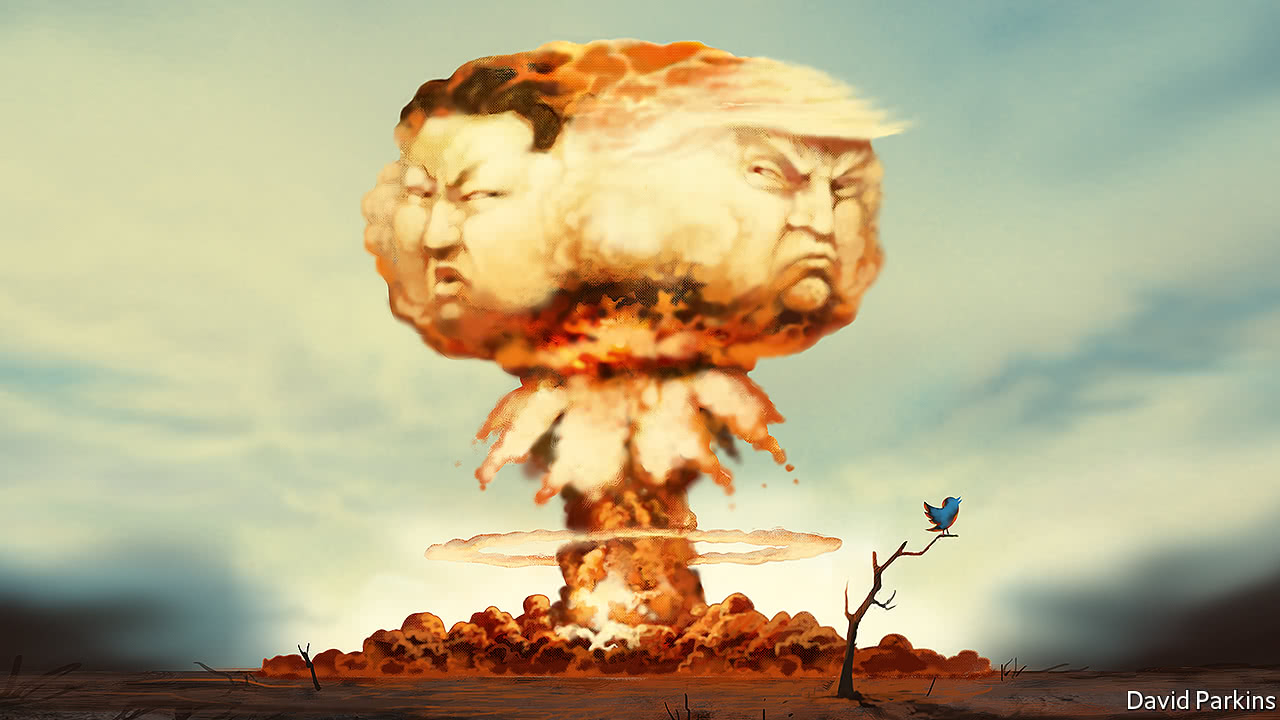
IT IS odd that North Korea causes so much trouble. It is not exactly a superpower. Its economy is only a fiftieth as big as that of its democratic capitalist cousin, South Korea. Americans spend twice its total GDP on their pets. Yet Kim Jong Un’s backward little dictatorship has grabbed the attention of the whole world, and even of America’s president, with its nuclear brinkmanship. On July 28th it tested an intercontinental ballistic missile that could hit Los Angeles. Before long, it will be able to mount nuclear warheads on such missiles, as it already can on missiles aimed at South Korea and Japan. In charge of this terrifying arsenal is a man who was brought up as a demigod and cares nothing for human life—witness the innocents beaten to death with hammers in his gigantic gulag. Last week his foreign ministry vowed that if the regime’s “supreme dignity” is threatened, it will “pre-emptively annihilate” the countries that threaten it, with all means “including the nuclear ones”. Only a fool could fail to be alarmed.
President Donald Trump has vowed to stop North Korea from perfecting a nuclear warhead that could threaten the American mainland, tweeting that “it won’t happen!” Some pundits suggest shooting down future test missiles on the launchpad or, improbably, in the air. Others suggest using force to overthrow the regime or pre-emptive strikes to destroy Mr Kim’s nuclear arsenal before he has a chance to use it.
Yet it is just this sort of military action that risks a ruinous escalation. Mr Kim’s bombs and missile-launchers are scattered and well hidden. America’s armed forces, for all their might, cannot reliably neutralise the North Korean nuclear threat before Mr Kim has a chance to retaliate. The task would be difficult even if the Pentagon had good intelligence about North Korea; it does not. The only justification for a pre-emptive strike would be to prevent an imminent nuclear attack on America or one of its allies.
Can Mr Kim be cajoled or bribed into giving up his nuclear ambitions? It is worth trying, but has little chance of success. In 1994 President Bill Clinton secured a deal whereby Kim Jong Il (the current despot’s father) agreed to stop producing the raw material for nuclear bombs in return for a huge injection of aid. Kim took the money and technical help, but immediately started cheating. Another deal in 2005 failed, for the same reason. The younger Kim, like his father, sees nuclear weapons as the only way to guarantee the survival of his regime. It is hard to imagine circumstances in which he would voluntarily give up what he calls his “treasured sword of justice”.
If military action is reckless and diplomacy insufficient, the only remaining option is to deter and contain Mr Kim. Mr Trump should make clear—in a scripted speech, not a tweet or via his secretary of state—that America is not about to start a war, nuclear or conventional. However, he should reaffirm that a nuclear attack by North Korea on America or one of its allies will immediately be matched. Mr Kim cares about his own skin. He enjoys the life of a dissolute deity, living in a palace and with the power to kill or bed any of his subjects. If he were to unleash a nuclear weapon, he would lose his luxuries and his life. So would his cronies. That means they can be deterred.
To contain Mr Kim, America and its allies should apply pressure that cannot be misconstrued as a declaration of war. They should ramp up economic sanctions not only against the North Korean regime but also against the Chinese companies that trade with it or handle its money. America should formally extend its nuclear guarantee to South Korea and Japan, and boost the missile defences that protect both countries. This would help ensure that they do not build nuclear weapons of their own. America should convince the South Koreans, who will suffer greatly if war breaks out, that it will not act without consulting them. China is fed up with the Kim regime, but fears that if it were to collapse, a reunified Korea would mean American troops on China’s border. Mr Trump’s team should guarantee that this will not happen, and try to persuade China that in the long run it is better off with a united, prosperous neighbour than a poor, violent and unpredictable one.
It is worth recalling that America has been here before. When Stalin and Mao were building their first atom bombs, some in the West urged pre-emptive strikes to stop them. Happily, cooler heads prevailed. Since then, the logic of deterrence has ensured that these terrible weapons have never been used. Some day, perhaps by coup or popular uprising, North Koreans will be rid of their repulsive ruler, and the peninsula will reunite as a democracy, like Germany. Until then, the world must keep calm and contain Mr Kim.
What another Korean war might look like
Yet the most serious danger is not that one side will suddenly try to devastate the other. It is that both sides will miscalculate, and that a spiral of escalation will lead to a catastrophe that no one wants. Our briefing this week lays out, step by step, one way that America and North Korea might blunder into a nuclear war (see article). It also lists some of the likely consequences. These include: for North Korea, the destruction of its regime and the death of hundreds of thousands of people. For South Korea, the destruction of Seoul, a city of 10m within easy range of 1,000 of the North’s conventional artillery pieces. For America, the possibility of a nuclear attack on one of its garrisons in East Asia, or even on an American city. And don’t forget the danger of an armed confrontation between America and China, the North’s neighbour and grudging ally. It seems distasteful to mention the economic effects of another Korean war, but they would of course be awful, too.Latest updates
Yet it is just this sort of military action that risks a ruinous escalation. Mr Kim’s bombs and missile-launchers are scattered and well hidden. America’s armed forces, for all their might, cannot reliably neutralise the North Korean nuclear threat before Mr Kim has a chance to retaliate. The task would be difficult even if the Pentagon had good intelligence about North Korea; it does not. The only justification for a pre-emptive strike would be to prevent an imminent nuclear attack on America or one of its allies.
Can Mr Kim be cajoled or bribed into giving up his nuclear ambitions? It is worth trying, but has little chance of success. In 1994 President Bill Clinton secured a deal whereby Kim Jong Il (the current despot’s father) agreed to stop producing the raw material for nuclear bombs in return for a huge injection of aid. Kim took the money and technical help, but immediately started cheating. Another deal in 2005 failed, for the same reason. The younger Kim, like his father, sees nuclear weapons as the only way to guarantee the survival of his regime. It is hard to imagine circumstances in which he would voluntarily give up what he calls his “treasured sword of justice”.
If military action is reckless and diplomacy insufficient, the only remaining option is to deter and contain Mr Kim. Mr Trump should make clear—in a scripted speech, not a tweet or via his secretary of state—that America is not about to start a war, nuclear or conventional. However, he should reaffirm that a nuclear attack by North Korea on America or one of its allies will immediately be matched. Mr Kim cares about his own skin. He enjoys the life of a dissolute deity, living in a palace and with the power to kill or bed any of his subjects. If he were to unleash a nuclear weapon, he would lose his luxuries and his life. So would his cronies. That means they can be deterred.
To contain Mr Kim, America and its allies should apply pressure that cannot be misconstrued as a declaration of war. They should ramp up economic sanctions not only against the North Korean regime but also against the Chinese companies that trade with it or handle its money. America should formally extend its nuclear guarantee to South Korea and Japan, and boost the missile defences that protect both countries. This would help ensure that they do not build nuclear weapons of their own. America should convince the South Koreans, who will suffer greatly if war breaks out, that it will not act without consulting them. China is fed up with the Kim regime, but fears that if it were to collapse, a reunified Korea would mean American troops on China’s border. Mr Trump’s team should guarantee that this will not happen, and try to persuade China that in the long run it is better off with a united, prosperous neighbour than a poor, violent and unpredictable one.
Everyone stay calm
All the options for dealing with the North are bad. Although America should not recognise it as a legitimate nuclear power, it must base its policy on the reality that it is already an illegitimate one. Mr Kim may gamble that his nukes give him the freedom to behave more provocatively, perhaps sponsoring terrorism in the South. He may also sell weapons to other cruel regimes or terrorist groups. The world must do what it can to thwart such plots, though some will doubtless succeed.It is worth recalling that America has been here before. When Stalin and Mao were building their first atom bombs, some in the West urged pre-emptive strikes to stop them. Happily, cooler heads prevailed. Since then, the logic of deterrence has ensured that these terrible weapons have never been used. Some day, perhaps by coup or popular uprising, North Koreans will be rid of their repulsive ruler, and the peninsula will reunite as a democracy, like Germany. Until then, the world must keep calm and contain Mr Kim.
