Biodun Iginla, BBC News

Biodun Iginla, BBC News
Showing posts with label northern Syria. Show all posts

Sunday, November 10, 2019

French IS suspects want to go home, and 'go on with our lives'

November 10, 2019 17H:26  GMT/ZULU
SULUK, Syria - Three French women who escaped from a camp for suspected jihadists in northern Syria say they want to go home and face whatever legal action France requires over their alleged links to the Islamic State (IS) militant group.
The three, interviewed in Syria’s Suluk town, controlled by Syrian rebels backed by Turkey, said they had fled during the chaos of Turkey’s incursion into Syria last month and turned themselves over to Turkish forces in hopes of returning home.
The women, who declined to give their names, suggested they were prepared to go France for the sake of their children, adding that conditions in the camp in Ain Issa, run by the U.S.-backed Syrian Democratic Forces (SDF), had been very hard.
The women gave no details of their life before detention. They are believed to be among the wives and children of former IS fighters killed or detained after the jihadist group was expelled from its strongholds in Iraq and Syria.
Ankara’s unilateral offensive angered Washington and Turkey’s main European NATO allies, who fear a return of IS in the region. European countries are especially concerned about foreign Islamic State fighters and adult relatives returning to Europe.
France has said citizens who joined the militant group, which operated in both Syria and Iraq, should be tried near where crimes were committed.
However Turkey says it will start repatriating IS detainees to their own countries on Monday, sending them back even if their citizenships have been revoked.
ADVERTISEMENT
The women’s preferred destination was France.
“We want to go back for our children to go on with their lives,” said one of the women, who like the others wore the niqab or full face veil.
“I’ve been here for five years  and I want to go back and go on with my life, go back to the time I lost. That’s it.”
A second woman said she wanted to return to France “quickly” and whatever the French courts decided was “not a problem”.
Their lives in the detention had been difficult. “Children got sick very quickly. There was not much to eat,” she said. “I want to go back to France with my son, (who is) 2-12 years old.”
A third woman said: “We have no problems with a ruling in France. It is for that reason that we handed ourselves over to the Turks, to go back to our country.”
ADVERTISEMENT
Turkey launched an offensive into northeastern Syria against the Kurdish YPG militia last month following a decision by U.S. President Donald Trump to withdraw troops from the region. The move prompted widespread concern over the fate of Islamic State prisoners in the region.
The YPG is the main element of the SDF, which has been a leading U.S. ally in beating back IS in the region. It has kept thousands of jihadists in jails across northeastern Syria.

Thursday, November 7, 2019

ANALYSIS AND BREAKING: Nato alliance experiencing brain death, says Macron


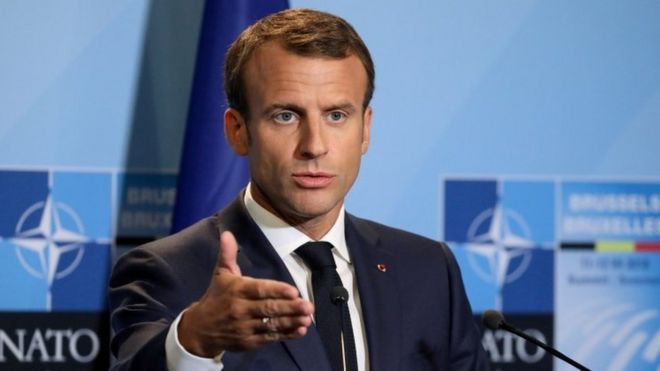
French President Emmanuel Macron at a Nato summit in Belgium, 2018Image copyrightREUTERS
by Natalie de Vallieres and Biodun Iginla, BBC News Analysts, Paris
President Emmanuel Macron of France has described Nato as "brain dead", stressing what he sees as waning commitment to the transatlantic alliance by its main guarantor, the US.
Interviewed by the Economist, he cited the US failure to consult Nato before pulling forces out of northern Syria.
He also questioned whether Nato was still committed to collective defence.
German Chancellor Angela Merkel, a key ally, said she disagreed with Mr Macron's "drastic words".
Nato, which celebrates 70 years since its founding at a London summit next month, has responded by saying the alliance remains strong.

What else did the French president say?

"What we are currently experiencing is the brain death of Nato," Mr Macron told the London-based newspaper.
He warned European members that they could no longer rely on the US to defend the alliance, established at the start of the Cold War to bolster Western European and US security.
Article Five of Nato's founding charter stipulates that an attack on one member will produce a collective response from the alliance.
But Mr Macron appeared unsure whether it was still valid when asked. "I don't know," he said.
The alliance, Mr Macron is quoted as saying, "only works if the guarantor of last resort functions as such. I'd argue that we should reassess the reality of what Nato is in the light of the commitment of the United States".
The French leader urged Europe to start thinking of itself as a "geopolitical power" to ensure it remained "in control" of its destiny.

Why the doubts over Nato?

President Donald Trump's abrupt decision to pull most US forces out of north-eastern Syria in October took European Nato members by surprise.
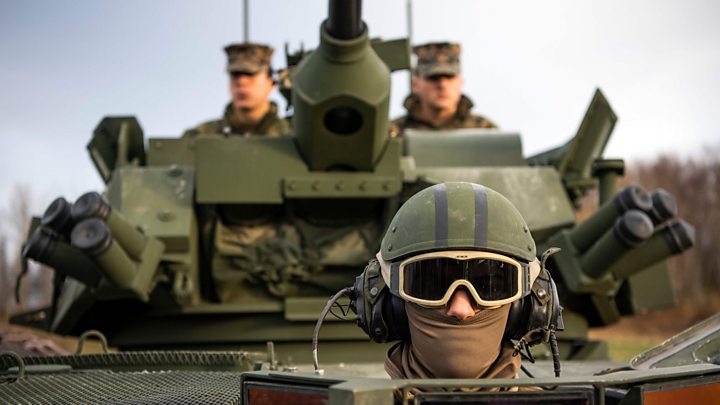
Media captionA Nato military exercise in 2018 - the biggest since Cold War
The move opened the way for Turkey - itself a powerful Nato member - to push into Syria and create what it termed a security zone along its border. Kurdish forces, who had been helping the US fight the Islamic State (IS) group, were expelled from the area.
Mr Macron at the time criticised Nato's failure to respond to the Turkish offensive.
Mr Trump has frequently accused European Nato members of failing to provide their fair share of military spending and for relying too heavily on the US for their defence.
For his part, Mr Macron has already been at the forefront of moves to boost defence co-operation among European countries. However, the European Union's other main military power, the UK, emphasises the importance of Nato to European defence.

What reaction has there been?

Mrs Merkel was speaking in Berlin alongside the visiting Nato Secretary-General Jens Stoltenberg.
Mr Macron "used drastic words - that is not my view of co-operation in Nato," she said.
Mrs Merkel acknowledged there were problems, but said she did not think "such sweeping judgements are necessary".
"Nato remains a cornerstone of our security," she added.
Mr Stoltenberg said the alliance remained strong.
"European allies are stepping up, investing more in defence.
"The US is increasing investments in Europe with more troops, more exercises. The reality is that we do work together. We have strengthened our collective defence. Any attempt to distance us from North America risks not only weakening the alliance, the transatlantic bond, but also weakening Europe."
Presentational grey line

No longer fit for purpose?

Analysis box by Jonathan Marcus, defence correspondent
With only weeks before the Nato summit, President Macron's comments suggest it might not be an entirely harmonious celebration.
One key fault line has been opened up by President Trump who frequently denigrates his Nato allies. He described many of them recently as "delinquent" for not spending sufficiently on their own defence.
Mr Macron said America was turning its back on Europe. The absence of co-ordination on strategic decision-making between the US and its Nato allies was exemplified by recent unilateral US and Turkish decisions in Syria.
Turkey's actions in particular, he said, raised all sorts of questions about the fundamental security guarantees that Nato gives to all its members. What would happen, he asked, if the Syrian government attacked Turkey due to its incursion into Syria?
With more members than ever and facing much more complex security challenges, Nato seems in Mr Macron's view to no longer be fit for purpose.
This is about much more than one US president. Nato must defend against multiple threats which different countries perceive in different ways. And a number of allies seem less and less keen to espouse the liberal democratic values that lie at Nato's core.
Presentational grey line

How did Nato come about?

The North Atlantic Treaty Organisation was created in 1949 to counter the threat from the Soviet Union as the Communist country sought to expand its power in Europe.
The Soviet Union, an ally in World War Two against Nazi Germany, became an adversary of the West during the Cold War.
It set up its own Warsaw Pact military alliance, including the then Communist countries of eastern Europe, in 1955.
That alliance was dissolved after the collapse of the Soviet Union in 1991 and former Warsaw Pact countries, though not Russia, became Nato members in the years following.
Originally set up to promote "stability and well-being in the North Atlantic area", Nato was faced with finding a new purpose after the demise of the Soviet Union.
From the mid-1990s, Nato forces were deployed on missions in the former Yugoslavia, launching air strikes to push Serbia out of Kosovo, and in Afghanistan, where the alliance took control of peacekeeping operations.
But as Nato has expanded, it has struggled to overcome Russian concerns that the alliance poses a threat on its borders.