Biodun Iginla, BBC News

Biodun Iginla, BBC News
Showing posts with label Turkish forces. Show all posts

Sunday, November 10, 2019

French IS suspects want to go home, and 'go on with our lives'

November 10, 2019 17H:26  GMT/ZULU
SULUK, Syria - Three French women who escaped from a camp for suspected jihadists in northern Syria say they want to go home and face whatever legal action France requires over their alleged links to the Islamic State (IS) militant group.
The three, interviewed in Syria’s Suluk town, controlled by Syrian rebels backed by Turkey, said they had fled during the chaos of Turkey’s incursion into Syria last month and turned themselves over to Turkish forces in hopes of returning home.
The women, who declined to give their names, suggested they were prepared to go France for the sake of their children, adding that conditions in the camp in Ain Issa, run by the U.S.-backed Syrian Democratic Forces (SDF), had been very hard.
The women gave no details of their life before detention. They are believed to be among the wives and children of former IS fighters killed or detained after the jihadist group was expelled from its strongholds in Iraq and Syria.
Ankara’s unilateral offensive angered Washington and Turkey’s main European NATO allies, who fear a return of IS in the region. European countries are especially concerned about foreign Islamic State fighters and adult relatives returning to Europe.
France has said citizens who joined the militant group, which operated in both Syria and Iraq, should be tried near where crimes were committed.
However Turkey says it will start repatriating IS detainees to their own countries on Monday, sending them back even if their citizenships have been revoked.
ADVERTISEMENT
The women’s preferred destination was France.
“We want to go back for our children to go on with their lives,” said one of the women, who like the others wore the niqab or full face veil.
“I’ve been here for five years  and I want to go back and go on with my life, go back to the time I lost. That’s it.”
A second woman said she wanted to return to France “quickly” and whatever the French courts decided was “not a problem”.
Their lives in the detention had been difficult. “Children got sick very quickly. There was not much to eat,” she said. “I want to go back to France with my son, (who is) 2-12 years old.”
A third woman said: “We have no problems with a ruling in France. It is for that reason that we handed ourselves over to the Turks, to go back to our country.”
ADVERTISEMENT
Turkey launched an offensive into northeastern Syria against the Kurdish YPG militia last month following a decision by U.S. President Donald Trump to withdraw troops from the region. The move prompted widespread concern over the fate of Islamic State prisoners in the region.
The YPG is the main element of the SDF, which has been a leading U.S. ally in beating back IS in the region. It has kept thousands of jihadists in jails across northeastern Syria.

Saturday, October 14, 2017

BREAKING: Syria war: Turkish forces set up positions in Idlib


  • 14 October 2017
  •  10H40  GMT/UTC/ZULU TIME
  • From the sectionMiddle East
Related Topics
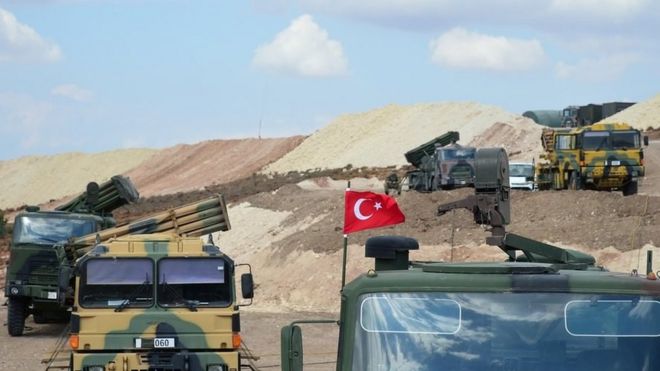
Handout photo made available by Turkish General Staff Press Office shows Turkish military vehicles as they cross into Idlib province, Syria (13 October 2017)Image copyrightEPA
Image captionThe Turkish convoy crossed into Idlib from Reyhanli, in the southern Turkish province of Hatay
by Nasra Ismail and Biodun Iginla, BBC News, Beirut
Turkish soldiers and armoured vehicles have crossed into Syria as part of an operation Ankara says is aimed at stopping fighting in Idlib province.
A military statement said the forces would set up observation posts to help monitor a "de-escalation zone" in line with an agreement with Russia and Iran.
Idlib is largely controlled by Hayat Tahrir al-Sham (HTS), a jihadist alliance linked to al-Qaeda.
It also borders the Kurdish enclave of Afrin, which Turkey wants to contain.
Turkey backs the opposition to Syrian President Bashar al-Assad and last year supported a rebel offensive against so-called Islamic State (IS) along the border in neighbouring Aleppo province.
That operation also served to prevent a US-backed alliance that is led by the Kurdish Popular Protection Units (YPG) seizing the territory and reaching Afrin.
Ankara considers the YPG an extension of the banned Kurdistan Workers' Party (PKK), which has fought for Kurdish autonomy in Turkey for three decades.
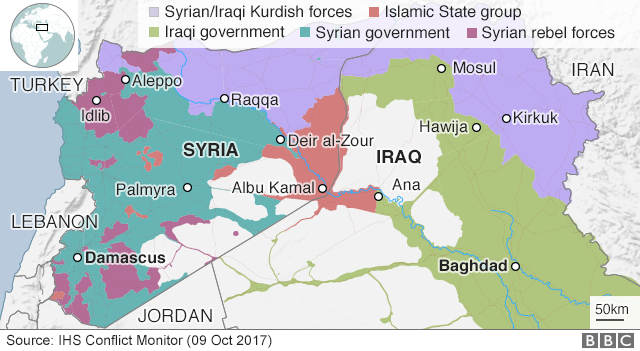
Map showing control of Iraq and Syria (9 October 2017)
Turkey's state-run Anadolu news agency reported that military convoys had crossed into Idlib from Reyhanli in the southern Turkish province of Hatay.
The Hurriyet newspaper said about 30 armoured vehicles and more than 100 soldiers were taking part in the operation, and speculated that more troops could be sent in the coming days.
The Turkish military statement said its soldiers had started their activities in Idlib by establishing observation posts in line with a plan agreed last month with Russia and Iran - which back President Assad - in the Kazakh capital Astana.
The three powers said they would each send about 500 observers to positions along the edge of the de-escalation zone to prevent clashes between Syrian government and rebel forces, allow the delivery of humanitarian aid and establish conditions necessary for the return of displaced people.
HTS, which was formed in January by a group previously known as al-Nusra Front, warned that the move would "end with restoring Bashar's rule" to Idlib.
However, the UK-based Syrian Observatory for Human Rights reported that HTS fighters had escorted the Turkish troops towards a western area adjoining Afrin.
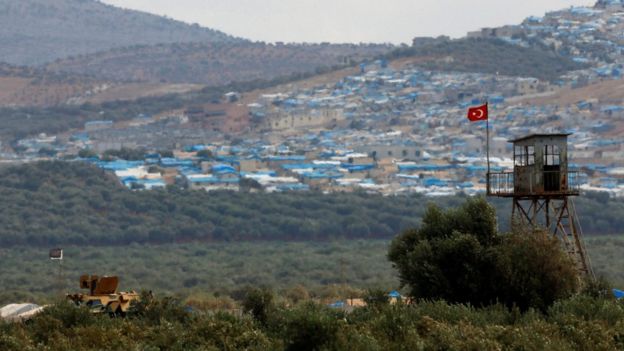
A Turkish military armoured vehicle guards the border with Syria's Idlib province, near the town of Atimeh (10 October 2017)Image copyrightREUTERS
Image captionTurkey wants to ensure Kurdish forces do not attempt to capture rebel-held areas of Idlib
A Kurdish militiaman told the Associated Press that the troops were stationed in three separate points along a "front" between Afrin and Idlib.
An official in a Free Syrian Army (FSA) faction said the Turkish deployment would "ensure the area is protected from Russian and regime bombing and to foil any attempt by the separatist YPG militias to illegally seize any territory".
Turkish President Recep Tayyip Erdogan vowed last week that he would not allow the YPG to form a "terror corridor" to the Mediterranean, which would require the Kurds capturing mountainous areas held by opposition and government forces.
CNN Turk reported that there had been a clash in the Idlib countryside near the Ogulpinar border crossing, but it was not clear which forces were involved.

Related Topics

More on this story

Sunday, September 4, 2016

Syria army besieges Aleppo as US, Russia talks stumble


by Leila Mohamed and Biodun Iginla, France24, Beirut


    © AFP / by Sara Hussein | Smoke billows on September 4, 2016 from a location on the southern outskirts of the Syrian city of Aleppo

    BEIRUT - 
    Syrian government troops renewed the siege of rebel-held parts of Aleppo on Sunday, as Washington and Moscow failed to reach a deal on stemming violence in the country's devastating war.
    Turkish forces and allied Syrian rebels meanwhile expelled the Islamic State group from the last stretch of the Syrian-Turkish border under its control, a monitor said.
    Syrian state media said the army and allied forces had taken an area south of Aleppo, severing the sole route left into the eastern neighbourhoods held by the opposition.
    "The armed forces in cooperation with their allies took full control of the military academy zone south of Aleppo and are clearing the remaining terrorists from the area," state television said, citing a military source.
    It said the advance "cut all the supply and movement routes for terrorist groups from southern Aleppo province to the eastern neighbourhoods and Ramussa."
    The development leaves about 250,000 people living in rebel-controlled parts of the city cut off from the outside world once again, and will raise new fears about a humanitarian crisis in Aleppo.
    Once Syria's economic powerhouse, the city has been ravaged by the war that began with anti-government protests in March 2011.
    It has been roughly divided between government control in the west and rebel control in the east since mid-2012, but in recent months regime forces slowly began to encircle the east.
    In July, they severed the only road into the rebel neighbourhoods, the key Castello Road running from the Turkish border in the north, creating food and fuel shortages in the east.
    The siege prompted international concern, with aid agencies urging 48-hour ceasefires to ensure humanitarian access.
    - US-Russia talks stumble -
    In early August, rebel forces including Al-Qaeda's former Syrian affiliate battled regime forces south of the city to open a new route to the east, through Ramussa district.
    But in recent days regime forces backed by Syrian and Russian war planes launched a counter-offensive.
    A key regime ally, Moscow began an aerial campaign in support of President Bashar al-Assad's government last September, even as it continued to publicly support efforts for a negotiated solution to the five-year war.
    Earlier Sunday, hopes were raised that Moscow and Washington might be on the verge of announcing a deal to halt the bloodshed.
    US President Barack Obama said both nations were working "around the clock" on a ceasefire, and a State Department official said a deal was close.
    But the hopes evaporated later in the day, with a State Department official saying Russia had "walked back on some of the areas we thought we were agreed on."
    Instead, US Secretary of State John Kerry and his Russian counterpart Sergei Lavrov are set to meet again on Monday in Hangzhou, China, where G20 leaders are gathered.
    "We're going to review some ideas tonight, a couple things on these couple of tough issues, and come back together and see where we are," said Kerry.
    "We're not going to rush," he said, stressing the importance of reaching a deal that was able "to try to get the job done".
    - IS expelled from border -
    Washington is opposed to Assad's government, but has been accused by the opposition of failing to deliver concrete support.
    And despite several rounds of international negotiations, a solution to the conflict that has killed more than 290,000 people and displaced millions remains elusive.
    The conflict has become increasingly complex, involving not only regime and rebels, but international backers on both sides, Kurdish forces, jihadists and now Turkey.
    Ankara began an operation inside Syria on August 24, dispatching troops to battle both the Islamic State group but also Syrian Kurdish forces it accuses of "terrorism".
    On Sunday, the Syrian Observatory for Human Rights monitor said rebels backed by Turkish tanks and warplanes had seized the last parts of the border held by IS from the extremist group.
    "IS has lost its contact with the outside world after losing the remaining border villages," the Britain-based monitor said.
    Much of the earlier work to expel IS from elsewhere on the border was done by the Syrian Kurdish YPG, working with the US-led coalition against the jihadist force.
    But Ankara considers the YPG a "terrorist" group and has been alarmed by its expansion along the border, fearing the creation of a contiguous, semi-autonomous Kurdish region in northern Syria.
    The loss of the Turkish border will deprive IS of a key transit point for recruits and supplies, though the group continues to hold territory in both Syria and Iraq.