Biodun Iginla, BBC News

Biodun Iginla, BBC News
Showing posts with label refugees. Show all posts

Saturday, September 1, 2018

Life upended for those left off Indian citizenship list


by Susan Kumar and Biodun Iginla, France24, GUWAHATI (INDIA)


    © AFP | Nimai Hajong, pictured with his wife, has been declared a non-citizen in India despite living there more than five decades

    GUWAHATI (INDIA) - 
    Nimai Hajong remembers almost nothing of the hills of eastern Bangladesh where he was born more than half a century ago, having fled as a small child to India where he has lived as a refugee ever since.
    The 58-year-old has been declared a foreigner -- one of four million people effectively stripped of citizenship by the government of the northeastern state of Assam.
    Their names have been left off a draft list of citizens published late July that rights groups say threatens to render millions stateless if they cannot prove they are Indian.
    The controversial registry includes only those able to show they were in Assam before 1971, when millions fled to the state to escape Bangladesh's war of independence, and their descendants.
    However, many whose families arrived before 1971 say authorities have rejected their papers and left them off the list.
    Critics say it is the latest move by the right-wing government of Prime Minister Narendra Modi to bolster India's Hindu majority at the expense of minorities. India will hold a national election next year.
    Many of those left off the list are Muslims, but those of other minorities and faiths -- including Hindus -- have also missed out.
    Assam, where one third of the population is Muslim, has for decades been wracked by tensions over migrants and is the only Indian state to compile such a register.
    Just over four million of the total Assam population of more than 30 million people who applied to be on the list were excluded from the draft, according to the registrar general of India.
    State officials say no "genuine" Indians need to worry about being left off the list, and there are avenues for appeal.
    But for Nimai -- who fled persecution in Bangladesh as a five-year-old on his mother's back -- his world has been upended once more.
    - 'Where do we go now?' -
    His family are Hajong, a Hindu indigenous people from the Chittagong Hill Tracts bordering India and Myanmar, a region wracked by decades of ethnic conflict.
    They were shocked to discover their names left off after submitting the same paperwork to authorities that had allowed them to remain in India for more than 50 years.
    "What do we do now? We have accepted this land as our home since 1964, and we have nowhere to go," Hajong told us at France24  in an email.in the small settlement of Bamunigaon, roughly 30 kilometres (19 miles) from Assam's capital Guwahati.
    "We have lived here all these years as refugees, but I want to die an Indian."
    The list will not be finalised until December, and state and federal governments have sought to allay concerns about the process.
    But that has done little to ease the anxiety of those excluded from the draft, who fear a life of limbo -- or even deportation to Bangladesh.
    "I was told there was a massacre there, forcing my parents to flee with others from their village," said Gunamoni Dalu, a Hajong woman whose family fled Bangladesh half a century ago to India.
    She was born in India in 1968, but was left off the list.
    "Since the death of my father, I have lived alone here," she said, fretting about her future.
    News of the draft register sparked opposition protests in the national parliament and outrage in Assam, where the state government brought in 25,000 extra security forces in case of trouble.
    Assam, known for its lush tea estates and cool hill climate, has witnessed terrible violence between indigenous tribes and settlers.
    About 2,000 suspected migrants were butchered in a single day in Nellie in 1983. Nearly all were Muslim, and many were children.
    - Local tensions -
    Modi's Hindu nationalist Bharatiya Janata Party won control of Assam in 2016 after promising to expel illegal immigrants and protect the rights of indigenous groups.
    Millions fled Bangladesh during its 1971 war of independence from Pakistan, but waves of refugees including the Hajong and the Buddhist Chakma had also escaped persecution to come to India before that.
    Many settled in Assam, which shares a long border with Bangladesh.
    Migrants have since been accused of illegally entering the state and taking land and jobs, causing tensions with locals.
    Rights groups have compared deletion from the citizenship list to Myanmar's removal of rights and protections for its Rohingya community in 1982.
    Robin Koch had hoped the process "would have sealed our Indian identity once and for all".
    "Instead, I don't know what went wrong. I can't eat and sleep at night," said the 55-year-old Hajong man, whose family crossed the border in 1964.
    "After our parents escaped... we lost all links with our clan. We have no one there now."

    Saturday, August 18, 2018

    Venezuelan migrants' dreams of new life dashed by Ecuador passport rule

    August 19, 2018  01H:02  GMT/UTC/ZULU TIME
    IPIALES, Colombia - Tears welled up in Gabriel Malavolta’s eyes on Saturday as he realized his dream of a new life in Peru was over, at least for now.
    Venezuelan migrants queue in line to register their entry into Ecuador at the International Bridge Rumichaca, Ecuador August 18, 2018. REUTERS/Luisa Gonzalez
    The 50-year-old mechanic fled Venezuela three days ago. He had hoped to make the overland crossing into Ecuador and then on to Lima, saying the deepening economic crisis in his homeland had left him without the basic means of survival.
    Traveling by bus with his fiance Yenny to the border town of Ipiales in southwest Colombia, Malavolta said he heard on the final leg of the trip that their plan had been ruined.
    SPONSORED
    As of 12 a.m. on Saturday, new regulations put in place by Ecuadorian President Lenin Moreno prohibit Venezuelans from entering Ecuador without a valid passport. Previously, they could enter with no other document than their national ID cards.
    Malavolta has a passport, but his fiancee only has an ID card. They arrived at the Rumichaca border crossing outside Ipiales just six hours after the new regulation took effect.
    “I don’t know what we’re going to do, but we can’t go back. I’m not sending my fiancee to go back and go hungry,” he said as he sat in a Red Cross tent in Ipiales.
    “You’ve no idea what it’s like, whole families eat from the trash,” he said of the desperate situation back home.
    Venezuelan migrants shout harangues against the Venezuelan government at the Rumichaca International Bridge, Ecuador August 18, 2018. REUTERS/Luisa Gonzalez
    More than a million Venezuelan migrants have entered Colombia over the last 15 months, according to official estimates, but Ecuador has also received many refugees until now.
    About 300 Venezuelans were lined up at the border crossing early on Saturday. Like Malavolta’s fiancee, many indicated they had no passports to gain entry to Ecuador.
    Peru’s government announced immigration measures similar to Ecuador’s on Friday, with passport requirements for Venezuelans beginning on Aug. 25.
    In Ipiales, Venezuelan mirgrants who said they had hitchhiked for days were huddled under blankets in tents when a team of Reuters arrived there late on Friday. Exhausted and hungry from their travels, some had scraped a few pesos together to buy food.
    “I understand why Ecuador’s doing this, it’s for security, but we have to understand this is a particular phenomenon, given Venezuela isn’t issuing IDs to people leaving the country,” Jorge Enrique Quiñónez, deputy representative of UNICEF Ecuador, told us at Reuters.
    Over the last two years, especially, many Venezuelans have struggled to obtain passports amid the OPEC nation’s political and economic chaos. Waiting in line for her passport to be stamped, 43-year-old Berta Casteñada, a Venezuelan math teacher, said she knew people who had been waiting for the prized documents for years.
    “It takes forever,” she said.
    Sitting on the floor outside a public toilet with her head in her hands, Adrianil Blanco sobbed.
    Slideshow (21 Images)
    She said she had spent two weeks hitchhiking and walking to reach the Rumichaca crossing. Her tattered canvas shoes were a testament to hardship.
    Blanco had arrived at the border at 11 p.m., with an hour to spare. She said she had no passport and her national ID card, a piece of laminated paper, was damaged so Ecuadorian border officials would not accept it.
    “They don’t understand what it was like getting here. We got wet, we were sleeping on the streets,” she said.
    Christian Kruger, head of Colombia’s migration authority, said on Friday Colombia has been bending the rules on migration issues to give a “helping hand” to Venezuelans.
    “We’re taking about 3,000 people a day. If they start to accumulate we’ll see a large population around this area.”
    He did not elaborate, but a buildup of refugees in and around Ipiales now seems unavoidable.
    This year alone, 423,000 Venezuelans have entered Ecuador through the Rumichaca border. But for Blanco, Malavolta and his fiance, the lack of passports means having to look elsewhere to make a new start.

    Wednesday, December 13, 2017

    MSF estimates more than 6,700 Rohingya killed in Myanmar


    December 14, 2017  07H:17  GMT/UTC/ZULU TIME
    Related Topics
    Rohingya landmine victim in a Bangladesh refugee campImage copyrightREUTERS
    Image captionMSF says the experiences recounted by refugees were "horrific"
    by Xian Wan and Biodun Iginla, BBC News, Dhaka, Bangladesh
    At least 6,700 Rohingya were killed in the month after violence broke out in Myanmar in August, Medecins Sans Frontieres (MSF) says.
    Based on surveys of refugees in Bangladesh, the number is much higher than Myanmar's official figure of 400.
    MSF said it was "the clearest indication yet of the widespread violence" by Myanmar authorities.
    More than 647,000 Rohingya have fled into Bangladesh since August, MSF says.
    The aid group's survey found that at least 9,000 Rohingya died in Myanmar, also known as Burma, between 25 August and 24 September.
    "In the most conservative estimations" at least 6,700 of those deaths have been caused by violence, including at least 730 children under the age of five, according to MSF.
    Previously, the armed forces stated that around 400 people had been killed, most of them described as Muslim terrorists.

    A case for the International Criminal Court?

    Jonathan Head, South East Asia correspondent
    Media captionRohingya Muslims displaced from Tula Toli village in Rakhine State gave disturbing accounts
    There have been plenty of detailed reports by journalists and researchers, based on interviews conducted with refugees, which make it hard to dispute that terrible human rights abuses took place at the hands of the security forces.
    But many of these reports focussed on the worst cases; there are several media reports about a massacre at one village called Tula Toli. Some Rohingya I interviewed told me they had fled in fear of violence, but had not actually experienced it.
    This well-researched figure by MSF suggests the operation conducted by the military was brutal enough to raise the possibility of taking a case to the International Criminal Court (ICC) for crimes against humanity.
    The problem would be that Myanmar has not ratified the Rome Statute of the ICC and is not bound to co-operate with it. Bringing a case would require the approval of all five permanent members of the UN Security Council, and China has until now given its full support to the Myanmar government's handling of the crisis.

    The military crackdown began on 25 August after Rohingya Arsa militants attacked more than 30 police posts.
    It denied killing any civilians, burning their villages, raping women and girls, and stealing possessions.
    The mostly Muslim minority are denied citizenship by Myanmar, where they are seen as immigrants from Bangladesh. The government does not use the term Rohingya but calls them Bengali Muslims.
    The government's assertions contradicted evidence seen by BBC correspondents. The United Nations human rights chief has said it seems like "a textbook example of ethnic cleansing".
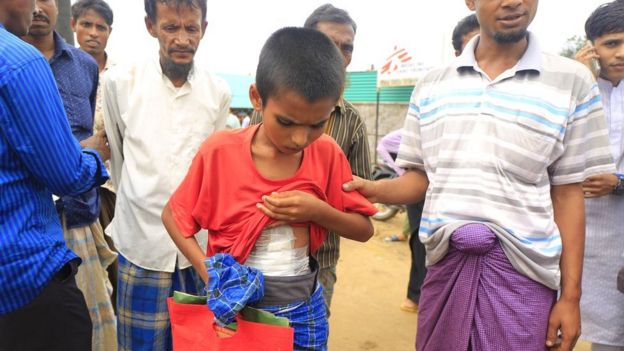
    An injured Rohingya boy lifts his T-shirt to reveal a large bandage across his stomach
    Image captionAmong the refugees are many young children
    "What we uncovered was staggering, both in terms of the numbers of people who reported a family member died as a result of violence, and the horrific ways in which they said they were killed or severely injured," MSF Medical Director Sidney Wong said.
    According to MSF:
    • 69% of the violence-related deaths were caused by gunshots
    • 9% were due to being burnt to death in their houses
    • 5% were beaten to death.
    Among the dead children below the age of five, MSF says more than 59% were reportedly shot, 15% burnt to death, 7% beaten to death and 2% killed by landmine blasts.
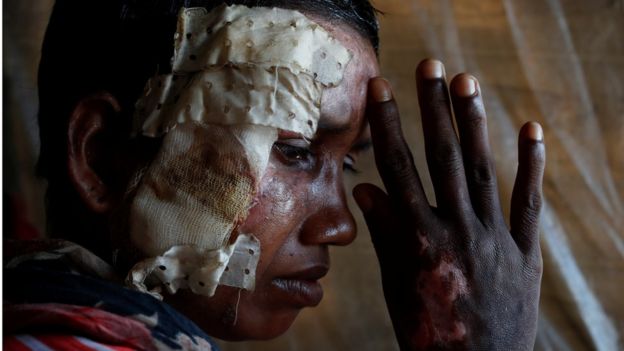
    Momtaz BegumImage copyrightREUTERS
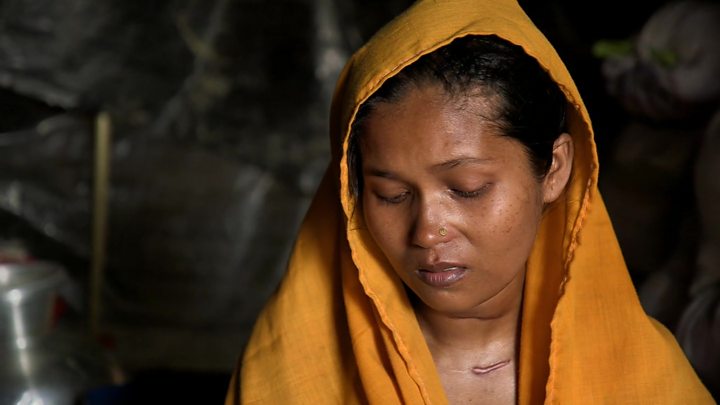
    Image captionMany refugees have been subject to brutal violence
    "The numbers of deaths are likely to be an underestimation as we have not surveyed all refugee settlements in Bangladesh and because the surveys don't account for the families who never made it out of Myanmar," Mr Wong said.
    In November, Bangladesh signed a deal with Myanmar to return hundreds of thousands of the refugees.
    MSF said the agreement was "premature" pointing out that "currently people are still fleeing" and reports of violence have come even in recent weeks.
    The group also warned there was still very limited access for aid groups into Rakhine state.
    The Rohingya are a stateless Muslim minority who have long experienced persecution in Myanmar, also known as Burma.

    More on this story

    Asia