Biodun Iginla, BBC News

Biodun Iginla, BBC News
Showing posts with label seven Muslim countries. Show all posts

Thursday, June 29, 2017

BREAKING: Trump travel ban comes into effect


  • June 30, 2017  04H:04  GMT/UTC/ZULU TIME
  •  
  • From the sectionUS & Canada
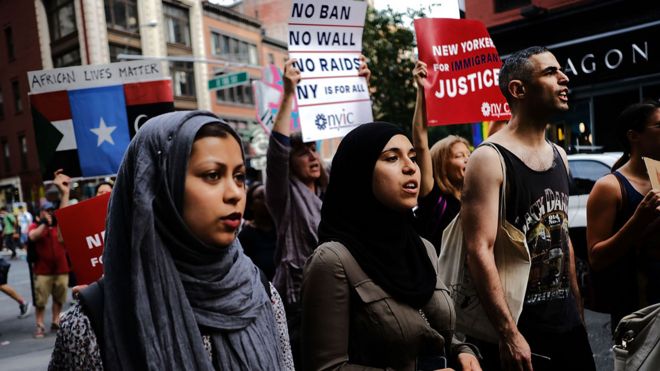
Protests in New YorkImage copyrightGETTY IMAGES
Image captionTravel ban protests took place in New York as the ban took effect
by Melissa Gruz and Biodun Iginla, BBC News, Washington DC/Ventimiglia (Italy)
People from six mainly Muslim countries and all refugees now face tougher US entry due to President Donald Trump's controversial travel ban.
It means people without close family or business relationships in the US could be denied visas and barred entry.
Grandparents, aunts, uncles, nephews and nieces are not considered to be "bona fide" relations.
The rules apply to people in Iran, Libya, Syria, Somalia, Sudan and Yemen, as well as all refugees.
Moments before the ban began at 20:00 Washington time (00:00 GMT), it emerged that the state of Hawaii had asked a federal judge for clarification.
It has in the past accused the US government of violating the Supreme Court's instructions by improperly excluding people.
Earlier this week, the Supreme Court partially upheld the ban, lifting injunctions that had halted one of the president's key policies.
The court ruled that people seeking visas to travel to the US from the six restricted countries, and all refugees, would have to prove a "bona fide relationship" to someone in the country.
The Supreme Court is expected to make a final decision on the ban in October.

Who can come in?

According to the new rules, for the next 90 days those from the six countries without a close relationship will not be able to enter the US.
IN - a parent, spouse, fiancĂ©, child, son- or daughter-in-law, or sibling, including step- or half-siblings.
OUT - grandparents, aunts, uncles, nieces, nephews, in-laws, extended family and grandchildren.
Also exempt from the new rules are those with business or educational ties to the US.
However, the guidelines specifically state that the relationship must be formal, documented and not formed for the purpose of evading the order.
Those who already hold valid visas are not affected. Dual nationals who travel on their passport from the unaffected country will also be allowed entry.
The court also approved a 120-day ban on refugees entering the US, allowing the government to bar entry to refugee claimants who cannot prove the same ties to an American individual or entity.

What has the reaction been?
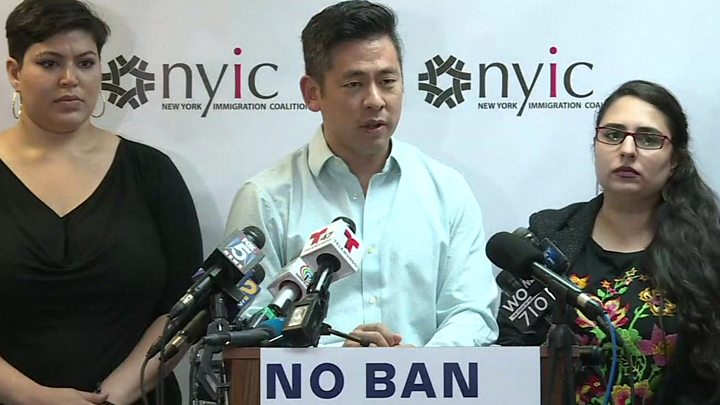
Media captionImmigration activist Steven Choi: 'An unjust and discriminatory Muslim ban'
After the Supreme Court ruling:
  • Attorney General Jeff Sessions said "the threat to our national security is real and becoming increasingly dangerous". He said the ruling was "an important step towards restoring the separation of powers between the branches of the federal government"
  • Omar Jadwat, director of the American Civil Liberties Union Immigrants' Rights Project, said that "in practical terms most of the people who stood to be affected by the ban will still be allowed to come in"
  • David Miliband, president of the International Rescue Committee (IRC), said "the court's decision threatens damage to vulnerable people waiting to come to the US: people with urgent medical conditions blocked, innocent people left adrift, all of whom have been extensively vetted"

How did we get here?

The US president insisted his ban was necessary for national security and pointed to terrorist attacks in Paris, London, Brussels and Berlin as evidence.
However, critics called the policy un-American and Islamophobic, and that this ban would not have stopped atrocities in the US perpetrated by American-born attackers.
The original ban, released on 27 January, provoked mass protests at American airports.
It included Iraq among nations whose travellers would be barred from the US, and imposed a full ban on refugees from Syria.
The president issued a revised version with a narrower scope on 6 March to overcome some of the legal problems.
The policy was left in limbo after it was struck down by federal judges in Hawaii and Maryland.

More on this story

Sunday, January 29, 2017

Analysis: Who is affected by Trump's immigration order?


by Rachel Rubin and Biodun Iginla,  France24, Washington DC


    © AFP | Protesters hold signs up during a protest at San Francisco International Airport in California on January 29, 2017

    WASHINGTON - 
    Ambiguity reigned Sunday as to the finer details of Donald Trump's temporary ban on incoming refugees and travelers from seven Muslim countries, with questions remaining about how exactly the measures affect various populations.
    The order initially took many travelers by surprise, especially those already aboard airplanes en route to the United States as the president signed the measure into force on Friday afternoon.
    Administration officials reported that 109 people had been detained as they arrived in the United States on Saturday, of which "a couple dozen" individuals were still being held as of Sunday morning.
    The following is a list of the nationalities and groups of people affected by Trump's order, which is titled "Protecting the Nation from Foreign Terrorist Entry into the United States."
    - Refugees -
    The decree prohibits entry to all refugees, regardless of nationality, for 120 days. Beyond that time, the United States will admit a maximum of 50,000 refugee in 2017, more than halving the 110,000-person limit set by former president Barack Obama.
    The US refugee program was previously frozen for three months following the September 11 attack in 2001.
    - Syrians -
    All Syrians, refugee or otherwise, are forbidden from entering the United States until further notice.
    According to the United Nations High Commissioner for Refugees, the Syrian war has forced 4.8 million people to flee the country since 2011.
    The Syrian Observatory for Human Rights said in December it had recorded the deaths of 312,001 people since the conflict began with anti-government protests in March 2011.
    - Iran, Iraq, Yemen, Somalia, Sudan and Libya -
    No visas will be issued for 90 days to migrants or visitors from seven mainly Muslim countries: Iran, Iraq, Libya, Somalia, Sudan, Syria and Yemen.
    - Green card holders -
    The decree does not affect those who hold a US green card. Secretary of Homeland Security John Kelly declared the entry of lawful permanent residents to be "in the national interest."
    However, White House Chief of Staff Reince Priebus said that nationals from the seven countries named in the order should expect to be subject to increased border controls.
    - Visa holders -
    All visa holders coming from the seven specified countries are subject to the new order, with the exception of those who hold diplomatic visas or visas to international institutions such as NATO or the United Nations.
    Judges in at least four states have blocked part of the ban, ordering authorities to stop deporting refugees and other travelers stuck at US airports.
    - Binationals -
    The situation for individuals with dual nationality remains complex. US officials said Saturday that American citizens who also have a passport from one of the seven barred countries are not affected by the order.
    An exemption is also granted to dual nationals holding British and Canadian passports.
    Britain said its nationals would not be subject to additional checks unless they traveled directly to the US from one of the listed countries.
    But dual nationals who hold passports from one of the seven countries plus an additional foreign country will not be able to gain entrance.