Biodun Iginla, BBC News

Biodun Iginla, BBC News
Showing posts with label Trump travel ban. Show all posts

Thursday, June 29, 2017

BREAKING: Trump travel ban comes into effect


  • June 30, 2017  04H:04  GMT/UTC/ZULU TIME
  •  
  • From the sectionUS & Canada
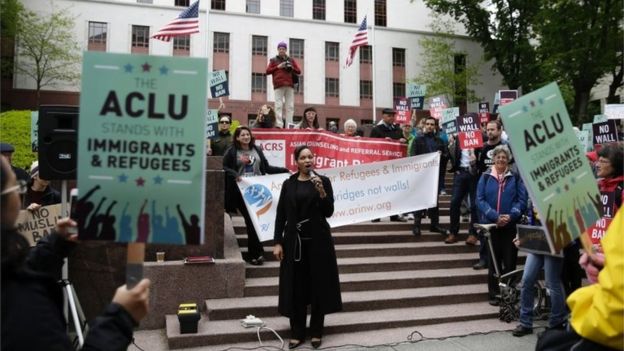
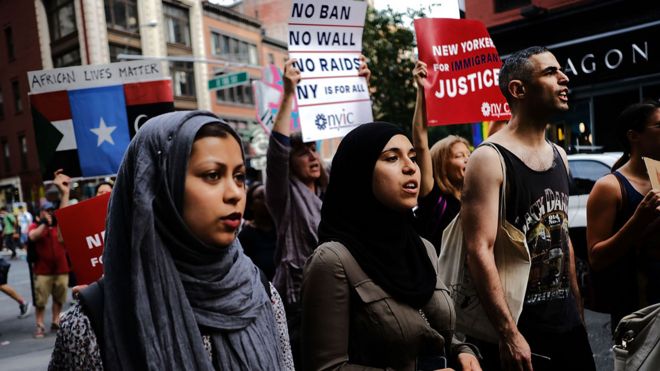
Protests in New YorkImage copyrightGETTY IMAGES
Image captionTravel ban protests took place in New York as the ban took effect
by Melissa Gruz and Biodun Iginla, BBC News, Washington DC/Ventimiglia (Italy)
People from six mainly Muslim countries and all refugees now face tougher US entry due to President Donald Trump's controversial travel ban.
It means people without close family or business relationships in the US could be denied visas and barred entry.
Grandparents, aunts, uncles, nephews and nieces are not considered to be "bona fide" relations.
The rules apply to people in Iran, Libya, Syria, Somalia, Sudan and Yemen, as well as all refugees.
Moments before the ban began at 20:00 Washington time (00:00 GMT), it emerged that the state of Hawaii had asked a federal judge for clarification.
It has in the past accused the US government of violating the Supreme Court's instructions by improperly excluding people.
Earlier this week, the Supreme Court partially upheld the ban, lifting injunctions that had halted one of the president's key policies.
The court ruled that people seeking visas to travel to the US from the six restricted countries, and all refugees, would have to prove a "bona fide relationship" to someone in the country.
The Supreme Court is expected to make a final decision on the ban in October.

Who can come in?

According to the new rules, for the next 90 days those from the six countries without a close relationship will not be able to enter the US.
IN - a parent, spouse, fiancĂ©, child, son- or daughter-in-law, or sibling, including step- or half-siblings.
OUT - grandparents, aunts, uncles, nieces, nephews, in-laws, extended family and grandchildren.
Also exempt from the new rules are those with business or educational ties to the US.
However, the guidelines specifically state that the relationship must be formal, documented and not formed for the purpose of evading the order.
Those who already hold valid visas are not affected. Dual nationals who travel on their passport from the unaffected country will also be allowed entry.
The court also approved a 120-day ban on refugees entering the US, allowing the government to bar entry to refugee claimants who cannot prove the same ties to an American individual or entity.

What has the reaction been?
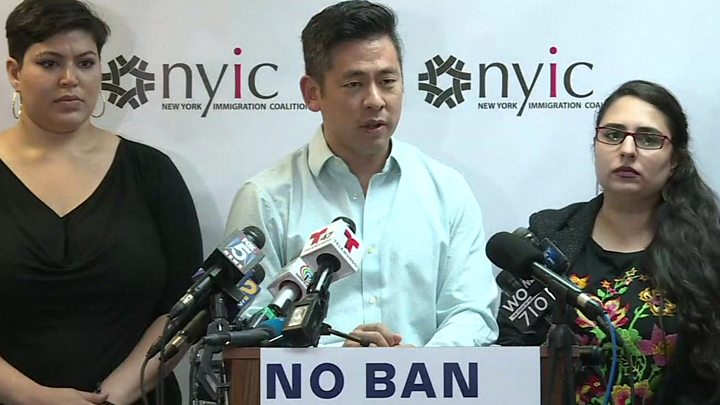
Media captionImmigration activist Steven Choi: 'An unjust and discriminatory Muslim ban'
After the Supreme Court ruling:
  • Attorney General Jeff Sessions said "the threat to our national security is real and becoming increasingly dangerous". He said the ruling was "an important step towards restoring the separation of powers between the branches of the federal government"
  • Omar Jadwat, director of the American Civil Liberties Union Immigrants' Rights Project, said that "in practical terms most of the people who stood to be affected by the ban will still be allowed to come in"
  • David Miliband, president of the International Rescue Committee (IRC), said "the court's decision threatens damage to vulnerable people waiting to come to the US: people with urgent medical conditions blocked, innocent people left adrift, all of whom have been extensively vetted"

How did we get here?

The US president insisted his ban was necessary for national security and pointed to terrorist attacks in Paris, London, Brussels and Berlin as evidence.
However, critics called the policy un-American and Islamophobic, and that this ban would not have stopped atrocities in the US perpetrated by American-born attackers.
The original ban, released on 27 January, provoked mass protests at American airports.
It included Iraq among nations whose travellers would be barred from the US, and imposed a full ban on refugees from Syria.
The president issued a revised version with a narrower scope on 6 March to overcome some of the legal problems.
The policy was left in limbo after it was struck down by federal judges in Hawaii and Maryland.

More on this story

Monday, June 12, 2017

Trump travel ban suffers new court defeat


  • June 12, 2017  22:H  GMT/UTC/ZULU TIME
  •  
  • From the sectionUS & Canada
protest outside appeals court in MayImage copyrightAFP/GETTY
Image captionMr Trump's travel ban has led to protests
by Rachel Rubin and Biodun Iginla, BBC News, San Francisco
A US appeals court has upheld a decision blocking President Donald Trump's revised "travel ban" on people from six mainly Muslim nations.
Ruling on a case brought by the state of Hawaii, the appeal judges found that the executive order violated existing immigration legislation
It is a further legal setback for the president's efforts to get the ban he promised his supporters.
The dispute may end up being decided in the US Supreme Court.
Mr Trump's own tweet from 5 June was cited in the judges' ruling.
An earlier version of the travel ban, issued by Mr Trump just days after taking office, sparked confusion at airports and protests.
In the revised executive order, the 90-day ban was to apply to people from Iran, Libya, Syria, Somalia, Sudan and Yemen. It also called for a 120-day ban on all refugees, but removed references to religious minorities.
During his election campaign, Mr Trump called for a "total and complete shutdown of Muslims entering the United States".
Reacting to the latest ruling, White House spokesman Sean Spicer defended the executive order, saying "we need every available tool at our disposal to prevent terrorists entering the United States and committing acts of bloodshed and violence".
"We continue to be confident that the president's executive order to protect this country is fully lawful and ultimately will be upheld by the Supreme Court," Mr Spicer added.

Trump's travel ban - the story so far

An older man wearing clothing indicating he may be a Muslim wheels a suitcase through the international arrivals hall at Washington Dulles International Airport in Virginia (February 2017)Image copyrightAFP
  • President Trump signed an executive order on 27 January, suddenly introducing a series of immigration measures, including a ban on travellers from seven Muslim-majority nations
  • Chaotic scenes at US airports and nationwide protests followed, before the order was halted seven days later by a federal judge in Seattle
  • On 9 February appeal court judges upheld the Seattle ruling
  • The president signed a new executive order on 6 March, including many of the provisions of the first order but no longer including Iraq, lifting the indefinite ban on all Syrian refugees, and clarifying the situation for green card holders
  • On 16 March federal judges in Hawaii and Maryland blocked the revised executive order in separate rulings, just hours before it was due to come into force
  • A federal appeals court upheld the Maryland court's ruling on 26 May
  • The White House filed two emergency applications with the US Supreme Court on 2 June to seek to overturn lower court rulings
  • On 12 June appeal court judges upheld the Hawaii ruling

The Ninth US Circuit Court of Appeals in San Francisco was reviewing a March ruling by a Hawaii-based federal judge that blocked parts of Mr Trump's order.
In their ruling, the judges said that "immigration, even for the president, is not a one-person show".
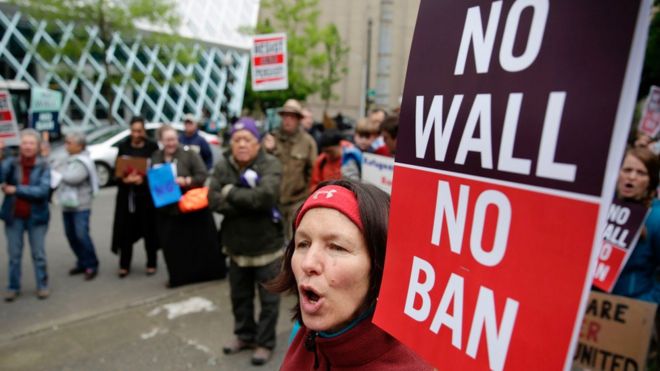
Protesters outside the 9th US Circuit Court of Appeals as they prepare to hear arguments on US President Donald Trump's revised travel ban in Seattle, Washington (May 15, 2017)Image copyrightAFP
Image captionMr Trump's travel bans have sparked protests and multiple court hearings
They said Mr Trump had failed to show that the entry of people from the six countries mentioned in the ban, as well as the refugees, would be detrimental to US interests.
But the judges said the government was allowed to review the vetting process for people entering the US - something the earlier Hawaii ruling had blocked.
Mr Trump has repeatedly said that the ban is necessary to protect Americans from terrorism.
Significant recent attacks in the US were not committed by citizens of any other the six countries named in the order.
The legal ruling comes on the first anniversary of the Orlando nightclub shooting, in which a US citizen shot dead 49 people at a Florida nightclub. It was the worst mass shooting in US history.

Analysis: James Cook, North America correspondent, BBC News

This ruling is bad news for the White House but it could have been worse.
The appeal court in San Francisco did uphold the ban on the ban - but it declined to take a position on whether or not President Trump's executive order breached the US constitution.
In fact the three appeal court judges scolded the federal district court in Hawaii, whose ruling they were considering, for failing to heed the judicial principle that "courts should be extremely careful not to issue unnecessary constitutional rulings".
The lower court had concluded, among other things, that the president's executive order was driven by "religious animus" and was intended to discriminate about Muslims.
That was improper, said the federal judges in California, because the order could actually be dismissed on a statutory rather than a constitutional basis.
In particular, they argued, the order exceeded the scope of the president's "broad authority to suspend the entry of aliens or classes of aliens" because the administration had failed to prove that banning more than 180 million people from entry based on their national origin would be detrimental to US interests.
In other words, the appeal court concluded that the president was required by law to prove his case for the ban and failed to do so.
His lawyers may now get another shot in front of the Supreme Court although it is not certain that the justices will actually decide to hear the case.

Monday's other Trump news

More on this story