Biodun Iginla, BBC News

Biodun Iginla, BBC News
Showing posts with label Islam. Show all posts

Friday, July 19, 2019

ANALYSIS: Ex-jihadist Tania Joya now fights to 'reprogram' extremists


British-born former jihadist Tania Joya is in Washington as part of a program to prevent violent extremism
British-born former jihadist Tania Joya is in Washington as part of a program to prevent violent extremism AFP
ADVERTISING
Washington 
Tania Joya has devoted her life to "reprogramming" extremists and reintroducing them into society -- a process she understands well as a "former Islamic jihadist" herself.
"My aim is for them to feel a sense of remorse and to train them so that they can be good citizens once they are released from prison, so they can adjust to society," Joya said during a visit to Washington, to present a project on preventing extremist violence.
Born in 1984 near London to a Muslim Bangladeshi family, Joya grew up confronted by racism and the struggles of integration. She radicalized at age 17, after the September 11 terror attacks in New York and Osama bin Laden's call for a global jihad.
In 2004, she married an American Muslim-convert, Yahya al-Bahrumi (born John Georgelas). She began advocating for an Islamic state, for which her three children would be soldiers.
But in 2013, her husband took her and their children against her will to northwestern Syria to join jihadist insurgents. Joya reported her husband to US authorities and, after three weeks, fled Syria to the United States.
Joya settled in Texas, her husband's home state. There, she rejected Islam and changed her life, divorced and re-married.
- Re-programming, giving them hope -
Yahya, her first husband, joined the Islamic State group, which would soon control large swathes of territory in Syria and Iraq. He was in charge of the group's English-language propaganda, and Joya said he became the "highest-ranking American" in the IS group.
He died in 2017 during fighting in Mayadin, in northern Syria, as the so-called IS "caliphate" crumbled.
However this created a new problem -- Western jihadists or their spouses and children wanting to come home.
Joya realized that she had something to offer. "It's really important to de-radicalize them, rehabilitate" these people, she said.
"It's reprogramming them and giving them a sense of hope in the political process."
It's also important to "get them to understand the psychology and the patterns... what led them to extremism," understanding "the rejection many in the US and Europe faced growing up there, the cultural conflict, the crisis they went through," she said.
"Once it's all explained to them, very logically, they will accept it just as I did."
Joya favors repatriating foreign rebels from the Middle East so they can be judged in their countries of origin.
While that is the US policy, many European countries such as France are wary of taking in the jihadists.
In May and June, 11 French nationals were sentenced to die in Iraq for their affiliation to IS.
Joya has campaigned for the return of Shamima Begum, who joined the jihadist group when she was just 15 but now wants to return home to Britain. However Begum's lack of remorse has turned public opinion against her, and the British government stripped her of her citizenship in February.
Kurdish-run camps in northeast Syria have taken in some 12,000 foreign fighters from 40 different countries, including 4,000 women and 8,000 children whose fathers are jihadists.
- 'Inoculation' against indoctrination -
Countries with jihadists stranded in refugee camps "are responsible for these individuals," said Joya. "We can't just push them off to the Middle East, to the Kurdish people... the abuses they're facing in these camps are only confirming their beliefs of radicalization."
Joya is participating in the Preventing Violent Extremism (PVE) program organized by the Clarion Program, a US non-profit dedicated to educating people "about the growing phenomenon of Islamic extremism," according to its website.
The PVE program provides "communication models" that offer "workshops for youth so that before a child is even indoctrinated or introduced to radical ideologies, they've really been inoculated" against religious and ideological extremism, said national program coordinator Shireen Qudosi.
"That goes from gangs, to radical ideologies: antifa, neo-Nazi groups, Islamist extremism," she said.

Wednesday, July 10, 2019

UK's Labour Party spars with BBC over charges of anti-Semitism

July 11, 2019  08H:07  GMT/ZULU
LONDON - British opposition leader Jeremy Corbyn’s office interfered in independent party discipline processes aimed at rooting out anti-Semitism, the BBC said on Wednesday, a claim that the Labour Party sharply rejected.
FILE PHOTO: Britain's opposition Labour Party leader Jeremy Corbyn speaks at the launch of Labour's European election campaign in Kent, Britain, May 9, 2019. REUTERS/Toby Melville/File Photo
A BBC investigation spoke to former Labour officials who said top party figures, including Corbyn’s communications director Seumas Milne and general secretary Jennie Formby, had minimized complaints of anti-Semitism against party members.
Labour said the accusations were “deliberate and malicious misrepresentations designed to mislead the public”.
Labour has battled accusations of anti-Semitism since 2016 and Corbyn - a veteran campaigner for Palestinian rights - as well as other senior party officials have been criticized for failing to take decisive action to deal with it.
British Jewish groups have accused Labour of becoming institutionally anti-Semitic, and the issue has played a part in Labour’s failure to take electoral advantage of the Conservative government’s turmoil over Brexit.
ADVERTISEMENT
The BBC quoted an email from Milne telling Labour’s internal complaints team that “something’s going wrong, and we’re muddling up political disputes with racism”.
Labour said this misrepresented Milne’s email, which referred to a dispute between Jewish Labour members with Zionist and anti-Zionist views. A fuller extract of the email read: “If we’re more than very occasionally using disciplinary action against Jewish members for anti-Semitism, something’s going wrong, and we’re muddling up political disputes with racism.”
The BBC investigation also quoted former party members who felt a hostile atmosphere toward Jews within the party in recent years, who were sometimes challenged over Israeli government actions by other party members.
Nine lawmakers quit the party this year, citing the leadership’s handling of anti-Semitism as well as its stance on Brexit as reasons for leaving.
British foreign secretary Jeremy Hunt said the BBC investigation showed that Corbyn was either “wilfully blind to anti-Semitism or anti-Semitic himself”.
ADVERTISEMENT
Labour’s deputy leader, Tom Watson, who is frequently critical of Corbyn, said he was “shocked, chilled and appalled” by the allegations in the BBC report.
Labour’s press office said the party was “implacably opposed to anti-Semitism,” and that some of the former officials quoted by the BBC had “personal and political axes to grind” against Corbyn.
Britain’s Conservatives face regular accusations of hostility toward Muslims. On Monday broadcaster Channel 4 published a survey of 892 Conservative Party members by pollsters YouGov which showed that 56% believed Islam was a general threat to Britain’s way of life.

Friday, January 11, 2019

BREAKING AND UPDATE: Rahaf al-Qunun: Saudi teen granted asylum in Canada


January 11, 2019  23H:24  GMT/UTC/ZULU TIME
Related Topics
Media captionThe #SaveRahaf campaign went viral after Rahaf started tweeting about her plight for asylum
by Wang Yang and Biodun Iginla, BBC News, Bangkok
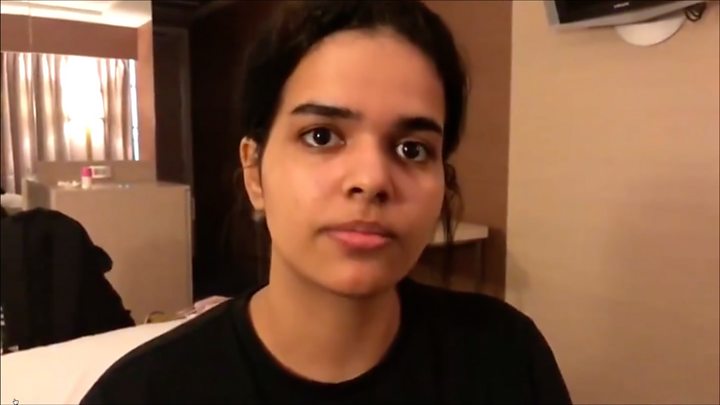
A Saudi woman who fled her family and became stranded at Bangkok's main airport is flying to Canada after being granted asylum status.
Rahaf Mohammed al-Qunun, 18, had been trying to reach Australia via Bangkok, but was initially told to return to Kuwait, where her family were waiting.
She refused to fly back and barricaded herself into her airport hotel room, attracting international attention.
She said she had renounced Islam, which is punishable by death in Saudi Arabia.
The UN's refugee agency has said it considers her to be a legitimate refugee.
Refugee status is normally granted by governments, but the UNHCR can grant it where states are "unable or unwilling to do so", according to its website.
Canadian Prime Minister Justin Trudeau told reporters: "Canada has been unequivocal that we will always stand up for human rights and women's rights around the world. When the UN made a request of us that we grant Ms al-Qunun asylum, we accepted."
Canada has previously angered Saudi Arabia after calling for the release of detained women's rights activists in the country - prompting Riyadh to expel Canada's ambassador and freeze all new trade.
ADVERTISEMENT
The UNHCR has welcomed Canada's decision to resettle Ms Qunun.
The UN High Commissioner for Refugees, Filippo Grandi, said: "[Her] plight has captured the world's attention over the past few days, providing a glimpse into the precarious situation of millions of refugees worldwide.
"Refugee protection today is often under threat and cannot always be assured, but in this instance international refugee law and overriding values of humanity have prevailed."

What happened to Rahaf Mohammed al-Qunun?

She was on a trip to Kuwait with her family, when she fled on a flight to Bangkok.
She said she intended to take a connecting flight to Australia - and had an Australian visa - but that her passport was seized by a Saudi diplomat when he met her coming off the flight at Suvarnabhumi airport, leaving her stranded.
A Saudi envoy in Bangkok denied any official Saudi involvement in Ms Qunun's detention.
Thai officials initially described her case as a "family problem" and said she would be repatriated back to Kuwait the next day.
However, Ms Qunun sent a series of tweets pleading for help from her airport hotel room, and her case was picked up by Human Rights Watch and journalists.
A number of countries, including Australia, have considered her case for asylum.
Presentational grey line

'Threats to her life'

Analysis by Jonathan Head, BBC south east Asia correspondent
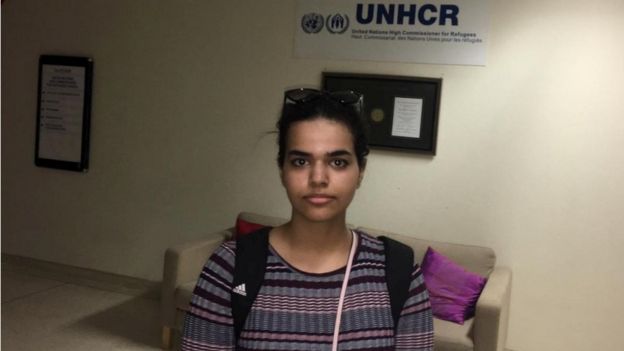
Rahaf Mohammed Al-qunun at the UN building in Bangkok, before departing to the airportImage copyrightUNHCR
Image captionMs Qunun, seen here at a UN building before leaving Bangkok, is en route to Toronto via Seoul
After days of speculation that she would move to Australia, Rahaf al-Qunun found herself on a flight in the opposite direction, to Canada. She was seen briefly, being escorted to the departure gate by UN officials.
As her plane took off Police General Surachate Hakparn, the immigration chief whose change of heart on Monday allowed her temporary asylum in Thailand, told journalists she had left the country cheerful and grateful to those who looked after her here.
Her father and brother, he said, who had come on what turned out to be a futile visit to try to persuade her to return to Saudi Arabia with them, would be leaving Thailand shortly after her.
It is only two days since the Australian government announced that it had been approached to take Ms Qunun, and that it would treat her request sympathetically. The UN usually approaches only one country at a time to seek asylum.
It is not clear why the Australian option fell through, and the UN switched to Canada. It might be that Australia's tough line towards refugees, and the insistence of its Home Affairs Minister Peter Dutton that she would get no special treatment, threatened to slow down the processing of her application.
The UN was concerned about her safety, following online threats to her life, and Canada may have been able to process her resettlement more quickly.
Presentational grey line

Why did she flee?

Renunciation of Islam is punishable by death in Saudi Arabia.
Under Saudi Arabia's "male guardianship system", a Saudi woman is required to obtain a male relative's approval to apply for a passport, travel outside the country, study abroad on a government scholarship, get married, leave prison, or even exit a shelter for abuse victims.
Ms Qunun told the BBC: "I shared my story and my pictures on social media and my father is so angry because I did this... I can't study and work in my country, so I want to be free and study and work as I want."
She also said she was afraid her family would kill her.
Separately, she told AFP she had suffered physical and psychological abuse from her family, including being locked in her room for six months for cutting her hair.
A spokesperson for her family told the BBC that they did not wish to comment and all they cared about was the young woman's safety.
On Friday, Ms Qunun wrote on Twitter that she had "some good news and some bad news", before deleting her account. Her friends said she had received death threats online.

Has anything like this happened before?

Yes. Ms Qunun's case echoes that of another Saudi woman who was in transit to Australia in April 2017.
Dina Ali Lasloom, 24, was en route from Kuwait via the Philippines but was taken back to Saudi Arabia from Manila airport by her family.
She used a Canadian tourist's phone to send a message, a video of which was posted to Twitter, saying her family would kill her. Her fate on arriving back in Saudi Arabia remains unknown.
Presentational white space

'Rahaf is an inspiration'

'Sara', a Saudi woman, spoke to BBC OS on the World Service on Wednesday
Rahaf is an inspiration. But she's not the first one who did this and definitely not the last one.
What we are going through is awful. We think about this every day because us women here do not know what it feels like to go out. We don't know what freedom tastes like.
Dad keeps my passport with him all the time, we go to hotels and he puts it next to him when he sleeps.
Unfortunately it's not a revolution. Every girl that is tweeting about this, it's either that she has already escaped or she's using a fake account like me. Some people tweeted me or DMed me to tell me to use my real account, for me to be brave.
We do not want the guardianship any more. I want to go out of the house and drink coffee from Starbucks. I don't have to take my whole family. This is just way too harsh on us.
Living this life is exhausting.

More on this story