Biodun Iginla, BBC News

Biodun Iginla, BBC News
Showing posts with label National Assembly. Show all posts

Saturday, January 5, 2019

Paris: Clashes erupt as 'yellow vests' protest at unrepentant Macron

January 5, 2019  21H:25  GMT/UTC/ZULU TIME
PARIS - Rioters in Paris torched motorbikes and set barricades ablaze on the upmarket Boulevard Saint Germain on Saturday, as protests against high living costs and the perceived indifference of President Emmanuel Macron turned violent on the fringes.
The latest “yellow vest” marches began peacefully but degenerated in the afternoon as protesters threw missiles at riot police blocking bridges over the Seine.
SPONSORED
Officers fired tear gas to prevent protesters crossing the river and reaching the National Assembly. One riverboat restaurant was set ablaze and a policeman was wounded when he was hit by a bicycle hurled from a street above the river bank.
Two months after they started blocking roads, occupying highway tollbooths and staging sometimes-violent street protests in Paris, the yellow vests wanted to inject new momentum into a movement that weakened over the holidays.
Macron’s government, shaken by the unrest, had this week hardened its stance, branding the protesters agitators seeking to overthrow the government.

Riot policemen run near a fire during a demonstration by the "yellow vests" movement at Boulevard Saint Germain in Paris, France, January 5, 2019. REUTERS/Gonzalo Fuentes
Driving the unrest is anger, particularly among low-paid workers, over a squeeze on household incomes, and a belief that Macron is deaf to citizens’ needs as he enacts reforms seen as favoring the wealthy.
“They have no right to leave us in the shit like this,” said protester Francois Cordier. “We’re fed up with having to pay out the whole time, we’ve had enough of this slavery, we should be able to live on our salaries.”
Government spokesman Benjamin Griveaux escaped from his office through a back door after a small number of protesters broke into the compound and smashed up vehicles.
Interior Minister Christophe Castaner said about 50,000 people had protested in cities nationwide, including Bordeaux, Toulouse, Rouen and Marseille.
The turnout was higher than last week but a small fraction of the numbers seen in the first weeks of the protests.

Slideshow (23 Images)

“POWER TO THE PEOPLE”

As darkness fell, officers dispersed scores of yellow vests gathered on Paris’s Avenue des Champs-Elysees. Television images showed hooded youths setting a car alight on a side street, but there was no repeat of the scenes in November when shops were looted, banks vandalized and the Arc de Triomphe was defaced.
Authorities have blamed the worst of the violence in recent weeks on anarchists, anti-capitalists and extreme groups on the fringes of the yellow vest movement.
The protests come 18 months into Macron’s tenure and his drive to reshape the economy, and have already forced him into concessions.
Ukrainian church gains independence from Russia
Last month, Macron promised tax cuts for pensioners, wage rises for the poorest workers and the scrapping of planned fuel tax increases, at a cost to the Treasury of 10 billion euros ($11 billion).
It was the first big U-turn for a president elected 18 months earlier on a platform to break with traditional French politics and liberalize the heavily regulated economy.
In a New Year’s Eve address, Macron vowed to press on with his reform agenda, saying: “We can’t work less, earn more, cut taxes and increase spending.”
Faced with record low popularity ratings, Macron is expected soon to set out his plans for the coming months. These include a nationwide debate on ecological, fiscal and institutional questions, the results of which he says will feed into policy.
($1 = 0.8777 euros)

Sunday, June 24, 2018

Analysis: Nicaragua: How Daniel Ortega has managed to stay in power

June 25, 2018  00:34  GMT/UTC/ZULU TIME
MANAGUA  - Nicaraguan President Daniel Ortega’s police and armed militias have attacked protesters demanding the resignation of the socialist leader who has ruled the impoverished nation for much of the past four decades.
FILE PHOTO: Riot police officers detain a demonstrator during a protest against Nicaragua's President Daniel Ortega's government in Managua, Nicaragua May 28, 2018. REUTERS/Oswaldo Rivas
More than two months of demonstrations have left at least 212 dead in the bloodiest protests in the Central American nation since its civil war ended in 1990.
Here are the main events that helped Ortega, a Cold War-era U.S. foe, return to the presidency in 2007 at the head of the Sandinista movement and tighten his grip over institutions:
FILE PHOTO: Riot police officers stand in front of a graffiti that reads "Justice" during a protest against Nicaragua's President Daniel Ortega's government in Managua, Nicaragua May 28, 2018. REUTERS/Oswaldo Rivas
* In 2000, the National Assembly approved a constitutional overhaul that reduced to 35 percent from 45 percent the minimum of valid votes needed to win the presidential election outright.
ADVERTISING
The reform was part of a power-sharing deal between Ortega, then the main opposition leader, and President Arnoldo Aleman of the Liberal Constitutionalist Party (PLC) to improve governability after protests organized by the Sandinistas. Since he lost general elections in 1990, ending a decade in power, Ortega’s support averaged around 35 percent, analysts say.
The changes allowed both parties to divide politically appointed seats on the Supreme Court and Electoral Council, and other institutions. Parties that failed to gain at least 4 percent of valid votes were stripped of their legal status.
FILE PHOTO: Riot police officers travel past a burning car during clashes with the anti-government protesters in Managua, Nicaragua May 28, 2018. REUTERS/Oswaldo Rivas
Aleman’s controversial pact with Ortega and his conviction in 2003 for money laundering and embezzlement weakened his PLC party. He was absolved in 2009 by the Supreme Court from his 20-year sentence.
* In 2007, Ortega’s government started receiving hundreds of millions of dollars in oil cooperation from Venezuela. Most of the funds are run by a private company, Albanisa, controlled by the party with little external oversight, to finance social projects and build a business conglomerate to pay back the loans.
Albanisa had accumulated about $3.2 billion - equivalent to a quarter of Nicaragua’s gross domestic product - in Venezuelan loans by the end of 2016, according to the International Monetary Fund.
* In 2010, the Sandinista-controlled Supreme Court lifted a ban on consecutive presidential re-election, allowing Ortega to run again the next year.
His opponents accused him of electoral fraud in the 2011 election that he won with 72.5 percent of the vote. The United States questioned the result of the general election that gave his Sandinista party an absolute majority in Congress. 
* In 2014, Congress changed the constitution to lift term limits to allow Ortega to run for office indefinitely.
* Weeks before the 2016 general election, the Supreme Court ousted Eduardo Montealegre as leader of the main opposition party, the Independent Liberation Party (PLI). A new party leader, Pedro Reyes Vallejos – who had strong ties to Ortega – was appointed by the court.

Monday, July 17, 2017

BREAKING: Venezuela referendum: Big show of support for opposition


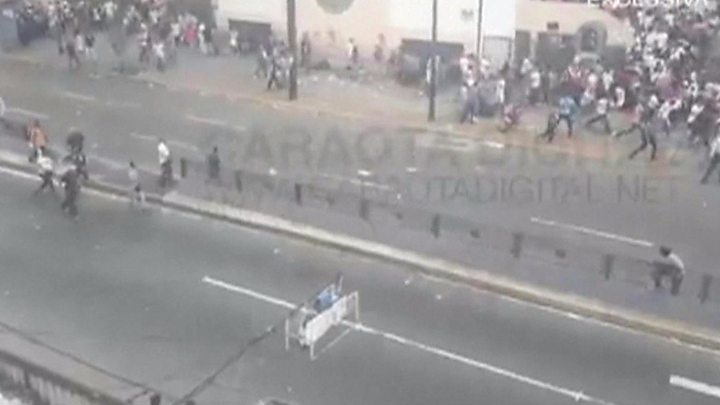
Media captionFootage shows voters panicking as a shot is heard
by Enrique Krause and Biodun Iginla, BBC News, Caracas
More than seven million voters have taken part in an opposition-organised referendum in Venezuela, according to academics monitoring the poll.
Voters strongly opposed government plans for a new constituent assembly with the power to scrap the National Assembly and rewrite the constitution.
Venezuela is polarised between backers of President Nicolás Maduro and opponents, who want fresh elections.
A nurse was shot dead while queuing to vote in the capital, Caracas.
Men on motorbikes opened fire, killing 61-year-old Xiomara Soledad Scott, and wounding three others.
The opposition blamed a "paramilitary" gang for the shooting, which prosecutors said they would investigate.
Separately, journalist Luis Olavarrieta was grabbed by what he said were a group of government supporters who robbed and beat him, but he managed to escape.

What does the opposition object to?

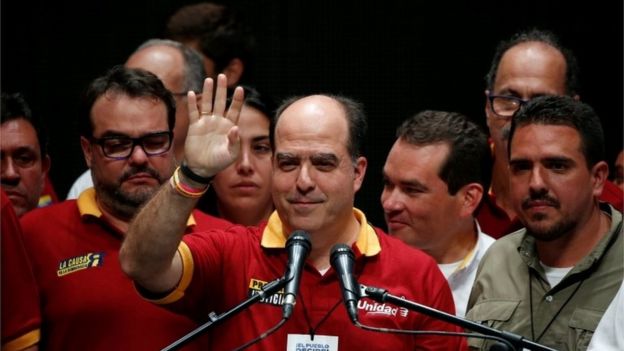
Julio Borges, President of the National Assembly in Venezuela, 16 July 2017Image copyrightREUTERS
Image caption"We don't want to be Cuba," says the head of the National Assembly
President Maduro's plan will see a vote on 30 July for the new constituent assembly.
Its 545 members will have the power to dissolve state institutions, including the National Assembly, where opposition parties are in the majority.
The opposition wants new elections before Mr Maduro's term expires in early 2019 and say rewriting the constitution would almost certainly delay this year's regional elections and next year's presidential election.
It fears the new body could herald dictatorship.
As Julio Borges, who heads the National Assembly, puts it: "We don't want to be Cuba. We don't want to be a country without freedom."

What does the government say?

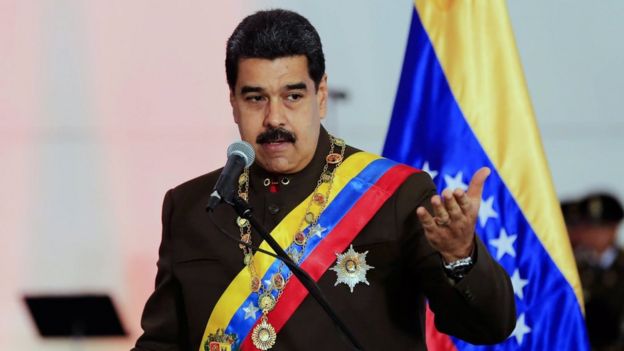
MaduroImage copyrightEPA
Image caption"Not legal" - President Maduro's verdict on Sunday's poll
Mr Maduro argues that the constituent assembly is the only way to help Venezuela out of its economic and political crisis and he described Sunday's vote as "meaningless".
"They have convened an internal consultation with the opposition parties, with their own mechanisms, without electoral rulebooks, without prior verification, without further verification. As if they are autonomous and decide on their own," he said.
On the same day as the unofficial referendum, the government held a "trial run" for the 30 July vote, which it described as a success.

Why is Venezuela in crisis?

Media captionYour video guide to the crisis gripping Venezuela
  • Nearly 100 people have been killed in clashes stemming from the political conflict
  • The deep economic crisis is made worse by the falling price of oil, which accounts for about 95% of Venezuela's export revenues and was used to finance some of the government's social programmes. Forced to make cuts, President Nicolás Maduro has seen his support fall among core backers
  • Basic necessities, such as medicine and food, are in short supply
  • The opposition accuses Mr Maduro of mismanaging the economy and eroding democratic institutions
  • In March, the Supreme Court decided it would take over the National Assembly. The decision was reversed, but Mr Maduro was accused by opponents of trying to stage a coup. That sparked almost daily protests calling for his resignation
  • Mr Maduro says the opposition is trying to overthrow his government

Unofficial vote result - in detail

The rector of the Central University of Venezuela, Cecilia García Arocha, said 6,492,381 people voted inside Venezuela and another 693,789 at polling stations abroad. However, the vote has no legal status.
The turnout is slightly less than the 7.7m people who voted for opposition candidates at the 2015 parliamentary elections. There are 19.5m registered voters in the country.
Voting on three questions, 98% rejected the new assembly proposed by President Maduro and backed a call for elections before 2019.
They also voted for the armed forces to defend the current constitution.
Sunday's unofficial poll was held in improvised polling stations at theatres, sports grounds and roundabouts.
The opposition plans to burn ballot papers from the informal poll so those who voted against the government cannot be identified and victimised.
While the vote was only symbolic, BBC South America correspondent Katy Watson said the opposition hopes the high turnout will heap pressure on the government.

Are you in the region? Did you take part in the referendum? Email haveyoursay@bbc.co.uk with your stories.
Please include a contact number if you are willing to speak to a BBC journalist. You can also contact us in the following ways:
Or use the form below
Your contact details
If you are happy to be contacted by a BBC journalist please leave a telephone number that we can contact you on. In some cases a selection of your comments will be published, displaying your name as you provide it and location, unless you state otherwise. Your contact details will never be published. When sending us pictures, video or eyewitness accounts at no time should you endanger yourself or others, take any unnecessary risks or infringe any laws. Please ensure you have read the terms and conditions.

More on this story