Biodun Iginla, BBC News

Biodun Iginla, BBC News
Showing posts with label Organisation of American States (OAS). Show all posts

Monday, November 11, 2019

ANALYSIS: Bolivia in chaos after Evo Morales quits

by Renee Celeste and Biodun Iginla, The Economist Intelligence Unit News Analysts


Gone, but not quietly

Violence worsens after he claims to be the victim of a coup
The Americas


EVO MORALES built his political career in the Chapare, a rural coca-growing region in central Bolivia. He became Bolivia’s first president of indigenous origin in 2006 and won re-election three times, thanks largely to his efforts to reduce poverty. But on the afternoon of November 10th, he returned to the Chapare to announce his resignation. Mr Morales made clear that he did not do so willingly. He hinted at dark forces seeking to destroy Bolivian democracy, and claimed that he was the victim of a coup.
His resignation creates a chaotic political situation with no obvious way forward. It follows three weeks of increasingly violent protests brought about by a disputed election on October 20th and mounting evidence of vote-rigging. In that vote Mr Morales avoided a run-off vote against Carlos Mesa, his closest rival, by just 35,000 of the 5.9m valid votes cast. Rather than put an end to the protests, the inflammatory rhetoric that Mr Morales used when he resigned has led to further violence.
His decision to quit followed the release of a report by the Organisation of American States (OAS), which had sent a team to audit the election. The OAS experts said that they found widespread evidence of falsified tally sheets, which list total votes for each precinct, and breaches in the software used to transmit the results. “The manipulations of the computer system are of such magnitude that they should be thoroughly investigated by the Bolivian state to get to the bottom of, and assign responsibility in, this serious case,” the report said. After it was released, police arrested members of the electoral tribunal.
Mr Morales apparently realised that he was fast losing support. Over the past week the “civil strike” against the election result, which brought hundreds of thousands of people onto the streets, intensified. Luis Fernando Camacho, the strike leader in Santa Cruz, Bolivia’s biggest city, called on Mr Morales to resign, and then urged protesters to shut down government buildings. On November 8th police in several regions joined the protesters and announced that they would no longer obey their commanders’ orders. On November 9th, after government supporters shot at buses carrying opposition backers from Potosí to La Paz, the administrative capital, protesters set fire to the houses of several politicians from the governing party. The governor and several mayors resigned, saying they feared for their safety. Three people have died in clashes between protesters and supporters of Mr Morales, who called upon them to defend his “victory”.
On the morning of November 10th, in response to the release of the OAS’s findings, Mr Morales announced a fresh election. But that was not enough to shore up support. Cabinet ministers and legislators from his party kept resigning. Williams Kaliman, the commander of Bolivia’s armed forces, gave a televised interview in which he urged Mr Morales to step down so that “peace can be restored and stability maintained, for the good of Bolivia”. Realising that he had run out of road, Mr Morales resigned in the late afternoon.
But, in his speech, Mr Morales rejected the results of the OAS audit and claimed that he was the victim of a “civic, political and police coup. My sin is being indigenous, a union leader and a coca farmer,” he said. He insisted that he had resigned only in order to prevent further bloodshed. Instead, his talk of a coup has further inflamed the violence. Mr Morales’s supporters burnt houses, businesses and buses in the streets of La Paz, and in the neighbouring city of El Alto. Several television stations and newspapers closed down to protect their employees. There are also reports that pro-opposition rioters ransacked Mr Morales’s house.
It is unclear what will happen next. In the uncertainty, conspiracy theories abound. Despite General Kaliman’s public intervention, some accused the police and armed forces of doing little to quell the unrest. On Twitter, Mr Mesa urged them to “guarantee and preserve order.” Police denied claims that they were seeking to arrest Mr Morales. Those in line to take over the presidency under the constitution—the vice-president, the president of the senate, and the president of the lower house—have resigned. Nearly two dozen leaders of Mr Morales’s party spent the night in the Mexican embassy. The Mexican foreign minister said he offered asylum to them and to Mr Morales. For the moment, Bolivia is leaderless.
Reuse this contentThe Trust Project

Thursday, July 20, 2017

BREAKING: Venezuela crisis: Deadly clashes as millions join strike


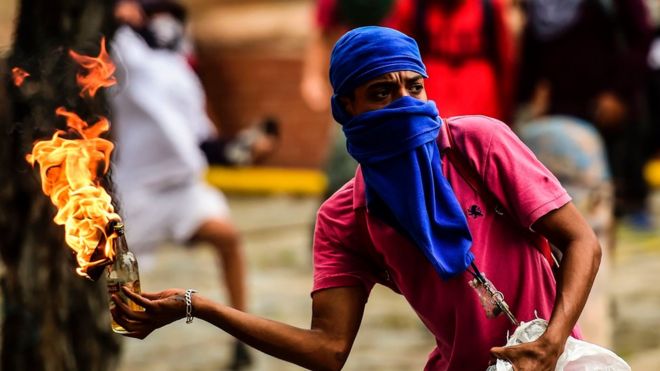
An opposition demonstrator prepares to throw a molotov cocktail during clashes with riot police in an anti-government protest in CaracasImage copyrightAFP
Image captionProtesters and police clashed in several cities across Venezuela
by Renee Celeste and Biodun Iginla, BBC News, Caracas
Millions of Venezuelans have joined a general strike called by the opposition as pressure mounts on President Nicolás Maduro to cancel elections for a new constituent assembly.
Clashes between police and protesters killed at least three people. More than 300 others were reportedly arrested.
Mr Maduro said the strike was minimal and that its leaders would be arrested.
Since April, when opposition protests intensified, almost 100 people have died across the country.
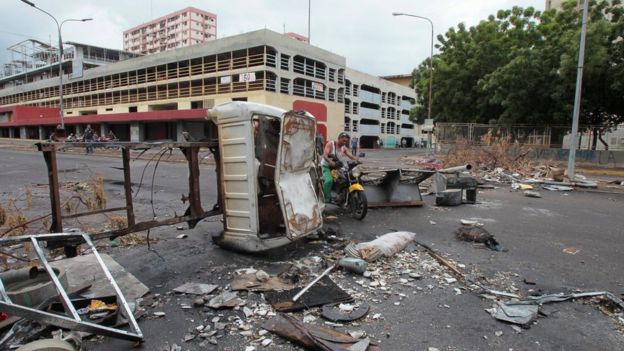
Protesters barricaded roads in the capital, Caracas, and other cities with rubbish and furniture. The opposition said that 85% of the country joined the strike.
But in pro-government areas of the capital, life went on as usual, with shops open and streets busy. Public employees also appeared to have worked normally.
In several cities, police fired tear gas as they clashed with protesters. One death was reported on the outskirts of Caracas while two others died in the northern city of Valencia.
More than 360 people had been arrested across the country, a local rights group said.
A motorcyclist pass through a barricade during a rally against Venezuelan President Nicolas Maduro's government in MaracaiboImage copyrightREUTERS
Image captionDemonstrators set up barricades on streets in several cities
Colombia, France, Spain, the US and the EU have urged the Venezuelan government to cancel the vote for a new constituent assembly on 30 July.
But Mr Maduro has rejected the calls.
In a speech on TV, he claimed "triumph", saying that key sectors had not joined the strike.
"Work has triumphed, love, life, and hope; work has triumphed. They [the Venezuelan opposition] who have never worked, let them carry on not working, we are moving forward, comrades."
"I've ordered the capture of all the fascist terrorists."
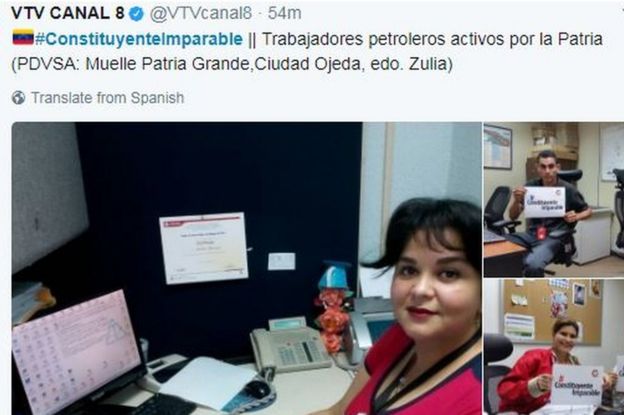
A tweet by state-run media channel VTV shows petroleum workers in their officesImage copyrightTWITTER/VTV CANAL 8
Image captionState-run media retweeted pictures of oil sector workers in their offices
The assembly would have the power to rewrite the constitution and to bypass the opposition-controlled legislature.
Opposition politicians say Mr Maduro wants to use the assembly to entrench himself in power, while the president argues a new constitution will promote dialogue in the polarised country.
The opposition have ramped up their schedule of protests in the days leading up to the elections, including Thursday's general 24-hour strike and a mass demonstration on Saturday.
Meanwhile, Isaias Medina, a senior diplomat representing the country at the UN, resigned, saying he could no longer represent the government because of human rights abuses.
Venezuela's ambassador to the UN, Rafael Ramirez, said Mr Medina had acted "dishonestly" and been fired.
Media captionYour video guide to the crisis gripping Venezuela
Earlier, the head of the Organisation of American States (OAS), Luis Almagro, warned of a "calamitous deterioration" of the situation, accusing Mr Maduro's government of having "blood on its hands".
"Behind every detainee, every political prisoner, every person tortured and every person killed there is someone that is institutionally responsible," Mr Almagro wrote in a report.
"The fear that is on everyone's mind, but we are too afraid to speak out loud, is our fear that this will escalate into a bloodbath."
Mr Almagro has long been one of the fiercest and most outspoken critics of the Venezuelan government.

Why is Venezuela in crisis?

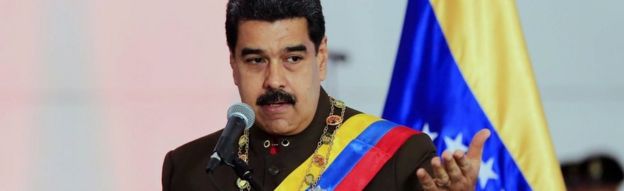
Venezuelan President Nicolas MaduroImage copyrightEPA
  • Almost 100 people have been killed in clashes stemming from the political conflict
  • The deep economic crisis is made worse by the falling price of oil, which accounts for about 95% of Venezuela's export revenues and was used to finance some of the government's social programmes. Forced to make cuts, President Nicolás Maduro has seen his support fall among core backers
  • Basic necessities, such as medicine and food, are in short supply
  • The opposition accuses Mr Maduro of mismanaging the economy and eroding democratic institutions
  • In March, the Supreme Court decided it would take over the National Assembly. The decision was reversed, but Mr Maduro was accused by opponents of trying to stage a coup. That sparked almost daily protests calling for his resignation

Related Topics

More on this story