Biodun Iginla, BBC News

Biodun Iginla, BBC News
Showing posts with label Rafael Ramirez. Show all posts

Wednesday, November 29, 2017

Sources say Venezuela's Maduro strips rival of U.N. post amid corruption purge

 NOVEMBER 29, 2017  21H:57 GMT/UTC/ZULU TIME
CARACAS/HOUSTON - Venezuela has ordered the removal of Rafael Ramirez, once a powerful oil minister and head of state oil company PDVSA, from his post as representative to the United Nations in New York, four sources with knowledge of the matter said on Wednesday.
FILE PHOTO: Venezuela's representative to the United Nations Rafael Ramirez is seen as he attends a meeting with Venezuela's Foreign Minister Jorge Arreaza (not pictured) during a meeting of accredited diplomatic teams in Caracas, Venezuela August 12, 2017. REUTERS/Carlos Garcia Rawlins/File Photo
Though the decision will not affect the OPEC nation’s struggling oil industry, it may help President Nicolas Maduro shore up his position in crisis-stricken Venezuela as the country heads toward presidential elections in 2018.
Ramirez, an increasingly vocal critic of Maduro in recent months, was seen by some as angling to be a presidential candidate as Maduro’s unpopular government and an economic crisis have fueled divisions with the ruling Socialist Party.
SPONSORED
“He was fired last night,” said a source with knowledge of the information, who asked not to be identified. Maduro sent Ramirez to the U.N. in 2014 in a major demotion from his decade-long roles as oil minister and head of PDVSA.
Venezuela’s Information Ministry did not immediately respond to a request for comment. The United Nations has not received formal notification of Ramirez’s removal, a U.N. spokesman said.
Vice President Tareck El Aissami said on Wednesday that he hoped that Maduro will be re-elected in 2018, the clearest indication yet that the former bus driver will seek another term despite the economic crisis.
A separate source said that Ramirez had been summoned to present himself in Venezuela “in coming days.” That source said Ramirez had not been formally removed and that he was working at the United Nations on Wednesday.
However, he was not present when his turn to speak at a meeting on the rights of the Palestinian people came up, according to diplomatic sources at the meeting.
Two sources said Foreign Minister Jorge Arreaza traveled to New York this week. Another source said Ramirez tried to fight back and negotiate but was unable to.
FILE PHOTO: Venezuela's President Nicolas Maduro (R) speaks with Venezuela's Foreign Minister Rafael Ramirez during the handover ceremony of the Secretary General of the Union of South American Nations (UNASUR) in Caracas September 11, 2014. REUTERS/Carlos Garcia Rawlins/File Photo
‘THE STORM’
Ramirez has published several online opinion pieces this year criticizing the management of PDVSA for allowing oil production to plummet and admonishing the government for not taking measures to improve Venezuela’s tanking economy.
In one piece this month entitled the “The Storm,” he described his efforts in 2014 to help stabilize the economy, which Maduro’s allies perceived as an attack on the president, according to one source.
FILE PHOTO: Venezuela's representative to the United Nations Rafael Ramirez speaks to a reporter at the United Nations in Manhattan, New York, U.S., September 20, 2016. REUTERS/Darren Ornitz/File Photo
The article played up his close relationship with late President Hugo Chavez, who tasked Ramirez with leading oil sector nationalizations that began in 2007.
Chavez’s deity-like status in the Socialist Party makes any relationship with him a commodity that officials often use when vying for influence or jockeying for position.
Maduro, who calls himself “the son of Chavez,” this week named a military officer to head PDVSA and promised to break up “mafias” that have stolen from the nation’s coffers. Some of his comments in a speech on Tuesday appeared aimed at Ramirez’ tenure.
“We’ve witnessed the rise of mafias that controlled important areas of our oil industry,” Maduro said in the speech during the swearing in of Major General Manuel Quevedo.
“They didn’t just steal from the country ... they believed themselves to be the owners of the oil industry.”
Venezuelan authorities last week arrested the acting president of its U.S.-based refiner Citgo and five of the subsidiary’s top executives as part of the corruption probe.
Since August the authorities have ordered the arrest of around 50 oil industry managers as part of the anti-corruption sweep.

Thursday, July 20, 2017

BREAKING: Venezuela crisis: Deadly clashes as millions join strike


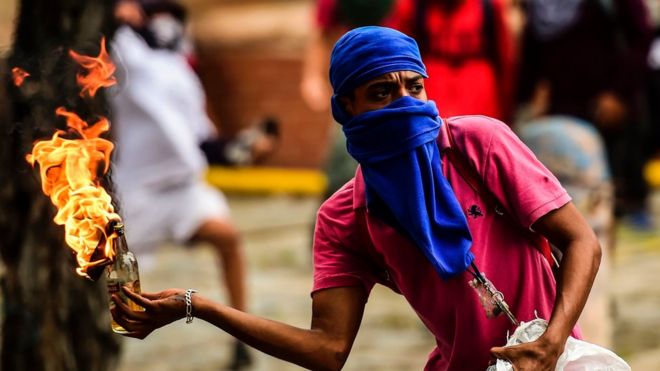
An opposition demonstrator prepares to throw a molotov cocktail during clashes with riot police in an anti-government protest in CaracasImage copyrightAFP
Image captionProtesters and police clashed in several cities across Venezuela
by Renee Celeste and Biodun Iginla, BBC News, Caracas
Millions of Venezuelans have joined a general strike called by the opposition as pressure mounts on President Nicolás Maduro to cancel elections for a new constituent assembly.
Clashes between police and protesters killed at least three people. More than 300 others were reportedly arrested.
Mr Maduro said the strike was minimal and that its leaders would be arrested.
Since April, when opposition protests intensified, almost 100 people have died across the country.
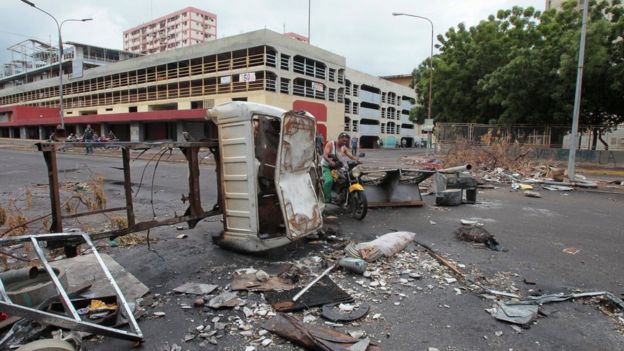
Protesters barricaded roads in the capital, Caracas, and other cities with rubbish and furniture. The opposition said that 85% of the country joined the strike.
But in pro-government areas of the capital, life went on as usual, with shops open and streets busy. Public employees also appeared to have worked normally.
In several cities, police fired tear gas as they clashed with protesters. One death was reported on the outskirts of Caracas while two others died in the northern city of Valencia.
More than 360 people had been arrested across the country, a local rights group said.
A motorcyclist pass through a barricade during a rally against Venezuelan President Nicolas Maduro's government in MaracaiboImage copyrightREUTERS
Image captionDemonstrators set up barricades on streets in several cities
Colombia, France, Spain, the US and the EU have urged the Venezuelan government to cancel the vote for a new constituent assembly on 30 July.
But Mr Maduro has rejected the calls.
In a speech on TV, he claimed "triumph", saying that key sectors had not joined the strike.
"Work has triumphed, love, life, and hope; work has triumphed. They [the Venezuelan opposition] who have never worked, let them carry on not working, we are moving forward, comrades."
"I've ordered the capture of all the fascist terrorists."
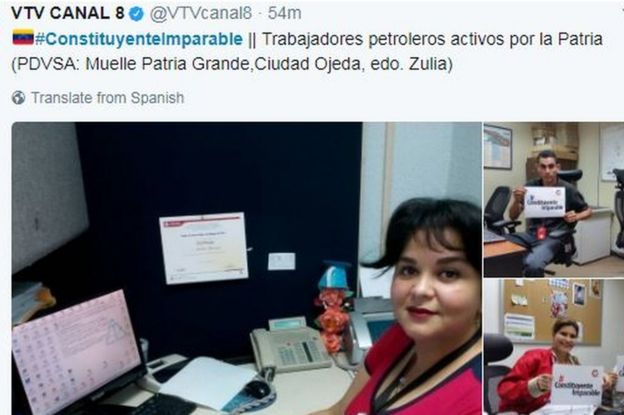
A tweet by state-run media channel VTV shows petroleum workers in their officesImage copyrightTWITTER/VTV CANAL 8
Image captionState-run media retweeted pictures of oil sector workers in their offices
The assembly would have the power to rewrite the constitution and to bypass the opposition-controlled legislature.
Opposition politicians say Mr Maduro wants to use the assembly to entrench himself in power, while the president argues a new constitution will promote dialogue in the polarised country.
The opposition have ramped up their schedule of protests in the days leading up to the elections, including Thursday's general 24-hour strike and a mass demonstration on Saturday.
Meanwhile, Isaias Medina, a senior diplomat representing the country at the UN, resigned, saying he could no longer represent the government because of human rights abuses.
Venezuela's ambassador to the UN, Rafael Ramirez, said Mr Medina had acted "dishonestly" and been fired.
Media captionYour video guide to the crisis gripping Venezuela
Earlier, the head of the Organisation of American States (OAS), Luis Almagro, warned of a "calamitous deterioration" of the situation, accusing Mr Maduro's government of having "blood on its hands".
"Behind every detainee, every political prisoner, every person tortured and every person killed there is someone that is institutionally responsible," Mr Almagro wrote in a report.
"The fear that is on everyone's mind, but we are too afraid to speak out loud, is our fear that this will escalate into a bloodbath."
Mr Almagro has long been one of the fiercest and most outspoken critics of the Venezuelan government.

Why is Venezuela in crisis?

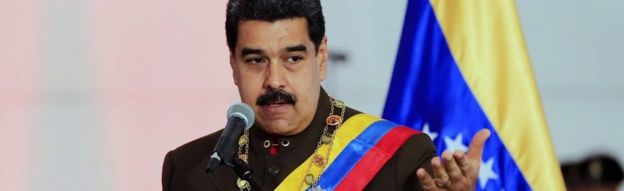
Venezuelan President Nicolas MaduroImage copyrightEPA
  • Almost 100 people have been killed in clashes stemming from the political conflict
  • The deep economic crisis is made worse by the falling price of oil, which accounts for about 95% of Venezuela's export revenues and was used to finance some of the government's social programmes. Forced to make cuts, President Nicolás Maduro has seen his support fall among core backers
  • Basic necessities, such as medicine and food, are in short supply
  • The opposition accuses Mr Maduro of mismanaging the economy and eroding democratic institutions
  • In March, the Supreme Court decided it would take over the National Assembly. The decision was reversed, but Mr Maduro was accused by opponents of trying to stage a coup. That sparked almost daily protests calling for his resignation

Related Topics

More on this story