Biodun Iginla, BBC News

Biodun Iginla, BBC News
Showing posts with label Remainers. Show all posts

Tuesday, March 19, 2019

ANALYSIS: Of Backstops, Brextremists and BOBs: A glossary of Brexit terms


Henry Nicholls, REUTERS | Anti-Brexit protesters outside the Houses of Parliament in London, on December 10, 2018.
A contraction of British exit, "Brexit" has spawned a baffling array of words and acronyms commonly used when discussing the UK’s tortuous departure from the European Union. Here are some of the key terms and phrases.
ADVERTISING
  • Article 50
Part of the EU's Lisbon Treaty, Article 50 sets out the procedure for a country wishing to leave the bloc and imposes a two-year countdown to its departure. Britain triggered the process on March 29, 2017, meaning it will cease to be an EU member on March 29, 2019 – unless it seeks to extend the process.
While any extension would require the approval of the EU’s 27 other members, the UK can unilaterally decide to revoke Article 50 should it choose to abandon Brexit altogether.
Theresa May signs the letter officially invoking Article 50. Christopher Furlong, AFP
  • Backstop
The backstop is part of the withdrawal agreement negotiated by Prime Minister Theresa May’s government – and the main reason it has twice been shot down by parliament. Often referred to as the “Irish backstop” (somewhat unfairly, since Ireland didn’t create the problem in the first place), it is an insurance policy designed to ensure there are no physical barriers or checks on people or goods crossing the border between EU member The Republic of Ireland and Northern Ireland, which is part of the UK.
ADVERTISING
Intended as a temporary measure, the backstop keeps the UK inside the EU’s customs union until new trade arrangements are in place. But critics fear it could become permanent and threaten the integrity of the UK.
  • BOBs
The poisonous debate on Britain’s exit from the EU has left the country bitterly divided between “Leavers”, who backed Brexit in a 2016 referendum, and “Remainers”, who want to remain part of the bloc. But Brexit fatigue after almost three years of debating the same points over and over again means many Britons now identify as BOBs, for "Bored of Brexit".
  • Brexiters
Brexiters – also spelled Brexiteers – are supporters of Britain's exit from the EU. Those who prefer a “hard” or “no-deal” Brexit (see below) are sometimes pejoratively referred to as “Brextremists”.
  • Customs union & single market
The European Union customs union removes all tariffs and border checks on goods moving within the 28-nation bloc, and applies common tariffs on goods entering from the outside. The single market makes the bloc a common economic zone in which goods and services can move freely with no internal borders or barriers.
  • Hard, soft and no-deal Brexit
hard Brexit would take Britain out of the EU's single market and customs union, meaning a return of trade tariffs, and also sever ties with the European Court of Justice. Supporters say it will enable Britain to forge its own trade deals around the world and give the country effective control over its borders and laws.
soft Brexit would see the UK retain its close economic ties with the EU, including membership of the single market and customs union. It is championed by businesses alarmed at the prospect of a return to border tariffs.
Business leaders who don’t want a hard Brexit are terrified at the prospect of a no-deal Brexit, which would see the UK crash out of the bloc with no alternative arrangements in place. Analysts say this would cause economic chaos, and parliament has voted to rule it out – though that decision does not have legal force.
  • People’s Vote
With parliament deadlocked on Brexit, calls for a second referendum – or People’s Vote – have gained traction. Advocates of a second referendum say the public should be given another vote since Brexit has turned out very differently to what voters were promised in 2016. But opponents argue that another referendum would betray voters’ first choice and undermine faith in UK democracy.
An anti-Brexit campaigner outside the Houses of Parliament in London on December 11, 2018. Oli Scarff, AFP
  • Remainers
Remainers are Britons who voted to stay in the European Union, as opposed to the “Leavers” who voted for Brexit in the 2016 referendum. Brexiters often use the derogative term “Remoaners” to refer to opponents of Brexit.
  • Withdrawal agreement
After almost two years of grueling negotiations, May’s government and EU leaders produced a 585-page withdrawal agreement last November setting out the terms of the UK's departure from the bloc, coupled with a shorter, non-binding political declaration committing the two parties to close future ties.
The agreement must be approved by the British and European parliaments to take effect – and the former's lawmakers have already rejected it twice, by huge margins.
Hardline critics in May’s own Conservative Party have described her deal as BRINO, for “Brexit in name only”.

Wednesday, July 18, 2018

Analysis: A second Brexit referendum

by Emily Straton and Biodun Iginla, News Analysts, The Economist Intelligence Unit, London
Here we go again?A second Brexit referendum is back in play

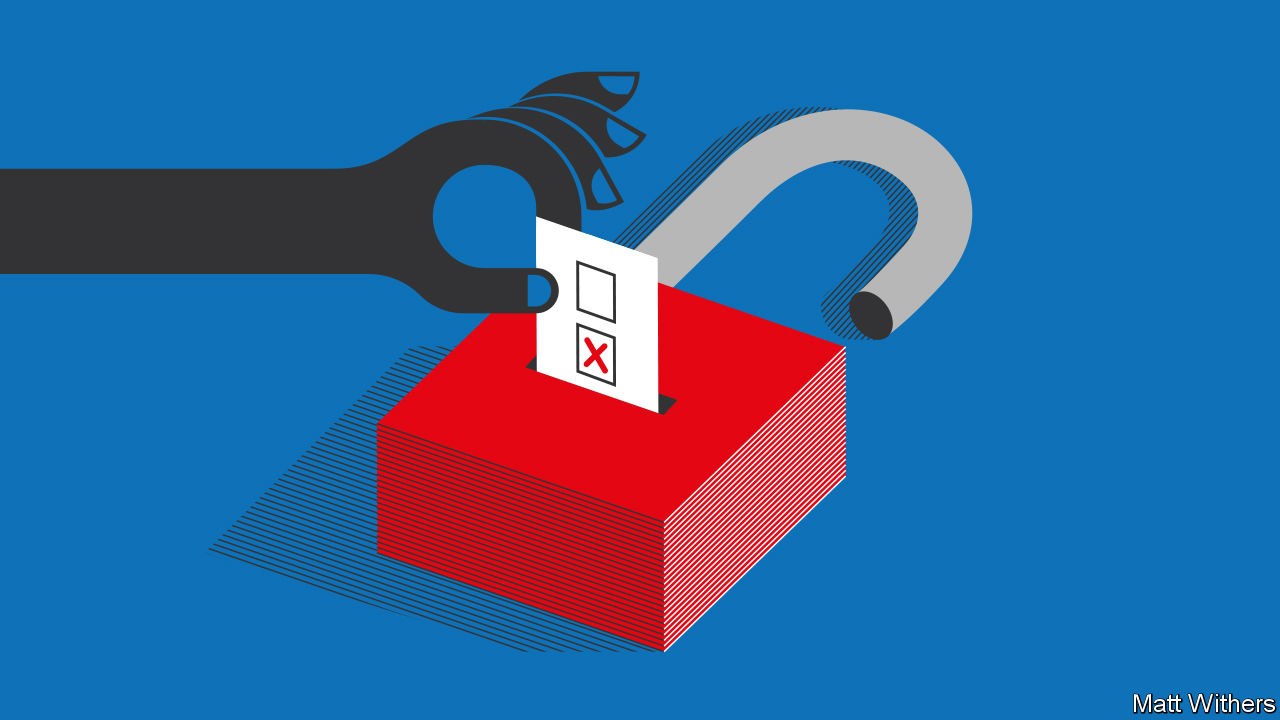
Parliamentary deadlock means it may be necessary to go back to the people
SINCE the vote to leave the European Union in June 2016, the more optimistic among those on the losing side have been lobbying for a rematch. Some argue for a re-run on the basis that Brexiteers lied during the campaign and broke election law (on July 17th the Electoral Commission fined the official Vote Leave campaign £61,000, or $80,000, for deliberately exceeding spending limits). Others say the public deserves a chance to vote on the final deal, which will bear little resemblance to the glittering one they were promised. Yet the idea of a second vote has never taken off. Polls have shifted only slightly in favour of remaining, and there is no great enthusiasm for another plebiscite, which would be the fourth nationwide vote in as many years.
But the idea of revisiting the referendum is back in play. By law, Theresa May’s government cannot sign a Brexit deal without MPs’ approval. And in the past couple of weeks it has begun to look as if Parliament will reject any deal. The Labour opposition has set six tests for the agreement, which look designed to be unpassable. The Conservative Party, meanwhile, is in a rebellious mood. This week hardline Tory Brexiteers forced the government to toughen its approach to customs, before a faction of Tory Remainers forced it to soften its policy on medical regulation. More defeats were avoided by as few as three votes. It is hard to imagine MPs agreeing to the unappealing deal that Mrs May is likely to bring back from Brussels later this year. And if they don’t, Britain could crash out of the EU on March 29th with no deal at all.

Latest stories

See more
Many in Westminster therefore wonder if the only way to break the deadlock may be to send the matter back to the people. One way would be with yet another election. Tory whips reportedly told their MPs that the government would call one over the summer if they defied it on key parts of its Brexit plan. But would Mrs May, election-flunker extraordinaire, risk it? Polls put Labour narrowly ahead of the Tories. In any case, a narrow victory for either party could leave Parliament in the same stalemate, since Labour is also divided over the best approach to Brexit.
So a second referendum is being proposed as a way to get a clear answer. On July 16th Justine Greening, one of Mrs May’s former cabinet ministers, proposed a vote with three options: stay in the EU; accept the deal that Mrs May agrees on with Brussels; or leave with no deal.
There are formidable obstacles to such a vote. Parliament would have to legislate for the referendum, which might be tricky if that same Parliament is against the Brexit deal that would be its subject. Labour says a referendum is “not its policy” and that MPs should sort out the mess. But it has left the door ajar: “To take [a second referendum] off the table completely, when there might be a set of circumstances where Parliament cannot deliver a meaningful vote, would be a mistake,” Tom Watson, Labour’s deputy leader, said on July 15th. The Scottish Nationalists would not oppose a second referendum; the Liberal Democrats would vote for one (provided they remembered to show up, as their leader failed to do at a vital Brexit vote this week). Mrs May has ruled out the idea—but of course, two years ago, she ruled out a snap election.
There would be little time to organise a new plebiscite. It took seven months to pass the bill for the original referendum. That process could be speeded up, especially now that Britain has a “here’s one I made earlier” template for such a vote, argues Eloise Todd of Best for Britain, which wants a second referendum. But it would almost certainly be necessary for Britain to ask the EU for more time. It would probably agree, believes Charles Grant of the Centre for European Reform, a think-tank, though it would hope to resolve matters before elections to the European Parliament at the end of May.
If all this could be done in time, what would be the question on the ballot? Britain has never had a multiple-choice referendum of the sort that Ms Greening suggests, though they are not unknown internationally. Finns were asked in 1931 if they wanted to scrap prohibition, maintain it, or remove it only for weak drinks (they overwhelmingly chose to abolish it). In 1977 Australians opted for “Advance Australia Fair” as their national song, from a line-up of four.
The difficulty is deciding how to pick a winner. Peter Kellner, a polling expert and Prospect columnist, notes that the same set of results could produce three possible winners, via first-past-the-post (picking the option with most first-preference votes), alternative vote (adding the second preferences of the bottom-ranked option to the tallies of the top two) or the Condorcet system (picking the overall winner of the three possible head-to-head contests). A poll last month for The Economist by YouGov, asking voters to rank hard Brexit, soft Brexit and Remain, returned exactly such a result (see table). With a second referendum, “there is already potential for a crisis of democratic legitimacy,” notes Akash Paun of the Institute for Government, a think-tank. A complex vote with multiple interpretations would not help.
Such a referendum would also introduce dangers that might make Remainers think twice. One is that the EU would have less incentive to offer a good deal if a referendum was on the cards—indeed, it might have an incentive to offer a bad one, in the hope that Britain would therefore choose to remain, as most Eurocrats would prefer.
It would also be fantastically risky to put “no deal” on the ballot, giving voters an option that no one except the loopiest Brexiteers supports. Ms Greening calls such an option a “clean break”, a phrase which Malcolm Barr of J.P. Morgan, a bank, describes as “a big misrepresentation”. Trading with the EU on World Trade Organisation terms is one thing. Leaving with no agreement on anything from aviation to citizens’ rights and radioactive materials would be dramatically worse, and not a “clean” break at all.
As the Brussels talks enter their closing phase, Remainers may be excited by the faint prospect of annulling Brexit. Yet the price of this is a corresponding rise in the probability of crashing out of the EU with no agreement. Mrs May has foolishly spent the past two years repeating the bluff, aimed at Brussels, that “no deal is better than a bad deal”. There is a terrible risk that the British public take her at her word.
Reuse this content