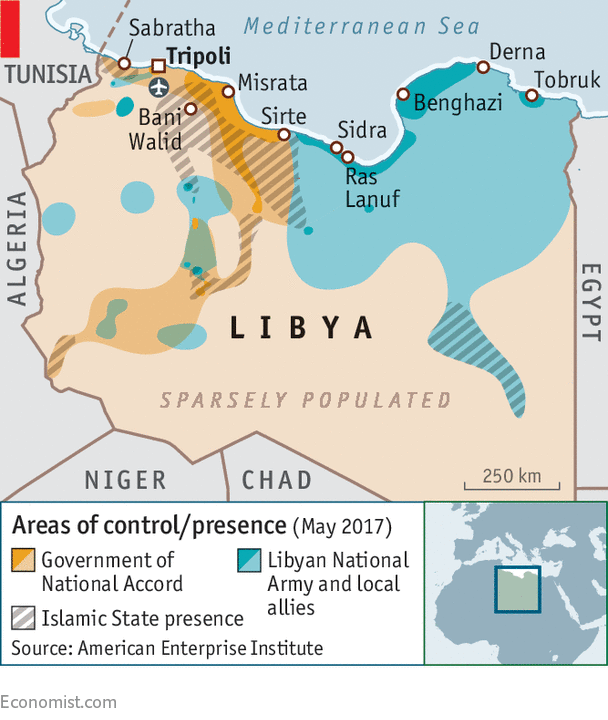
LIKE their comrades in Iraq and Syria, the jihadists of Islamic State (IS) in Libya were in retreat earlier this year. Their branch, considered the most lethal outside the Levant, was pushed out of Sirte, its coastal stronghold, in December and hit hard by American bombers in January. The blows seemed to dispel the idea that, as the core of its “caliphate” crumbled, Libya might serve as a fallback base for IS.
But although the jihadists are down in Libya, they are not out. And they may have international reach. Many of the fighters have regrouped in a swathe of desert valleys and rocky hills south-east of Tripoli. British police are probing links between Salman Abedi, the suicide-bomber who murdered 22 people at a concert in Manchester on May 22nd, and IS, which claimed responsibility for the attack. Mr Abedi was in Libya recently; his brother and father were arrested in Tripoli on May 24th. The militia holding them says the brother is a member of IS and was planning an attack on Tripoli.
Chaos has been the norm in Libya since the uprising that toppled Muammar Qaddafi in 2011. Myriad armed groups, loosely aligned with rival governments in the east and west, vie for power. A UN-backed peace deal, signed by some of the adversaries in 2015, has failed to unite the country or create an effective state under the “government of national accord” (GNA). IS has fed on the chaos—and added to it, lately by attacking water pipelines and pumping stations. There are thought to be around 500 IS fighters operating in Libya, not the thousands estimated before their recent setbacks. But there are perhaps 3,000 jihadists of all types. In a sign of how fluid things are, IS is now said to be receiving support from local al-Qaeda fighters, despite feuding between the groups’ leaders abroad. In Libya they operate in the same areas. Fighters move back and forth between them. “I can well imagine that they are co-operating on logistics and sharing information,” says Wolfgang Pusztai, a former Austrian defence attaché to Libya.
The terrain in the south makes it difficult to attack IS from the ground, say GNA officials, who oversaw the retaking of Sirte. But there are problems with air strikes too—the jihadists stopped travelling in large numbers after American bombers killed more than 80 of them in one set of strikes in January. Now they move in small groups along unpatrolled roads. The GNA says it is keeping tabs on them from a base near Bani Walid, while America is watching from the air. It has been flying surveillance drones over Libya from bases in Tunisia since last summer, and it is building a new drone base in Niger.
Neighbours worry that their own militants will find inspiration and training in Libya—and then return home. Chad closed its border with Libya in January, fearing an influx of jihadists. (It has since reopened one crossing.) Algeria has opened a new air base to guard its frontiers. Tunisia, which has suffered several attacks by jihadists, has built a 200km (125-mile) earth wall along its border with Libya. But even so, IS maintains cells near Sabratha, in the west, to help its fighters get in and out.
Europe, only some 400km away, is eyeing the situation with concern. The chaos has made Libya the main point of entry to Europe for African migrants. Despite more patrols, some 50,000 migrants are thought to have reached Italy by boat so far this year, over 40% more than in the same period last year. Some believe the smuggling business helps to finance terrorism—and that jihadists may be among those making the trip.
For now IS and its allies are keeping a low profile in Libya, if not elsewhere, as they try to rebuild their strength. Meanwhile, hopes of a settlement to the conflict look dim. The chaos is likely to continue, giving the jihadists an opportunity to reassert themselves at home.
Theresa May is to raise concerns with Donald Trump after evidence from the Manchester Arena bombing was apparently leaked to US media.
UK officials were "furious" when photos appearing to show debris from the attack appeared in the New York Times.
Monday night's attack at Manchester Arena killed 22 people - including children - and injured 64.
Eight men are now in custody following the attack, carried out by suicide bomber Salman Abedi.
The prime minister is expected to raise the issue of the leak with the US president when they meet at a Nato summit later.
Details about Abedi's identity had already emerged in the US media less than 24 hours after the explosion and against the UK's wishes.
Home Secretary Amber Rudd said she was "irritated" by the disclosure of Abedi's identity and had warned Washington "it should not happen again".
However, the pictures of debris - which appear to show bloodstained fragments from the bomb and the backpack used to conceal it - were subsequently leaked to the New York Times, prompting a furious response from within Whitehall and from UK police chiefs.
BBC security correspondent Gordon Corera says UK officials believe that US law enforcement rather than the White House is the likely culprit for the leaks.
Further two arrests
The meeting between Mrs May and Mr Trump, at a Nato summit in Brussels, will take place as British police continue to investigate an alleged "network" linked to Abedi.
Early on Thursday morning, detectives carried out a controlled explosion as they searched a property in the Moss Side area of Manchester.
Two men were also arrested following a search of an address in the Withington area of Greater Manchester.
In total, eight men, including Abedi's older brother, and a woman have been arrested in a series of raids across Manchester, Wigan and Nuneaton.
The woman was subsequently released without charge in the early hours of Thursday.
Meanwhile, Abedi's father and a younger brother have been detained by militia in Libya.
Media caption"I made known my concerns about it to the US ambassador" - Andy Burnham
A Whitehall source described the second US leak as "on another level", and told the BBC it had caused "disbelief and astonishment" across the British government.
The source said the the issue was "being raised at every relevant level by the British authorities with their US counterparts".
The UK's National Police Chiefs' Council described the "unauthorised disclosure" as a breach of trust which had potentially undermined a "major counter-terrorism investigation".
Counter-terrorism detectives have spoken in the past about how important it sometimes is the names of suspects do not make it into the media.
A delay of around 36 hours, before the public know who they are investigating, can allow them to arrest known associates of the suspect before they know police are looking for them.
Greater Manchester Mayor Andy Burnham said the leaks had worried him "greatly," and he had raised them with the US ambassador.
Mr Burnham told Newsnight a decision had been taken to adopt a "cautious approach" to making information public, "and yet the first reports were coming seemingly out of the United States".
Abedi's identity was first reported in the US - with American TV networks CBS and NBC naming him as the suspect.
In other developments, the government has announced that a minute's silence will be held at 11:00 BST on Thursday in remembrance of those who lost their lives or were affected by the attack.
The Conservatives and Labour are to resume local general election campaigning on Thursday, and national campaigning on Friday.
What's happening with the investigation?
Image captionIsmail Abedi was detained in Chorlton, south Manchester; his father, Ramadan, was held in Tripoli
Eight men and one woman have been arrested in the UK since Monday night, including Abedi's older brother Ismail, 23, although the woman has since been released.
Younger brother Hashem, 20, was held by militia in the Libyan capital Tripoli, as was their father.
Speaking on Wednesday afternoon, Greater Manchester Chief Constable Ian Hopkins said: "I think it's very clear that this is a network that we are investigating.
"And as I've said, it continues at a pace. There's extensive investigations going on and activity taking place across Greater Manchester, as we speak."
As part of their investigation, police raided a block of flats near Manchester Piccadilly station in the city centre, requiring them to carry out a controlled explosion and briefly close the railway line.
Police carried out another controlled explosion in the early hours of Thursday morning at an address in the Moss Side area of Manchester.
Anyone with information about the attack can call the anti-terror hotline on 0800 789321.
Who are the victims?
Image captionClockwise, from top left: Georgina Callander, Saffie Roussos, Olivia Campbell, Martyn Hett, Michelle Kiss, Sorrell Leczkowski, Alison Howe, Lisa Lees, Jane Tweddle-Taylor, Nell Jones, Marcin Klis, Angelika Klis, Kelly Brewster and John Atkinson
Some of the victims had been making their way outside at the end of the gig when Abedi detonated his "nuts-and-bolts" bomb.
Others had been waiting in the foyer to pick up children and family.
A serving Cheshire police officer - off-duty at the time - was among those killed. She has not yet been named.
The victims include 14-year-old Sorrell Leczkowski, from Leeds, whose grandmother is critically injured in hospital.
South Shields couple Chloe Rutherford, 17, and Liam Curry, 19 have been named among the dead. Family members paid tribute to the teenagers and in a statement issued by police said: "They wanted to be together forever and now they are."
Eilidh MacLeod, a 14-year-old from Barra in the Outer Hebrides, also died. Her family issued a statement saying: "Words cannot express how we feel at losing our darling Eilidh."
Of the 64 injured, 20 are in a critical condition. Twelve of them are children.
The BBC understands the partner of the unnamed police officer is critically ill and his two children were injured.
The chief constable of Greater Manchester Police said the families of all those injured had been contacted.
Who was the attacker?
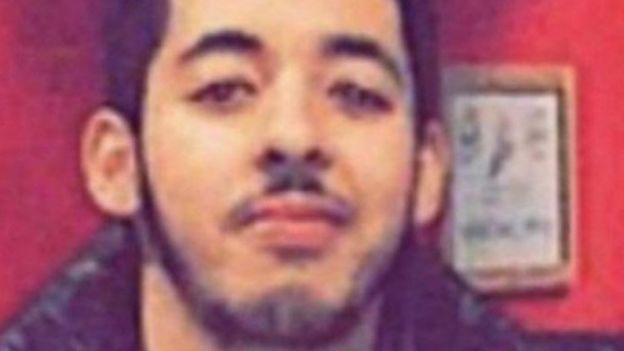
Image captionSalman Abedi was described by a former classmate as short-tempered and gullible
Salman Abedi is understood to have been a 22-year-old born in Manchester to Libyan parents, and a former University of Salford student.
He attended Burnage Academy for Boys in Manchester between 2009 and 2011, and The Manchester College until 2013.
Hamid El-Said, who worked for the UN on tackling radicalisation and now works at Manchester Metropolitan University, said Abedi had had a "really bad relationship" with his family and his parents had tried but failed to keep him on the "right path".
"Eventually he was doing very bad at his university, at his education, and he didn't complete, and they tried to take him back to Libya several times. He had difficulties adjusting to European lifestyle," he said.
A former classmate of Abedi's told the BBC that he was a "very jokey lad" but also "very short tempered" and would get angry at "the littlest thing".
The man, who did not want to be identified, said Abedi had hung around "the wrong crowd and was very, very gullible".
Before leaving Burnage Academy in 2011, Abedi had become "more and more religious", the man added.
A Muslim community worker, who did not want to be identified, has told the BBC that two people who had known Abedi at college had made separate calls to a hotline to warn the police about his extremist views.
He said they had been worried that Abedi was "supporting terrorism" and he had expressed the view that "being a suicide bomber was ok".
The calls are thought to have been made five years ago, he added.