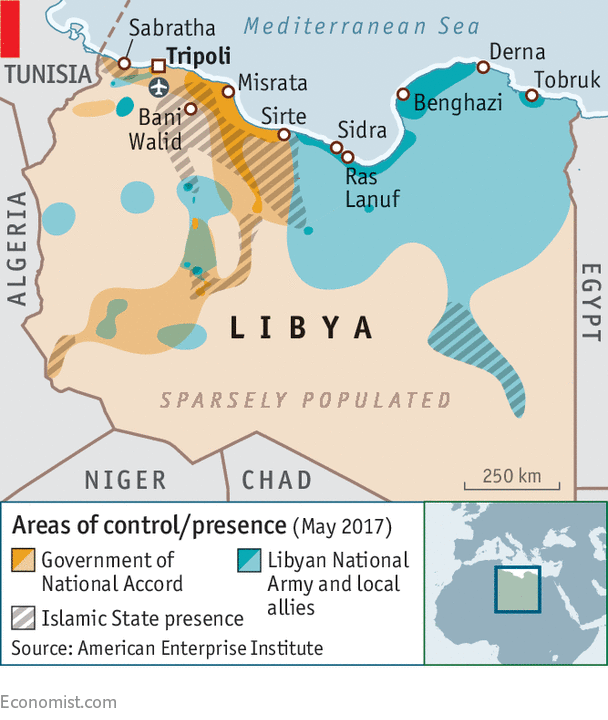
LIKE their comrades in Iraq and Syria, the jihadists of Islamic State (IS) in Libya were in retreat earlier this year. Their branch, considered the most lethal outside the Levant, was pushed out of Sirte, its coastal stronghold, in December and hit hard by American bombers in January. The blows seemed to dispel the idea that, as the core of its “caliphate” crumbled, Libya might serve as a fallback base for IS.
But although the jihadists are down in Libya, they are not out. And they may have international reach. Many of the fighters have regrouped in a swathe of desert valleys and rocky hills south-east of Tripoli. British police are probing links between Salman Abedi, the suicide-bomber who murdered 22 people at a concert in Manchester on May 22nd, and IS, which claimed responsibility for the attack. Mr Abedi was in Libya recently; his brother and father were arrested in Tripoli on May 24th. The militia holding them says the brother is a member of IS and was planning an attack on Tripoli.
Chaos has been the norm in Libya since the uprising that toppled Muammar Qaddafi in 2011. Myriad armed groups, loosely aligned with rival governments in the east and west, vie for power. A UN-backed peace deal, signed by some of the adversaries in 2015, has failed to unite the country or create an effective state under the “government of national accord” (GNA). IS has fed on the chaos—and added to it, lately by attacking water pipelines and pumping stations. There are thought to be around 500 IS fighters operating in Libya, not the thousands estimated before their recent setbacks. But there are perhaps 3,000 jihadists of all types. In a sign of how fluid things are, IS is now said to be receiving support from local al-Qaeda fighters, despite feuding between the groups’ leaders abroad. In Libya they operate in the same areas. Fighters move back and forth between them. “I can well imagine that they are co-operating on logistics and sharing information,” says Wolfgang Pusztai, a former Austrian defence attaché to Libya.
The terrain in the south makes it difficult to attack IS from the ground, say GNA officials, who oversaw the retaking of Sirte. But there are problems with air strikes too—the jihadists stopped travelling in large numbers after American bombers killed more than 80 of them in one set of strikes in January. Now they move in small groups along unpatrolled roads. The GNA says it is keeping tabs on them from a base near Bani Walid, while America is watching from the air. It has been flying surveillance drones over Libya from bases in Tunisia since last summer, and it is building a new drone base in Niger.
Neighbours worry that their own militants will find inspiration and training in Libya—and then return home. Chad closed its border with Libya in January, fearing an influx of jihadists. (It has since reopened one crossing.) Algeria has opened a new air base to guard its frontiers. Tunisia, which has suffered several attacks by jihadists, has built a 200km (125-mile) earth wall along its border with Libya. But even so, IS maintains cells near Sabratha, in the west, to help its fighters get in and out.
Europe, only some 400km away, is eyeing the situation with concern. The chaos has made Libya the main point of entry to Europe for African migrants. Despite more patrols, some 50,000 migrants are thought to have reached Italy by boat so far this year, over 40% more than in the same period last year. Some believe the smuggling business helps to finance terrorism—and that jihadists may be among those making the trip.
For now IS and its allies are keeping a low profile in Libya, if not elsewhere, as they try to rebuild their strength. Meanwhile, hopes of a settlement to the conflict look dim. The chaos is likely to continue, giving the jihadists an opportunity to reassert themselves at home.
THE ground is shrinking beneath the feet of the jihadists of Islamic State (IS). Iraqi troops are moving closer to the centre of Mosul, the last big city under its control in Iraq, while Kurdish and Arab fighters eye Raqqa, its putative capital in Syria. How will IS react—and, perhaps, adapt—when it loses its remaining territory? To answer that question, look to Libya, where the jihadists have been pushed out of their stronghold in the coastal city of Sirte.
Mired in civil war, Libya has become something of a hub for jihadists in the region. At its height earlier this year, IS controlled over 150 miles (240km) of the country’s coastline, according to the UN. Sirte, the hometown of Muammar Qaddafi, Libya’s former dictator, was even seen as a fallback capital for the group, should it lose Raqqa. But, after nearly seven months of intense fighting, it has been dislodged from its Libyan base.
The campaign against the jihadists was nominally led by a UN-backed “government of national accord” (GNA) in Tripoli, the capital, though militiamen from Misrata, whose loyalty is decidedly fickle, did most of the actual fighting. They were backed by American air strikes. There have been more than 500 of those since August. IS was once thought to have several thousand local and foreign fighters in Sirte. But many, including several leaders, are now believed to be dead.
Analysts warn that the group still poses a significant threat—to the West, the region and Libya itself. Jonathan Winer, America’s special envoy to Libya, told Congress last month that IS’s remaining fighters were probably forming underground cells around the country. “We believe they are waiting for opportunities to engage in further attacks in Libya or its neighbours, and if possible to reassert [IS] geographically,” he said. Nicholas Rasmussen, America’s top counterterrorism official, says he is concerned about attacks on foreign targets by the jihadists.
Hundreds of jihadists are thought to have retreated south from Sirte during the fighting. Others were already there. IS has long had fighters scattered around Libya. In Benghazi they have attacked forces under the command of Khalifa Haftar, an anti-Islamist general, and may be linking up with other Islamist militants. IS fighters can also be found in the country’s vast stretches of desert, from where they have staged attacks on Sirte and elsewhere. Though weakened, they might find succour via the networks of various jihadist groups, such as Ansar al-Shariah and al-Qaeda in the Islamic Maghreb.
Beyond Sirte, the same conditions that allowed the group to flourish still exist. The GNA cannot even secure the capital, parts of which are controlled by armed groups that support a previous Islamist government. Yet another government in the east, this one supported by Mr Haftar, also refuses to stand down. His forces recently took control of several oil facilities, which should boost his leverage if the UN-backed peace plan that produced the GNA is renegotiated, as some have suggested.
But many believe Mr Haftar, who paints most Islamists as terrorists, has no intention of laying down his arms. His forces recently repelled a coalition of militias (supported, some claim, by the GNA’s defence minister) that tried to take back the oil facilities under his control. Backed by Egypt, the United Arab Emirates and Russia, Mr Haftar might decide to push further west. His supporters hope that Donald Trump, America’s president-elect and a fan of anti-Islamist strongmen, will also take his side. But Mr Trump has shown little interest in Libya. Meanwhile, with the campaign in Sirte ending, America’s bombing of IS will soon fall under stricter rules of engagement.
Despite the setback in Sirte, and reported tension between local and foreign fighters, IS will continue to benefit from the chaos in Libya. Arms are easy to obtain, the borders are porous and the disgruntled population provides ample recruits. The terrorists can operate and train in the country’s vast ungoverned spaces, producing attacks on neighbours such as Tunisia, which it has already hit. Until a broader peace is agreed upon and an effective government established, IS soldiers will cause trouble in Libya. The same will be true in Syria and probably Iraq, even after Raqqa and Mosul fall.
Libyan forces said on Monday they were close to securing a final patch of land where Islamic State militants were holding out in their former North African stronghold of Sirte.
Islamic State took over Sirte in early 2015, setting up its most important base outside the Middle East and extending its control along about 250 km (150 miles) of Mediterranean coastline.
Forces led by brigades from the western city of Misrata launched a counter-attack against the jihadist group in May, and since Aug. 1 the United States has carried out more than 490 air strikes to support them.
A spokesman for Misrata-led forces, Rida Issa, said they were in control of Sirte's Ghiza Bahriya neighborhood and were securing the area, where officials said 34 Islamic State fighters, including at least two senior commanders, surrendered earlier in the day.
Another spokesman, Mohamed al-Gasri, told Misrata TV the forces were "continuing to besiege the remaining buildings" held by Islamic State, more than 20 of whose fighters had been killed. A field commander said fighting was ongoing.
Three of the Misrata-led forces were killed on Monday and 17 were wounded, said Mohamed Lajnef, a staff member at a field hospital outside Sirte.
Militants have been clinging on in a few dozen buildings in Ghiza Bahriya for weeks. In recent days, Libyan forces say dozens of women and children have escaped or been freed from the area, and Lajnef said at least 10 more left militant-held ground on Monday.
RUINS
The presence of the families had been one of the factors complicating attempts to push forward into the final sliver of land held by Islamic State, and several women carried out suicide attacks as they were being granted safe passage.
Images issued over the past two days by Misrata-led forces showed the bodies of Islamic State fighters laid out on the ground and veiled women, some carrying babies, emerging from the rubble. "In general all the women and children are hungry and dehydrated," Lajnef said.
The forces fighting in Sirte are nominally aligned with a U.N.-backed government that moved to Tripoli in March, part of international efforts to end the conflict and political turmoil that have plagued Libya since long-time ruler Muammar Gaddafi was toppled in an uprising in 2011.
The chaos allowed Islamic State to gain a foothold from 2014 and implant itself in Sirte, Gaddafi's home city.
The loss of Sirte leaves the jihadist group without territory under its control in Libya, though it retains an active presence in the country. Libyan and Western officials fear that sleeper cells and militants who have fled Sirte could turn to an insurgent campaign.
Almost all of Sirte's estimated population of 80,000 have fled since Islamic State took over, and parts of the city have been left in ruins by recent fighting.
More than 700 fighters from the Misrata-led brigades have been killed in the campaign for Sirte, and more than 3,200 wounded, said Akram Gliwan, a spokesman at Misrata central hospital.
At least 34 Libyan fighters were killed and more than 180 wounded on Sunday as they closed in on the last Islamic State militant holdouts in the coastal city of Sirte, according to field hospitals.
Forces aligned with Libya's U.N.-backed government, supported since Aug. 1 by U.S. air strikes, have pushed militants back into a small residential area in central Sirte in a three-month-old campaign. Heavy fighting resumed on Sunday after a one-week lull.
The Libyan brigades, mostly from the city of Misrata, say they are close to victory in Sirte, but they have struggled to defend themselves against suicide bombings, sniper fire and landmines.
On Sunday several brigades stationed close to Sirte's seafront advanced several hundred meters eastwards through Sirte's neighborhood Number One, while other fighters overran Islamic State positions in street-to-street fighting to the south.
Fighters used tanks, rocket-propelled grenades and anti-aircraft guns to try to blast through Islamic State sniper positions.
The Misrata-led brigades said there had been five attempted car bombings on Sunday in a "desperate attempt to disrupt the advance", though at least one of the bombs had been destroyed before it could reach its target.
The front lines in Sirte were quieter earlier this week as government-led forces said they were giving time to the wives and children of Islamic State fighters to leave the battle zone.
Almost all the city's estimated 80,000 residents left after Islamic State took full control of the city last year, turning it into its regional stronghold and expanding its presence along about 250 km (155 miles) of coastline.
The United States has carried out dozens of air strikes against Islamic State positions and vehicles in Sirte. This week the U.S. Africa Command said Marine AH-1W SuperCobra helicopters were being used in the operation, alongside jets and drones.
Libyan commanders say some Islamic State militants probably escaped around the start of the campaign to recapture Sirte in May, and their forces have been trying to secure the desert to the south and west of Sirte.