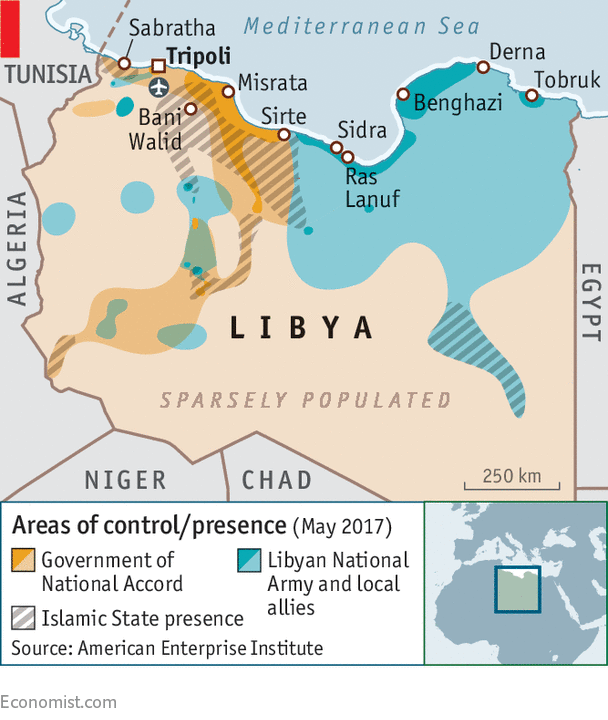
LIKE their comrades in Iraq and Syria, the jihadists of Islamic State (IS) in Libya were in retreat earlier this year. Their branch, considered the most lethal outside the Levant, was pushed out of Sirte, its coastal stronghold, in December and hit hard by American bombers in January. The blows seemed to dispel the idea that, as the core of its “caliphate” crumbled, Libya might serve as a fallback base for IS.
But although the jihadists are down in Libya, they are not out. And they may have international reach. Many of the fighters have regrouped in a swathe of desert valleys and rocky hills south-east of Tripoli. British police are probing links between Salman Abedi, the suicide-bomber who murdered 22 people at a concert in Manchester on May 22nd, and IS, which claimed responsibility for the attack. Mr Abedi was in Libya recently; his brother and father were arrested in Tripoli on May 24th. The militia holding them says the brother is a member of IS and was planning an attack on Tripoli.
Chaos has been the norm in Libya since the uprising that toppled Muammar Qaddafi in 2011. Myriad armed groups, loosely aligned with rival governments in the east and west, vie for power. A UN-backed peace deal, signed by some of the adversaries in 2015, has failed to unite the country or create an effective state under the “government of national accord” (GNA). IS has fed on the chaos—and added to it, lately by attacking water pipelines and pumping stations. There are thought to be around 500 IS fighters operating in Libya, not the thousands estimated before their recent setbacks. But there are perhaps 3,000 jihadists of all types. In a sign of how fluid things are, IS is now said to be receiving support from local al-Qaeda fighters, despite feuding between the groups’ leaders abroad. In Libya they operate in the same areas. Fighters move back and forth between them. “I can well imagine that they are co-operating on logistics and sharing information,” says Wolfgang Pusztai, a former Austrian defence attaché to Libya.
The terrain in the south makes it difficult to attack IS from the ground, say GNA officials, who oversaw the retaking of Sirte. But there are problems with air strikes too—the jihadists stopped travelling in large numbers after American bombers killed more than 80 of them in one set of strikes in January. Now they move in small groups along unpatrolled roads. The GNA says it is keeping tabs on them from a base near Bani Walid, while America is watching from the air. It has been flying surveillance drones over Libya from bases in Tunisia since last summer, and it is building a new drone base in Niger.
Neighbours worry that their own militants will find inspiration and training in Libya—and then return home. Chad closed its border with Libya in January, fearing an influx of jihadists. (It has since reopened one crossing.) Algeria has opened a new air base to guard its frontiers. Tunisia, which has suffered several attacks by jihadists, has built a 200km (125-mile) earth wall along its border with Libya. But even so, IS maintains cells near Sabratha, in the west, to help its fighters get in and out.
Europe, only some 400km away, is eyeing the situation with concern. The chaos has made Libya the main point of entry to Europe for African migrants. Despite more patrols, some 50,000 migrants are thought to have reached Italy by boat so far this year, over 40% more than in the same period last year. Some believe the smuggling business helps to finance terrorism—and that jihadists may be among those making the trip.
For now IS and its allies are keeping a low profile in Libya, if not elsewhere, as they try to rebuild their strength. Meanwhile, hopes of a settlement to the conflict look dim. The chaos is likely to continue, giving the jihadists an opportunity to reassert themselves at home.
DETAILS of the Manchester Arena bombing are slowly emerging. Islamic State has claimed responsibility for the attack. The police have confirmed that the murderous act last night was carried out by a single suicide-bomber who detonated an improvised explosive device packed with shrapnel in a crowded foyer. He has been named as Salman Abedi, reportedly a Manchester-born 22-year-old with family of Libyan origin. Separately, a 23-year-old man has been arrested in a Manchester suburb in connection with the crime. Wrenching photos of the first young victims and missing concert-goers have been posted online.
The rest, so far, is speculation. The selection of a pop concert as the target for the attack has echoes of the Bataclan massacre in Paris in November 2015. It has become standard operating practice for both Islamic State and al-Qaeda-inspired terrorists to try to hit large venues hosting events that symbolise what they regard as Western cultural decadence. The fact that many of the victims of this attack will have been teenagers will only have encouraged the perpetrator because of the added dimension of horror.
The only comfort the British authorities can take from what happened is that there were no gunmen wielding automatic weapons, as was the case in Paris, waiting to kill more people as they fled from the initial attack. That is both a tribute to Britain’s tight firearms regulations and an indication of the plot’s relative lack of complexity.
However, that does not mean the killer was unknown to Britain’s counter-terrorism forces, nor that he was acting alone. MI5, Britain’s domestic intelligence service, has tabs on up to 3,000 people whom it regards as religious extremists, but it only has the resources for the constant monitoring of about 40 of them; 24-hour surveillance of a single suspect requires up to 18 officers. There are also strict rules about how long such intensive surveillance of an individual can continue. Consequently, people who turn out to be highly dangerous frequently slip off the radar of even Britain’s relatively well-resourced security services. The scale of the threat they have to deal with is daunting. In the 18 months to March this year at least 12 terrorist plots were thwarted, according to Dominic Grieve, who chairs the parliamentary Intelligence and Security Committee. It is inevitable that over time some will succeed.
Much has been made recently of so-called “lone wolf” attacks—self-radicalised individuals acting more or less alone using any weapon they can get their hands on. On March 22nd Khalid Masood, a 52-year-old British Muslim convert, murdered five people in central London using a hired car and a kitchen knife. The fact the Manchester attack was a bombing makes it a good deal more likely that the perpetrator had help. Although there are plenty of jihadist websites with handy instructions on how to assemble an improvised bomb, making one small enough to conceal in a suicide-bomber’s belt or vest and which will reliably go off when it is meant to is not that easy.
If the Manchester bomber was not part of a terrorist cell operating in Britain, he may have acquired the degree of expertise needed to carry out his attack elsewhere. Some 800 people have travelled from Britain to fight for various jihadist outfits in Syria, and more than 400 of them are believed to have returned home. Some of those will be trained and hardened fighters with the skills and the motivation to carry out mass-casualty attacks at home. Should that description fit the Manchester bomber, it will be the security services’ worst nightmare come true.
There will also be speculation about the timing of the attack. Some have noted that it took place on the anniversary of the murder of a British soldier, Lee Rigby, four years ago on a street in south-east London. It is also possible that the attack was aimed at disrupting the general election on June 8th, although in Britain there is no viable far-right party that might benefit.
That is not to say that this attack will have no impact on the election beyond the temporary suspension of campaigning. Whatever her other deficiencies, Theresa May, after six years at the Home Office (Britain’s interior ministry), can plausibly present herself as a “security prime minister”. By contrast, the leader of the opposition Labour Party, Jeremy Corbyn, has a record as a sympathiser of the Irish Republican Army and has described members of Hamas and Hizbullah, both designated as terrorist groups by the EU and America, as “friends”. Polls have recently shown Mrs May’s lead over Mr Corbyn to be narrowing, following the launch last week of an unpopular Conservative manifesto. With terrorism back in the news, that slide may come to an end. Note: This story was updated on May 23rd to include the identity of the attacker.