
Geopolitics
by Xian Wan and Biodun Iginla, Political News Analysts, The Economist Intelligence Unit, Beijing
It bet that China would head towards democracy and the market economy. The gamble has failed
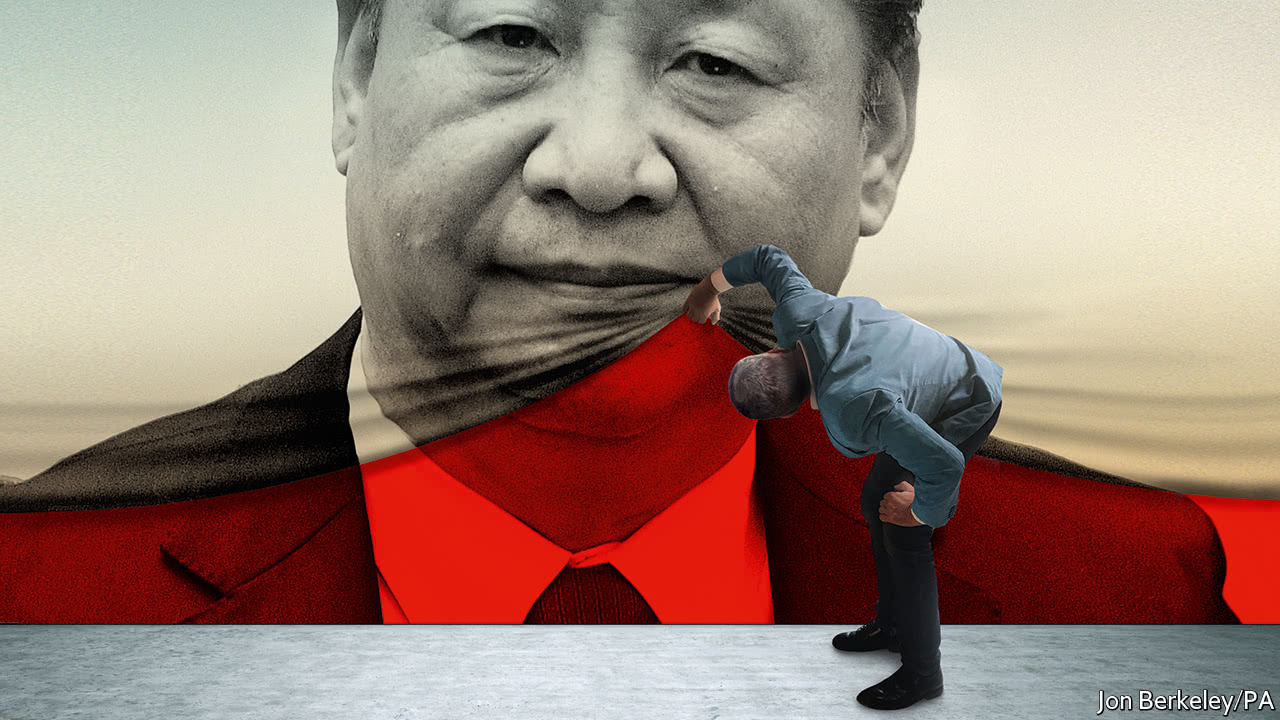
LAST weekend China stepped from autocracy into dictatorship. That was when Xi Jinping, already the world’s most powerful man, let it be known that he will change China’s constitution so that he can rule as president for as long as he chooses—and conceivably for life. Not since Mao Zedong has a Chinese leader wielded so much power so openly. This is not just a big change for China (see article), but also strong evidence that the West’s 25-year bet on China has failed.
After the collapse of the Soviet Union, the West welcomed the next big communist country into the global economic order. Western leaders believed that giving China a stake in institutions such as the World Trade Organisation (WTO) would bind it into the rules-based system set up after the second world war (see Briefing). They hoped that economic integration would encourage China to evolve into a market economy and that, as they grew wealthier, its people would come to yearn for democratic freedoms, rights and the rule of law.
It was a worthy vision, which this newspaper shared, and better than shutting China out. China has grown rich beyond anybody’s imagining. Under the leadership of Hu Jintao, you could still picture the bet paying off. When Mr Xi took power five years ago China was rife with speculation that he would move towards constitutional rule. Today the illusion has been shattered. In reality, Mr Xi has steered politics and economics towards repression, state control and confrontation.
China used to profess no interest in how other countries run themselves, so long as it was left alone. Increasingly, however, it holds its authoritarian system up as a rival to liberal democracy. At the party’s 19th congress last autumn, Mr Xi offered “a new option for other countries” that would involve “Chinese wisdom and a Chinese approach to solving the problems facing mankind.” Mr Xi later said that China would not export its model, but you sense that America now has not just an economic rival, but an ideological one, too.
The bet to embed markets has been more successful. China has been integrated into the global economy. It is the world’s biggest exporter, with over 13% of the total. It is enterprising and resourceful, and home to 12 of the world’s 100 most valuable listed companies. It has created extraordinary prosperity, for itself and those who have done business with it.
Yet China is not a market economy and, on its present course, never will be. Instead, it increasingly controls business as an arm of state power. It sees a vast range of industries as strategic. Its “Made in China 2025” plan, for instance, sets out to use subsidies and protection to create world leaders in ten industries, including aviation, tech and energy, which together cover nearly 40% of its manufacturing. Although China has become less blatant about industrial espionage, Western companies still complain of state-sponsored raids on their intellectual property. Meanwhile, foreign businesses are profitable but miserable, because commerce always seems to be on China’s terms. American credit-card firms, for example, were let in only after payments had shifted to mobile phones.
China embraces some Western rules, but also seems to be drafting a parallel system of its own. Take the Belt and Road Initiative, which promises to invest over $1tn in markets abroad, ultimately dwarfing the Marshall plan. This is partly a scheme to develop China’s troubled west, but it also creates a Chinese-funded web of influence that includes pretty much any country willing to sign up. The initiative asks countries to accept Chinese-based dispute-resolution. Should today’s Western norms frustrate Chinese ambition, this mechanism could become an alternative.
And China uses business to confront its enemies. It seeks to punish firms directly, as when Mercedes-Benz, a German carmaker, was recently obliged to issue a grovelling apology after unthinkingly quoting the Dalai Lama online. It also punishes them for the behaviour of their governments. When the Philippines contested China’s claim to Scarborough Shoal in the South China Sea, China suddenly stopped buying its bananas, supposedly for health reasons. As China’s economic clout grows, so could this sort of pressure.
This “sharp power” in commerce is a complement to the hard power of armed force. Here, China behaves as a regional superpower bent on driving America out of East Asia. As with Scarborough Shoal, China has seized and built on a number of reefs and islets. The pace of Chinese military modernisation and investment is raising doubts about America’s long-run commitment to retain its dominance in the region. The PLA still could not defeat America in a fight, but power is about resolve as well as strength. Even as China’s challenge has become overt, America has been unwilling or unable to stop it.
Instead Mr Trump needs to recast the range of China policy. China and the West will have to learn to live with their differences. Putting up with misbehaviour today in the hope that engagement will make China better tomorrow does not make sense. The longer the West grudgingly accommodates China’s abuses, the more dangerous it will be to challenge them later. In every sphere, therefore, policy needs to be harder edged, even as the West cleaves to the values it claims are universal.
To counter China’s sharp power, Western societies should seek to shed light on links between independent foundations, even student groups, and the Chinese state. To counter China’s misuse of economic power, the West should scrutinise investments by state-owned companies and, with sensitive technologies, by Chinese companies of any kind. It should bolster institutions that defend the order it is trying to preserve. For months America has blocked the appointment of officials at the WTO. Mr Trump should demonstrate his commitment to America’s allies by reconsidering membership of the Trans-Pacific Partnership, as he has hinted. To counter China’s hard power, America needs to invest in new weapons systems and, most of all, ensure that it draws closer to its allies—who, witnessing China’s resolve, will naturally look to America.
Rivalry between the reigning and rising superpowers need not lead to war. But Mr Xi’s thirst for power has raised the chance of devastating instability. He may one day try to claim glory by retaking Taiwan. And recall that China first limited the term of its leaders so that it would never again have to live through the chaos and crimes of Mao’s one-man rule. A powerful, yet fragile, dictatorship is not where the West’s China bet was supposed to lead. But that is where it has ended up.
After the collapse of the Soviet Union, the West welcomed the next big communist country into the global economic order. Western leaders believed that giving China a stake in institutions such as the World Trade Organisation (WTO) would bind it into the rules-based system set up after the second world war (see Briefing). They hoped that economic integration would encourage China to evolve into a market economy and that, as they grew wealthier, its people would come to yearn for democratic freedoms, rights and the rule of law.
Latest stories
All hail, Xi Dada
Start with politics. Mr Xi has used his power to reassert the dominance of the Communist Party and of his own position within it. As part of a campaign against corruption, he has purged potential rivals. He has executed a sweeping reorganisation of the People’s Liberation Army (PLA), partly to ensure its loyalty to the party, and to him personally. He has imprisoned free-thinking lawyers and stamped out criticism of the party and the government in the media and online. Though people’s personal lives remain relatively free, he is creating a surveillance state to monitor discontent and deviance.China used to profess no interest in how other countries run themselves, so long as it was left alone. Increasingly, however, it holds its authoritarian system up as a rival to liberal democracy. At the party’s 19th congress last autumn, Mr Xi offered “a new option for other countries” that would involve “Chinese wisdom and a Chinese approach to solving the problems facing mankind.” Mr Xi later said that China would not export its model, but you sense that America now has not just an economic rival, but an ideological one, too.
The bet to embed markets has been more successful. China has been integrated into the global economy. It is the world’s biggest exporter, with over 13% of the total. It is enterprising and resourceful, and home to 12 of the world’s 100 most valuable listed companies. It has created extraordinary prosperity, for itself and those who have done business with it.
Yet China is not a market economy and, on its present course, never will be. Instead, it increasingly controls business as an arm of state power. It sees a vast range of industries as strategic. Its “Made in China 2025” plan, for instance, sets out to use subsidies and protection to create world leaders in ten industries, including aviation, tech and energy, which together cover nearly 40% of its manufacturing. Although China has become less blatant about industrial espionage, Western companies still complain of state-sponsored raids on their intellectual property. Meanwhile, foreign businesses are profitable but miserable, because commerce always seems to be on China’s terms. American credit-card firms, for example, were let in only after payments had shifted to mobile phones.
China embraces some Western rules, but also seems to be drafting a parallel system of its own. Take the Belt and Road Initiative, which promises to invest over $1tn in markets abroad, ultimately dwarfing the Marshall plan. This is partly a scheme to develop China’s troubled west, but it also creates a Chinese-funded web of influence that includes pretty much any country willing to sign up. The initiative asks countries to accept Chinese-based dispute-resolution. Should today’s Western norms frustrate Chinese ambition, this mechanism could become an alternative.
And China uses business to confront its enemies. It seeks to punish firms directly, as when Mercedes-Benz, a German carmaker, was recently obliged to issue a grovelling apology after unthinkingly quoting the Dalai Lama online. It also punishes them for the behaviour of their governments. When the Philippines contested China’s claim to Scarborough Shoal in the South China Sea, China suddenly stopped buying its bananas, supposedly for health reasons. As China’s economic clout grows, so could this sort of pressure.
This “sharp power” in commerce is a complement to the hard power of armed force. Here, China behaves as a regional superpower bent on driving America out of East Asia. As with Scarborough Shoal, China has seized and built on a number of reefs and islets. The pace of Chinese military modernisation and investment is raising doubts about America’s long-run commitment to retain its dominance in the region. The PLA still could not defeat America in a fight, but power is about resolve as well as strength. Even as China’s challenge has become overt, America has been unwilling or unable to stop it.
Take a deep breath
What to do? The West has lost its bet on China, just when its own democracies are suffering a crisis of confidence. President Donald Trump saw the Chinese threat early but he conceives of it chiefly in terms of the bilateral trade deficit, which is not in itself a threat. A trade war would undermine the very norms he should be protecting and harm America’s allies just when they need unity in the face of Chinese bullying. And, however much Mr Trump protests, his promise to “Make America Great Again” smacks of a retreat into unilateralism that can only strengthen China’s hand.Instead Mr Trump needs to recast the range of China policy. China and the West will have to learn to live with their differences. Putting up with misbehaviour today in the hope that engagement will make China better tomorrow does not make sense. The longer the West grudgingly accommodates China’s abuses, the more dangerous it will be to challenge them later. In every sphere, therefore, policy needs to be harder edged, even as the West cleaves to the values it claims are universal.
To counter China’s sharp power, Western societies should seek to shed light on links between independent foundations, even student groups, and the Chinese state. To counter China’s misuse of economic power, the West should scrutinise investments by state-owned companies and, with sensitive technologies, by Chinese companies of any kind. It should bolster institutions that defend the order it is trying to preserve. For months America has blocked the appointment of officials at the WTO. Mr Trump should demonstrate his commitment to America’s allies by reconsidering membership of the Trans-Pacific Partnership, as he has hinted. To counter China’s hard power, America needs to invest in new weapons systems and, most of all, ensure that it draws closer to its allies—who, witnessing China’s resolve, will naturally look to America.
Rivalry between the reigning and rising superpowers need not lead to war. But Mr Xi’s thirst for power has raised the chance of devastating instability. He may one day try to claim glory by retaking Taiwan. And recall that China first limited the term of its leaders so that it would never again have to live through the chaos and crimes of Mao’s one-man rule. A powerful, yet fragile, dictatorship is not where the West’s China bet was supposed to lead. But that is where it has ended up.

