Biodun Iginla, BBC News

Biodun Iginla, BBC News
Showing posts with label humanitarian crisis. Show all posts

Sunday, February 3, 2019

Trump says U.S. military intervention in Venezuela 'an option'

February 3, 2019  23H:40  GMT/ZULU
CARACAS - U.S. President Donald Trump said military intervention in Venezuela was “an option” as Western nations boost pressure on socialist leader Nicolas Maduro to step down, while the troubled OPEC nation’s ally Russia warned against “destructive meddling.”
FILE PHOTO: U.S. President Donald Trump holds a news conference to mark six months since the passage of the Tax Cuts and Jobs Act, in the White House East Room in Washington, U.S., June 29, 2018. REUTERS/Kevin Lamarque/File Photo
The United States, Canada and several Latin American countries have disavowed Maduro over his disputed re-election last year and recognized self-proclaimed President Juan Guaido as the country’s rightful leader.
In an interview with CBS on Sunday, Trump said U.S. military intervention was under consideration.
“Certainly, it’s something that’s on the - it’s an option,” Trump said, adding that Maduro requested a meeting months ago.
“I’ve turned it down because we’re very far along in the process,” he said in a CBS “Face the Nation” interview. “So, I think the process is playing out.”
The Trump administration last week issued crippling sanctions on Venezuelan state-owned oil firm PDVSA, a key source of revenue for the country suffering medicine shortages and malnutrition.
SPONSORED
ADVERTISING
Maduro, who has overseen an economic collapse and the exodus of millions of Venezuelans, still maintains the powerful backing of Russia, China and Turkey, and the critical support of the military.
Russia, a major creditor to Venezuela in recent years, quickly urged restraint.
“The international community’s goal should be to help (Venezuela), without destructive meddling from beyond its borders,” Alexander Shchetinin, head of the Latin America department at Russia’s Foreign Ministry, told Interfax.
France and Austria said they would recognize Guaido if Maduro did not respond to the European Union’s call for a free and fair presidential election by Sunday night.
Guaido allies plan to take a large quantity of food and medicine donated by the United States, multilateral organizations and non-profit groups across the Colombian border into the Venezuelan state of Tachira this week, according to a person directly involved in the effort.
The group has not yet determined which border point they will cross, said the person, who asked not to be identified because he is not authorized to speak publicly about the issue.
It is unclear whether Maduro’s government, which denies the country is suffering a humanitarian crisis, will let any foreign aid through.
Slideshow (5 Images)

MILITARY IN FOCUS

Maduro on state television promised peace for the country without specifically responding to Trump. Tens of thousands of people thronged the streets of various Venezuelan cities on Saturday to protest Maduro’s government.
“In Venezuela, there will be peace, and we will guarantee this peace with the civil military union,” he said in the company of khaki and black-clad soldiers who were earlier shown carrying guns and jumping from helicopters into the sea.
Venezuela’s ambassador to Iraq, Jonathan Velasco, became the latest official to recognize opposition leader Guaido this weekend. Air Force General Francisco Yanez in a video also called on members of the military to defect but there were no signs the armed forces were turning against Maduro.
Venezuela has as many as 2,000 generals, according to unofficial estimates, many of whom do not command troops and whose defection would not necessarily weaken the ruling socialists.
Iranian Defence Ministry release footage purportedly showing long-range missile test
The police have also fallen in line with Maduro.
A special forces unit called FAES led home raids following unrest associated with opposition protests in January, killing as many as 10 people in a single operation in a hillside slum of Caracas.

Friday, November 23, 2018

Crime menaces migrants on Mexico border as Tijuana declares crisis

November 24, 2018  02H:39  GMT/UTC/ZULU TIME
TIJUANA, Mexico - Unaccompanied minors and other vulnerable migrants risk falling victim to crime in the Mexican border city of Tijuana, where thousands of Central Americans from caravans may be stuck for months as authorities tighten up asylum rules, advocates say.
Some 4,600 migrants from the bedraggled caravans whose advance has angered U.S. President Donald Trump are camped out with blankets and little food in an overcrowded stadium in Tijuana, whose mayor has declared a “humanitarian crisis.”
Trump has sent troops to the U.S.-Mexico border, authorized the use of lethal force and threatened to shut down the frontier entirely if the migrant caravans are not stopped.
Among the Central Americans, many of whom are Hondurans fleeing violence and poverty in the struggling region, are about 80 minors between the ages of 10 and 17, according to migrants rights groups.
Josue, a 15-year-old Honduran in Tijuana, said that during a previous attempt to cross into the United States last year he was kidnapped and badly beaten in Mexico by drug traffickers claiming to be from the notorious Zetas gang.
“I ended up in the hospital, I don’t know how, because I arrived there half-dead,” he said, declining to give his second name.
Once he was well enough, authorities deported him, he said.
SPONSORED
Reuters was not able to independently corroborate details of his story. Mexico’s immigration institute did not immediately respond to a request for comment about the case.
Tijuana was rated by Mexican think tank Seguridad Justicia y Paz as the fifth most violent city in the world in 2017, with a higher murder rate than the Central American cities from which the migrants are escaping.
Juan Manuel Gastelum, Tijuana’s mayor, said late on Thursday that the city was facing a humanitarian crisis and that supporting the migrants was costing more than 500,000 pesos ($25,000) a day. He urged international agencies to help Tijuana.

WAITING LIST

Activists fear the Central Americans could be stranded for a long time in the city, where some protests against the presence of the caravan have broken out.
In May, citing a lack of processing space at the same crossing, U.S. immigration officials stalled a previous caravan that also drew Trump’s anger. Eventually, they began letting in a trickle of people from the group.
To manage flows of asylum claimants, Mexican and U.S. authorities have in recent years maintained a waiting list. Lawyers and human rights group Amnesty International have said such measures slow the process.
U.S. Customs and Border Protection said in a statement sent to us at Reuters that the San Ysidro Port of Entry, which connects Tijuana to San Diego in California, could process up to 100 people per day and that it was working with Mexico to manage the flow.
Mexico’s National Immigration Institute said it protects the rights of all foreigners and was “respectful of immigration policy implemented by other countries.”
Stalled for days, migrants from the caravan have been signing onto the waiting list. They include gay and transgender teenagers.
Erika Pinheiro, director of litigation at Al Otro Lado, an immigration legal advocacy group, last week told a Californian court under oath that “LGBT children cannot safely stay in Mexico. They are at risk of violence and persecution.”
Tijuana has just one shelter for migrant children, which subsists with the help of civic organizations.
“Young people are definitely the most vulnerable in this type of movement,” said Mynor Contreras, who runs the local YMCA. “We’ve never received so many in such a short time.”
Tension and frustration at the U.S.-Mexico border
If the children cannot enter the United States, they risk being deported from Mexico. That can spell big trouble.
“I don’t want to die,” said 16-year-old Justin, who related how his life was threatened last month for not paying a “war tax” that gangsters charged for his small used-clothing business in the Honduran city of San Pedro Sula. “That day I told my mother to give me her blessing and I left,” he said, crying.

Thursday, November 30, 2017

Yemen: The war the world ignores--analysis


by Leila Mohamed and Biodun Iginla, Political News Analysts, The Economist Intelligence Unit, Sanaa
How—and why—to end the war in Yemen

A pointless conflict has caused the worst humanitarian crisis in the world
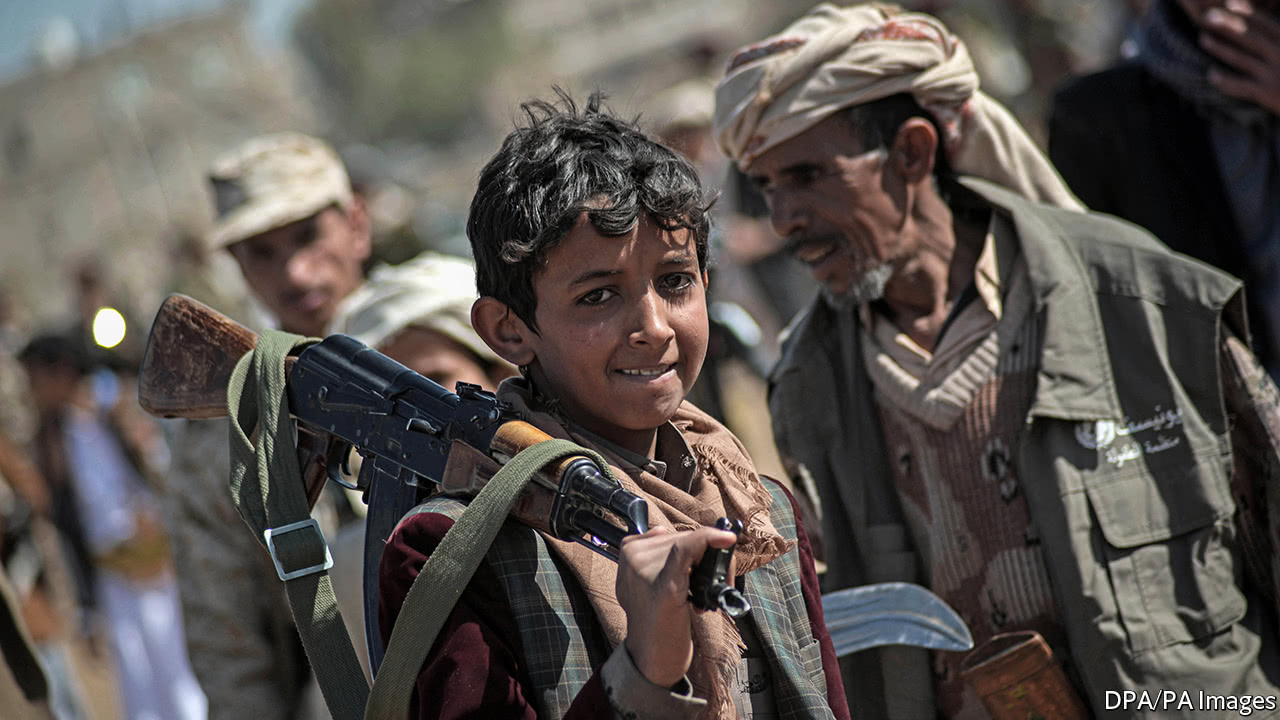
YEMEN lost the title of Arabia Felix, or “Fortunate Arabia”, long ago. It has suffered civil wars, tribalism, jihadist violence and appalling poverty. But none of this compares with the misery being inflicted on the country today by the war between a Saudi-led coalition and the Houthis, a Shia militia backed by Iran.
The UN reckons three-quarters of Yemen’s 28m people need some kind of humanitarian aid. Mounting rubbish, failing sewerage and wrecked water supplies have led to the worst cholera outbreak in recent history. The country is on the brink of famine. The economy has crumbled, leaving people with impossible choices. Each day the al-Thawra hospital in Hodeida must decide which of the life-saving equipment to run with what little fuel it has.

Latest updates

See all updates
Perhaps the worst of it is that much of the world seems unperturbed (see Briefing), calloused by the years of bloodshed in Syria and other parts of the Middle East, and despairing of its ability to effect change. To be cynical, Yemen is farther away from Europe than Syria is; its wretched people do not, on the whole, wash up in the West seeking asylum.
Yet the world ignores Yemen at its peril. Set aside for a moment the obligation to relieve suffering and protect civilians. Hard security interests are also at stake. The world can ill afford another failed state—a new Afghanistan or Somalia—that becomes a breeding-ground for global terrorism. Yemen, moreover, dominates the Bab al-Mandab strait, a choke-point for ships using the Suez canal. Like it or not, the West is involved. The Saudi-led coalition is fighting with Western warplanes and munitions. Western satellites guide its bombs.
Slippery Saleh
Like so much else in the Arab world, Yemen’s agony can be traced to the Arab-spring uprisings of 2011. Mass protests, a near-assassination of the then president, Ali Abdullah Saleh, and a shove from neighbouring petro-states forced him to step down in 2012 in favour of his vice-president, Abd Rabbo Mansour Hadi. A draft constitution in 2015 proposed a federal system and a parliament split between northerners and southerners. But the Houthi rebels, who had fought Mr Saleh, rejected it. The Houthis, who follow the Zaydi branch of Shiism (as do perhaps 40% of Yemenis), complained that, among other things, the constitution stuck them in a region with few resources and without access to the sea.
Now allied with Mr Saleh, who spotted an opportunity for a comeback, the Houthis ousted Mr Hadi from Sana’a, the capital, and chased him all the way to Aden. Saudi Arabia gathered a coalition of Arab states and local militias—among them Islamists, Salafists and southern separatists—and forced the Houthis to retreat partway. For the past year, the battle-lines have barely moved. The Houthis are too weak to rule over Yemen but too powerful for Saudi Arabia to defeat.
As a result, Yemenis have become the pawns in the regional power-struggle between Saudi Arabia and Iran. Alarmed by Iran’s spreading influence, the Saudis have begun to speak of the Houthis rather as Israelis refer to the Lebanese militia, Hizbullah: a dangerous Iranian proxy army on their border. Indeed, the Saudis have much to learn from Israel’s experience. Even with the most sophisticated weapons, it is all but impossible to defeat a militia that is well entrenched in a civilian population. The stronger side is blamed for the pain of those civilians. For the weaker lot, survival is victory.
So, even though the Houthis are primarily responsible for starting the war and capable of great cruelty, it is the Saudis who are accused of war crimes. Often the accusation is justified. In their air campaign, they have been careless and incompetent at best, and probably cynical. Human-rights groups say bombs have been aimed at schools, markets, mosques and hospitals. And the blockade raises suspicion that the Saudis are using food as a tool of war.
The longer the war goes on, the more Saudi Arabia’s Western allies are complicit in its actions. President Donald Trump has given Saudi Arabia carte blanche to act recklessly (see article). He may think it is all part of confronting Iran; or he may want to support the liberalising reforms of the Saudi crown prince, Muhammad bin Salman; or he may hope to profit by selling the Saudis “lots of beautiful military equipment”. Whatever the case, he is damaging America’s interests. Precisely because of the importance of Saudi Arabia—the world’s biggest oil exporter and home to Islam’s two holiest places—the West should urge restraint on the impetuous prince and help disentangle him from an unwinnable war.
How? Peace talks led by the UN have begun with the demand that the Houthis surrender. That is unrealistic. Better to freeze the conflict and find another mediator, such as Oman or Kuwait. A deal should involve a phased withdrawal of Houthi fighters from Sana’a and the Saudi border, and the end of the Saudi blockade. Yemen needs an inclusive government, elections and a new structure for the state. Saudi Arabia will need guarantees that Iranian arms are not flowing into Yemen. Then it will have to cough up the cash to rebuild the country.
None of this will be easy. But a reasonable peace offer is more likely to crack the Houthis than more bombing. Without the cover of fighting Saudi aggression, the Houthis will have to answer for their failures. The public is increasingly turning against them, the alliance with Mr Saleh is fraying and the Houthis themselves are divided.
Stop the war
Right now, far from halting the spread of Iran’s influence, the war has deepened the Houthis’ reliance on Iran, which has an easy and cheap means of tormenting the Saudis. And because Saudi Arabia is bogged down in Yemen, Iran has a freer hand to set the terms of a settlement in Syria. The war is a drain on the Saudis at a time of austerity and wrenching economic reforms at home. They should therefore learn another lesson from Israel’s experience of fighting Hizbullah. If wars are to be fought at all, they should be short, and have limited aims. Deterrence is better than debilitating entanglement.
This article appeared in the Leaders section of the print edition under the headline "The war the world ignores"