
Will Donald junior’s conduct jolt Republicans?
Perhaps nothing will
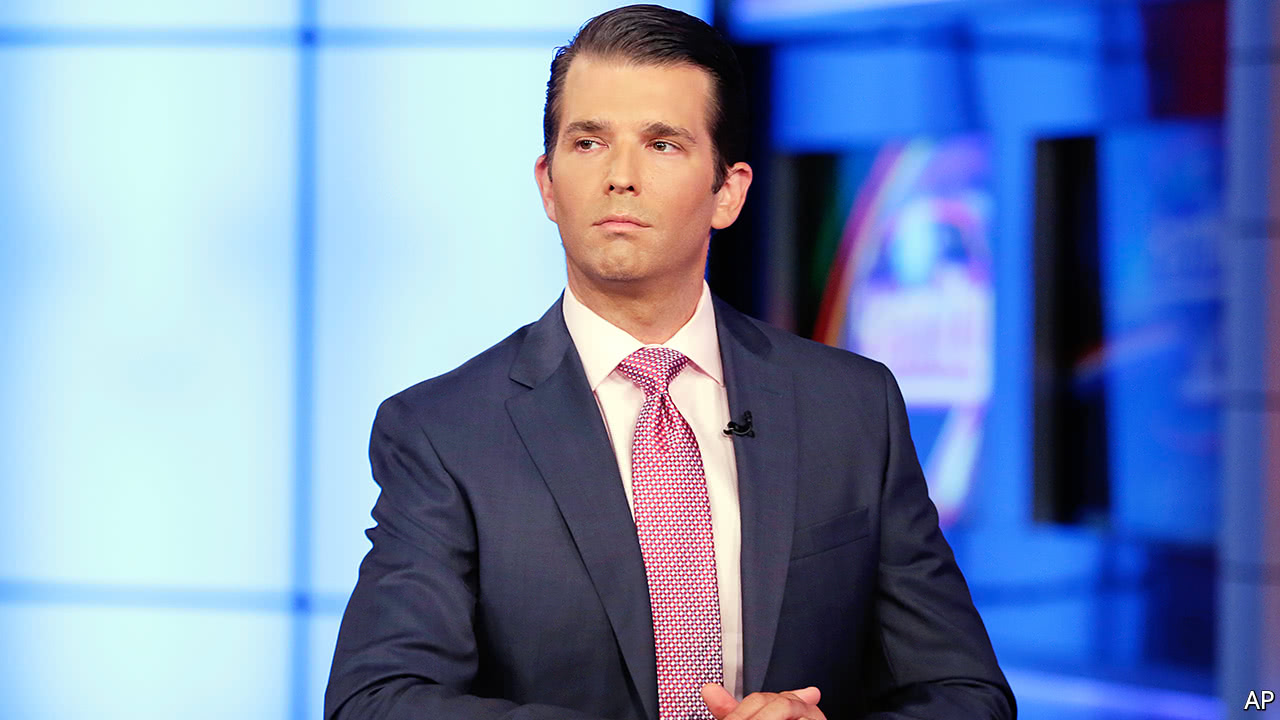
THE first rule of modern conspiracies is that you do not talk about them in e-mails. It always seemed unlikely that, if Donald Trump’s associates had conspired with the Kremlin, they would have been amateurish enough to leave a paper trail. At least, it seemed that way until July 11th, when the president’s son, Donald junior, released astonishing messages he sent and received in advance of a meeting, in 2016, with a Russian lawyer. In the convoluted saga of the Trumps and the Russians, this may be the most explosive revelation yet.
It is no good arguing, in the younger Mr Trump’s defence, that he gave the e-mails up himself: he knew the New York Times was about to publish them, because it had asked him for his side of the story. It scarcely helps to note that the lawyer, Natalia Veselnitskaya, says she does not work for the Kremlin. Her use of such a meeting to assail American sanctions, a neuralgic subject for Vladimir Putin, suggests that she was not simply a private citizen. Nor does it help that Donald junior says she did not, in the end, provide the dirt on Hillary Clinton he craved. Whoever she was, whatever the outcome, the intent to collude is plain. That vindicates what has always been the real charge: not that the Russians swayed the election, a claim that is impossible to verify, but that Mr Trump’s team overstepped the bounds of propriety, and maybe the law (see article).
In the e-mails Donald junior was promised “very high level and sensitive information” that “is part of Russia and its government’s support for Mr Trump”, then a candidate. “I love it,” the son replied. Ms Veselnitskaya is described as a “Russian government attorney”; the goods are said to come from a Russian prosecutor. Rather than calling the FBI, Donald junior took the meeting—bringing Jared Kushner, his brother-in-law, and Paul Manafort, who later quit as campaign manager amid uproar over his ties to Russian-backed Ukrainian politicians.
Contrary to claims from defenders of Mr Trump, a freelance bid by a junior Democratic operative to get dirt on Mr Manafort from the Ukrainians does not compare to this intrigue. Among other things, Ukraine is not a hostile power. Not only does this reinforce a pattern of fishy meetings involving Russian officials and Mr Trump’s advisers, many of which were mysteriously forgotten when they filled out security forms or testified in Congress; this looks worse, for both the Trumps and America. It is worse than Mr Kushner’s bizarre bid to set up a back-channel to talk to Moscow. It is more nakedly collusive than what has so far emerged about Michael Flynn, forced out as national security adviser for lying about his contacts with Russia’s ambassador. It ought to be damning.
That the reaction to such a bombshell could be in doubt exemplifies the damage being inflicted on America. As the president’s support holds up among ordinary Republicans, most Republican congressmen have dismissed the Russian affair as chatter or partisanship. Maintaining that blithe posture now will imply—or confirm—that they have entirely ditched principle for short-term self-interest. Another big risk is that misleading accounts of Russian meetings, which continue to multiply, may even now give the Kremlin leverage over the White House. The administration was told of that worry over Mr Flynn, but the president fired him only when he had no choice. (Soon, of course, he also fired James Comey, who was overseeing the FBI’s Russia probe, and whose treatment may itself constitute obstruction of justice.) Mr Trump claims not to have known about Ms Veselnitskaya; but then he would.
It is no good arguing, in the younger Mr Trump’s defence, that he gave the e-mails up himself: he knew the New York Times was about to publish them, because it had asked him for his side of the story. It scarcely helps to note that the lawyer, Natalia Veselnitskaya, says she does not work for the Kremlin. Her use of such a meeting to assail American sanctions, a neuralgic subject for Vladimir Putin, suggests that she was not simply a private citizen. Nor does it help that Donald junior says she did not, in the end, provide the dirt on Hillary Clinton he craved. Whoever she was, whatever the outcome, the intent to collude is plain. That vindicates what has always been the real charge: not that the Russians swayed the election, a claim that is impossible to verify, but that Mr Trump’s team overstepped the bounds of propriety, and maybe the law (see article).
Latest updates
Contrary to claims from defenders of Mr Trump, a freelance bid by a junior Democratic operative to get dirt on Mr Manafort from the Ukrainians does not compare to this intrigue. Among other things, Ukraine is not a hostile power. Not only does this reinforce a pattern of fishy meetings involving Russian officials and Mr Trump’s advisers, many of which were mysteriously forgotten when they filled out security forms or testified in Congress; this looks worse, for both the Trumps and America. It is worse than Mr Kushner’s bizarre bid to set up a back-channel to talk to Moscow. It is more nakedly collusive than what has so far emerged about Michael Flynn, forced out as national security adviser for lying about his contacts with Russia’s ambassador. It ought to be damning.
That the reaction to such a bombshell could be in doubt exemplifies the damage being inflicted on America. As the president’s support holds up among ordinary Republicans, most Republican congressmen have dismissed the Russian affair as chatter or partisanship. Maintaining that blithe posture now will imply—or confirm—that they have entirely ditched principle for short-term self-interest. Another big risk is that misleading accounts of Russian meetings, which continue to multiply, may even now give the Kremlin leverage over the White House. The administration was told of that worry over Mr Flynn, but the president fired him only when he had no choice. (Soon, of course, he also fired James Comey, who was overseeing the FBI’s Russia probe, and whose treatment may itself constitute obstruction of justice.) Mr Trump claims not to have known about Ms Veselnitskaya; but then he would.
The gun smokes
The scandal is becoming a clash between the worst aspects of American democracy and the best. The worst is its bilious, myopic hyper-partisanship; the best the unrivalled ability of American institutions, including journalists whom Mr Trump reviles, to hold the powerful to account. Legally and politically, the ending is unclear. Morally, the verdict is already in.


