Biodun Iginla, BBC News

Biodun Iginla, BBC News
Showing posts with label Kremlin. Show all posts

Friday, August 17, 2018

From Russia with attitude: Pussy Riot slates Kremlin at Fringe

August 17, 2018  14H:24  GMT/UTC/ZULU TIME
EDINBURGH - Screaming, chanting, and torrents of religious-style vocals are the backdrop to Pussy Riot’s Edinburgh Fringe show, which centers on the real-life trial and imprisonment of Russian front woman Maria Alyokhina.

A fierce critic of Russian President Vladimir Putin, Alyokhina, 30, retells the story of the group’s 2012 protest performance in a Moscow cathedral and the two-year prison sentence she and another band-member received for it.
The group uses video footage and subtitles on two screens above the stage and rants at a delighted public, at one point spraying them with water and throwing bottles into the crowd.
SPONSORED
ADVERTISING
The band’s lyrics are sacrilegious and feminist, and make fun of Russian power in songs like “Putin peed his pants”, with lyrics like “The glorious Madonna will teach you how to fight/The feminist Magdalene went to a protest march”.
“Our country is not only these assholes at the Kremlin, but us as well,” Alyokhina told us at Reuters before the show.
“(We are about) freedom and truth: Maybe it sounds naive but ... you can get imprisoned because of a song or because of a Facebook post, but it’s not one or two cases, it’s happening every week now.”
Her book “Riot Days”, which she is also presenting this week at the Edinburgh International Book Festival, is part protest manual, part memoir. She aims to show what she says is the true face of Putin and to inspire others to say “no”.

Pussy Riot performs at the Edinburgh Fringe, in Edinburgh, Scotland, August 15, 2018. REUTERS/Russell Cheyne
Pussy Riot’s tour of the United Kingdom comes as relations with Russia are at a low after the poisoning of former Russian double agent Sergei Skripal and his 33-year-old daughter, Yulia.
Britain has blamed Russia for the attack and, together with Western allies, expelled dozens of diplomats. Russia denies any involvement.
Alyokhina said the poisoning was no surprise, given that the security services are the major force in Russian politics. “It’s (the KGB Russian secret service) method. It’s a method which was created 100 years ago, and it’s still alive,” she said.
To attend the Edinburgh festival Alyokhina defied an order that she stay in Russia, but she did not give details on how she did so. She said she would return to Russia, despite fraught dealings with the authorities, where she has an 11-year-old son.
Asked if she feared for her life, she said: “No. Fear paralyses people. And if you want changes, you should overcome yourself.”
Russia hosted the World Cup earlier this year, and what was largely seen as a successful championship was set off-kilter by a brief invasion of the pitch by Pussy Riot members during the final.
Alyokhina said she was not convinced of Putin’s popularity in Russia, saying that he was aided by the repression of his opponents. In March, he secured a new six-year presidential term after more than 70 percent of voters backed him.
“In spite of the fact all the (television) channels belong to him, look what’s happening in the street. Students, teenagers, people from completely different parts of society come out to protest in spite of the fact that they could find themselves behind bars at any moment for doing that,” she said.

Slideshow (5 Images)
“I believe that’s the real Russia.”

Wednesday, April 25, 2018

Russian civilians helping Assad use military base back in Russia - witnesses

April 25, 2018  11H:25  GMT/UTC/ZULU TIME
MOLKINO, Russia - The Kremlin says it has nothing to do with Russian civilians fighting in Syria but on three recent occasions groups of men flying in from Damascus headed straight to a defense ministry base in Molkino, Reuters reporters witnessed.
Molkino in southwestern Russia is where the Russian 10th Special Forces Brigade is based, according to information on the Kremlin website.
The destination of the Russians arriving from Syria provides rare evidence of a covert Russian mission in Syria beyond the air strikes, training of Syrian forces and small numbers of special forces troops acknowledged by Moscow.
Kremlin spokesman Dmitry Peskov said on Feb. 14 Russians may be in Syria but “they are not part of the armed forces of the Russian Federation”. He referred Reuters to the defense ministry when asked why civilians fighting in Syria return to a military base. The ministry did not immediately respond.
A duty officer at the 10th special forces brigade, asked why non-military people were entering the military base, said: “Nobody enters it, as far as I am aware ... You’ve seen them, okay. But you should not believe everything ... You can maybe. But how can we comment on what other organizations do?”
More than 2,000 Russian contractors are fighting to help Syrian forces recapture land from their opponents, several sources, including one contractor, have said.
The contractors are transferred by Syrian airline Cham Wings, the sources said.
Reuters reporters saw a Syrian Cham Wings charter flight from Damascus land at the civilian airport in Rostov-on-Don on April 17 and watched groups of men leave the terminal through an exit separate from the one used by ordinary passengers.
They boarded three buses, which took them to an area mainly used by airport staff. A luggage carrier brought numerous oversized bags and the men, dressed in civilian clothes, got off the buses, loaded the bags and got back on.
The three buses then left the airport in convoy and headed south; two made stops near cafes along the way and one on the roadside. All three reached the village of Molkino, 350 km (220 miles) south, shortly before midnight.
A still image from a video footage taken on April 6, 2018 shows a bus transferring Russian private military contractors leaving an airport outside Rostov-on-Don, Russia. REUTERS/Stringer
In the village, each bus paused for a minute or two at a checkpoint manned by at least two servicemen, before driving on. About 15-20 minutes later the buses drove back through the checkpoint empty. Publicly available satellite maps show the road leads to the military facility.

EXCURSION?

The buses took men along the same route from the airport to Molkino on Mar. 25 and Apr. 6, a Reuters reporter saw.
Several relatives, friends and recruiters of fighters told us at Reuters that Russian private contractors have had a training camp in Molkino since the time they fought in eastern Ukraine alongside pro-Russian separatists.
Slideshow (5 Images)
The military facility is known for its recently renovated firing range, where the military trains for counter terrorist operations, tank battles and sniper shooting, the Russian defense ministry website says.
Reuters contacted the owners of some of the buses transporting the groups of men from the airport. They said they rent out their buses but declined to say who to: one said a trip to Molkino could have been an excursion.
One of the buses, a white 33-year-old Neoplan with a slogan of a tourist company on its boards, was imported into Russia in 2007 and initially registered in the town of Pechory. Dmitry Utkin, identified by three sources as leader of the contractors, previously commanded a special forces unit based in Pechory.

Thursday, July 13, 2017

The Trumps and Russia--analysis

by Melissa Gruz and Biodun Iginla, News Analysts, The Economist Intelligence Unit, New York
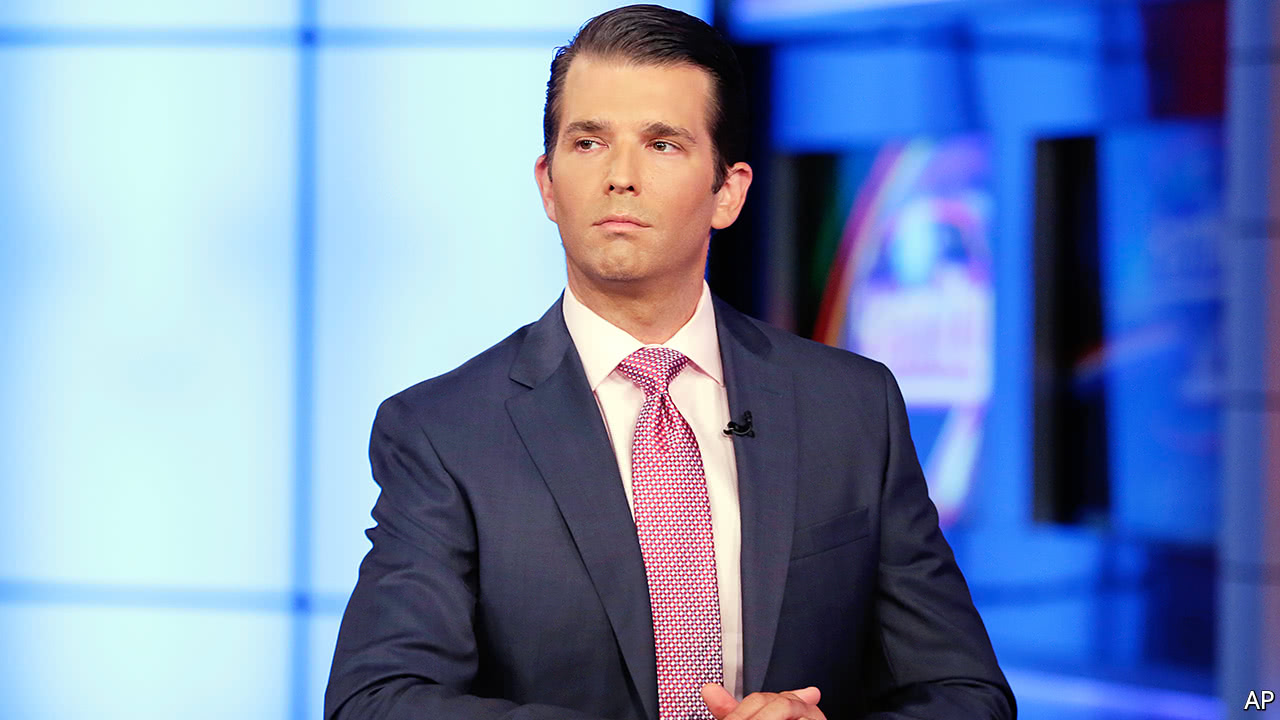
Will Donald junior’s conduct jolt Republicans?

Perhaps nothing will
THE first rule of modern conspiracies is that you do not talk about them in e-mails. It always seemed unlikely that, if Donald Trump’s associates had conspired with the Kremlin, they would have been amateurish enough to leave a paper trail. At least, it seemed that way until July 11th, when the president’s son, Donald junior, released astonishing messages he sent and received in advance of a meeting, in 2016, with a Russian lawyer. In the convoluted saga of the Trumps and the Russians, this may be the most explosive revelation yet.
It is no good arguing, in the younger Mr Trump’s defence, that he gave the e-mails up himself: he knew the New York Times was about to publish them, because it had asked him for his side of the story. It scarcely helps to note that the lawyer, Natalia Veselnitskaya, says she does not work for the Kremlin. Her use of such a meeting to assail American sanctions, a neuralgic subject for Vladimir Putin, suggests that she was not simply a private citizen. Nor does it help that Donald junior says she did not, in the end, provide the dirt on Hillary Clinton he craved. Whoever she was, whatever the outcome, the intent to collude is plain. That vindicates what has always been the real charge: not that the Russians swayed the election, a claim that is impossible to verify, but that Mr Trump’s team overstepped the bounds of propriety, and maybe the law (see article).

Latest updates

See all updates
In the e-mails Donald junior was promised “very high level and sensitive information” that “is part of Russia and its government’s support for Mr Trump”, then a candidate. “I love it,” the son replied. Ms Veselnitskaya is described as a “Russian government attorney”; the goods are said to come from a Russian prosecutor. Rather than calling the FBI, Donald junior took the meeting—bringing Jared Kushner, his brother-in-law, and Paul Manafort, who later quit as campaign manager amid uproar over his ties to Russian-backed Ukrainian politicians.
Contrary to claims from defenders of Mr Trump, a freelance bid by a junior Democratic operative to get dirt on Mr Manafort from the Ukrainians does not compare to this intrigue. Among other things, Ukraine is not a hostile power. Not only does this reinforce a pattern of fishy meetings involving Russian officials and Mr Trump’s advisers, many of which were mysteriously forgotten when they filled out security forms or testified in Congress; this looks worse, for both the Trumps and America. It is worse than Mr Kushner’s bizarre bid to set up a back-channel to talk to Moscow. It is more nakedly collusive than what has so far emerged about Michael Flynn, forced out as national security adviser for lying about his contacts with Russia’s ambassador. It ought to be damning.
That the reaction to such a bombshell could be in doubt exemplifies the damage being inflicted on America. As the president’s support holds up among ordinary Republicans, most Republican congressmen have dismissed the Russian affair as chatter or partisanship. Maintaining that blithe posture now will imply—or confirm—that they have entirely ditched principle for short-term self-interest. Another big risk is that misleading accounts of Russian meetings, which continue to multiply, may even now give the Kremlin leverage over the White House. The administration was told of that worry over Mr Flynn, but the president fired him only when he had no choice. (Soon, of course, he also fired James Comey, who was overseeing the FBI’s Russia probe, and whose treatment may itself constitute obstruction of justice.) Mr Trump claims not to have known about Ms Veselnitskaya; but then he would.
The gun smokes
The scandal is becoming a clash between the worst aspects of American democracy and the best. The worst is its bilious, myopic hyper-partisanship; the best the unrivalled ability of American institutions, including journalists whom Mr Trump reviles, to hold the powerful to account. Legally and politically, the ending is unclear. Morally, the verdict is already in.
This article appeared in the Leaders section of the print edition under the headline "He loves it"
View comments
Reuse this content

Monday, March 27, 2017

Russian rumbling: Anti-corruption demonstrations

by Maria Ogryzlo and Biodun Iginla, Political News Analysts, The Economist Intelligence Unit, Moscow Anti-corruption demonstrationssweep across Russia

The protests show opposition leader Alexei Navalny remains a force
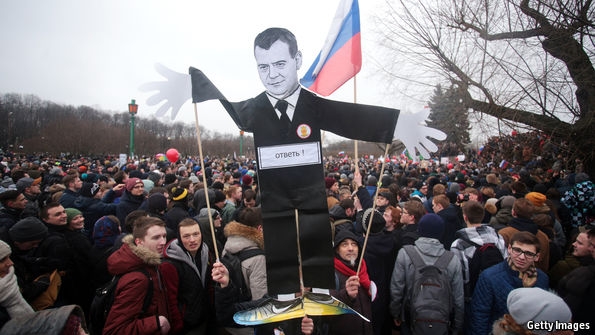
VLADIMIR PUTIN won his first presidential election on March 26th 2000. Exactly 17 years later, tens of thousands of Russians across the country came out to protest the corruption that has come to define his tenure. The demonstrations, the most significant challenge to Mr Putin’s regime since 2012, began on Russia’s Pacific coast, where hundreds marched through Vladivostok. Throughout the day reports of rallies, most of them unsanctioned, flowed in from dozens of cities, including metropolises like Novosibirsk and Yekaterinburg, industrial centres like Chelyabinsk and Nizhny Tagil, and even Makhachkala, capital of Dagestan, a North Caucasian region where Mr Putin regularly receives more than 90% of the vote. The largest crowds emerged in Moscow and in St Petersburg, where they spilled onto Palace Square—an echo of the 1917 Russian revolution that is unlikely to be lost on the Kremlin.
The Sunday marches came in response to a call from Aleksei Navalny, an opposition leader and anti-corruption campaigner. Mr Navalny recently released a film alleging that Dmitry Medvedev, the prime minister, has used charities and shell companies to amass a collection of mansions, yachts and other luxuries. The video has been watched nearly 12m times on the internet, and Mr Navalny implored his followers to take to the streets demanding answers.

Latest updates

See all updates
Demonstrators reprised slogans from the 2011-12 Bolotnaya protests, chanting “Russia without Putin” and “Russia will be free!” The authorities met them with riot police and vans. Human-rights groups say more than 700 people were arrested in Moscow alone, including Mr Navalny. On March 27th a court sentenced Mr Navalny to 15 days in jail for organising an unauthorised demonstration.
Mr Navalny’s selection of Mr Medvedev as a target was a strategic calculation. Mr Putin remains popular, and even Russians who dislike him would hesitate to protest against him directly. Mr Medvedev is widely disliked and seen as weak. Many Russians hold him responsible for the weak economy. Over the past three years, as the oil-price collapse and Western sanctions tipped Russia’s economy from stagnation into recession, consumers have been hit hard. Though GDP growth has turned a corner and is projected to return to positive territory again this year, retail sales continue to fall and inequality is growing. Nonetheless, the protests were not restricted to Mr Medvedev; they were a statement of general dissatisfaction with the system. As Angelina, a pensioner in Moscow, put it, “I’m fed up with this mess.”
The scale and the geographical scope of the demonstrations surprised many observers. Analysts and sociologists have long insisted that widespread unrest is unlikely: 83% of Russians say they would not participate in political protests, though only about 50% believe that the country is heading in the right direction, according to the Levada Centre, an independent pollster. But polls may be a poor indicator of the nation’s mood, especially in Russia’s regions, where the downturn has been felt especially acutely. For many who attended Sunday’s marches, exasperation seemed to have overcome apathy and fear. “Even if I’m arrested for 15 days, it’ll be a joy—I’ll go on a diet,” quipped Lena, a young journalist who marched along Tverskaya Street, steps from Red Square.
The crowds reflected a generational shift. Whereas the Bolotnaya protests in 2011-12 had a middle-aged core, Sunday’s rallies were filled with people in their teens and twenties—most of whom have no memory of their country without Mr Putin at the helm. “The point of democracy is that different rulers are needed at different times,” said a computer-engineering student who was attending his first protest. “They’ve been in power for 17 years already, it’s time to change the leader.”
As the marches rippled across the country, Russian officialdom was largely silent. State-run television acted as if nothing of note was happening. As thousands marched down Tverskaya Street, just steps from the Kremlin, the Rossiya 24 news network focused on Ukraine’s decision to ban Russia’s entry to the Eurovision song contest, a volcanic eruption in Kamchatka, and a shooting at a nightclub in Cincinnati, Ohio. The Kremlin issued no statements. Moscow city authorities said little except to commend the police for their “impeccable” work.
The mass arrests seem designed in part to deter protests during the 2018 presidential elections. Officials still reckon that lingering patriotic enthusiasm over the annexation of Crimea in 2014 will carry Mr Putin to a fourth term. The Kremlin has reportedly set goals of at least 70% turnout and a share of the vote of at least 70%, too. Russians now call the return of Crimea their second-greatest point of pride after the victory over Nazi Germany, and Mr Putin’s approval ratings remain well above 80%.
But the “Krym Nash” (“Crimea is ours”) effect may be fading. Anniversary celebrations of the annexation earlier this month were a damp squib. Economic issues and corruption worry Russians more than the unresolved war in Ukraine. Denis Volkov of the Levada Centre writes that for most Russians, Crimea’s return “has lost its relevance, and is spoken of less in focus groups”. Mr Navalny has declared his intention to run for president next year, despite being barred from the ballot because of a trumped-up conviction. The events of this weekend show that he remains a force. 
View comments
Reuse this content