AS EUROPEANS know to their lamentable cost, assassinations can start wars, even world wars. A bullet fired by a Serbian nationalist, killing Austria’s archduke in June 1914, sparked the calamitous first world war which arguably paved the way to the second. Earlier assassinations may have drastically altered the course of history, too. The bomb thrown in 1881 at Tsar Alexander II, who had emancipated the serfs, woefully stymied reform in Russia.
More recently, the murder in 1961 of Patrice Lumumba, the Congolese prime minister, often blamed on the CIA, helped set that country on its path to mayhem. The killing in 1994 of Rwanda’s president, Juvénal Habyarimana, set off Africa’s worst genocide. The murder of Israel’s prime minister, Yitzhak Rabin, by a Jewish fanatic the following year dimmed the prospect of peace between Israelis and Palestinians. The assassination in 2007 of Benazir Bhutto, when she was bidding to become Pakistan’s prime minister, stalled her country’s efforts to build democracy.
These and other cases suggest that Benjamin Disraeli was wrong when, after Abraham Lincoln’s killing, he remarked, “Assassination has never changed the history of the world.” And given its frequency, it would be stranger if it did not. From 1875-2004, 298 assassination attempts on national leaders were reported, according to a paper by Benjamin Jones and Benjamin Olken published by Northwestern University in America in 2007. They count 59 resulting in a leader’s death. Since 1950 a national leader has been assassinated in nearly two out of every three years.
Yet an attack does not have to be on a head of state to prove a political shock. The phenomenon of state-sanctioned attacks on perceived enemies at home, but especially abroad, has recently concentrated the minds of lawyers and policymakers. The neurochemical attack this month on Sergei Skripal, a retired Russian double agent, in Salisbury, a sleepy British cathedral city, is just the latest in a line of brazen incidents. On March 12th Britain’s prime minister, Theresa May, told Parliament that the Russian state was “highly likely” to have been the perpetrator. Two days later she announced the expulsion of 23 Russian diplomats (see article).
If Mrs May is right, the attack in Salisbury would join the list of attempts by the Russian state under Vladimir Putin to kill its enemies. On his own turf journalists, politicians and businessmen have been murdered. But the assassination of enemies on the soil of other countries is more audacious. Russia’s successor to the KGB, the Federal Security Service (FSB), sometimes in cahoots with criminal business networks that have thrived under Mr Putin, has not hesitated to kill perceived enemies of the state abroad, such as Alexander Litvinenko in London in 2006. The targeting of Mr Skripal—presuming he was a victim of the FSB—is not all that unusual.
And Russia is far from the first country to seek out and kill supposed enemies abroad. During the Cold War, military regimes in South America co-operated to kidnap and murder leftists who had sought exile in countries outside their own. Under apartheid, the South African government assassinated members of the now ruling African National Congress in neighbouring countries.
Licences to kill
The state that over the past half-century has most actively pursued a policy of hunting down and killing enemies abroad is surely Israel. According to Ronen Bergman, a prominent Israeli journalist, whose history of the subject, “Rise and Kill First”, was published this year, Israel’s security services have carried out some 2,700 assassinations. After Palestinians began to target Israelis across Europe, notoriously killing 11 members of the Israeli Olympic team in Munich in 1972, Mossad, the Israeli security service, was given a free rein to hunt down such enemies (though Mr Bergman questions whether the Munich attackers were ever killed). From then on, a string of attacks on Palestinian operatives in such places as Jordan, Lebanon, Malta, Tunisia and the United Arab Emirates was carried out.
Assassinations of Palestinians suspected of planning or perpetrating violence against Israelis have been relentlessly conducted also in the West Bank and Gaza, territories controlled by Israel that seek to become an independent Palestinian state. Khaled Meshal, who went on to become leader of Hamas, a Palestinian Islamist group that has carried out myriad suicide attacks, narrowly survived after being poisoned in the ear in Amman, Jordan’s capital, in 1997. Sheikh Ahmed Yassin and Abdel Aziz al-Rantisi, successive leaders of Hamas, were both assassinated by Israel in 2004. According to Mr Bergman, the Israelis assassinated more than 300 Palestinians (and 150-odd bystanders) during the intifada (uprising) of 2000-2005.
What the Israelis have termed “targeted preventions” by snipers, booby-traps, helicopters, F-16 fighter jets and increasingly by armed drones were at first often criticised by Western governments for violating international and humanitarian law. But after Osama bin Laden’s attack on the Twin Towers on September 11th 2001, the American administrations of George W. Bush and then Barack Obama, and more recently the British and French governments, have in some respects followed the example of the Israelis in tracking down and killing enemies abroad, sometimes including their own citizens, by using drones.
A year ago President Donald Trump approved a Pentagon request to designate parts of three unnamed Yemeni provinces as “areas of active hostilities” where suspected enemy fighters could be targeted. The term has no clear legal definition, says Peter Bergen of New America, a think-tank. But it lets armed forces operate as they do in conventional war zones and hit terrorist targets at will. The Trump administration has expanded the area where American forces conduct drone strikes from Pakistan, Yemen and Somalia to include Niger.
Whereas attacks such as the one on Mr Skripal have been almost universally condemned, the use of drones to kill targeted individuals has been more contentious. Many human-rights lawyers see them as unlawful. Agnes Callamard, the UN’s special rapporteur on extrajudicial, summary or arbitrary executions, says that “outside the context of active hostilities, the use of drones for targeted killing is almost never likely to be legal,” adding that lethal force can only be legally used when there is evidence that it would protect against an imminent threat. She also deplores the “kill lists” of what the Americans call “specially designated global terrorists” who, she says, have no way of proving that they are not, for example, helping al-Qaeda, yet in effect face a sentence of death without due process of law.
The Israeli and American authorities dislike the word “assassination” being applied to what they prefer to call “targeted attacks” because it implies a flouting of international law. At the end of 2016, just before he left office, Barack Obama issued a report on the legal framework guiding the United States’ use of force. It says, “Using targeted lethal force against an enemy consistent with the law of armed conflict does not constitute an ‘assassination’.” Assassinations, it notes, are unlawful under an executive order signed by Ronald Reagan in 1981 (which updated those by Gerald Ford and Jimmy Carter). But today there is “a new and different kind of conflict against enemies who do not wear uniforms or respect geographic boundaries and who disregard the legal principles of warfare.”
Broadening the battlefield
By implication this requires more elastic rules to be followed by governments facing such challenges, while broadly invoking the principle of self-defence to apply to enemies in the territory of another state. Due process, it is argued, cannot be applied when responding to an imminent attack or when the capture or extradition of a suspected enemy is not feasible. The report by the Obama administration also notes that it is permissible to “impinge on another state’s sovereignty” if it is unable or unwilling to “mitigate the threat emanating” from its own territory. Witness the case of Pakistan and bin Laden, subjected to a “targeted killing” in 2011.
Those on either side of the debate continue to argue over definitions of “self-defence”, “active hostilities” and “imminent”. For their part the Israelis also posit a “ticking bomb” argument: even if an attack is not imminent, a would-be perpetrator is still a legitimate target, they argue, because he is bent on an eventual attack. Amnesty International, by contrast, has denounced a “policy of assassinating those who do not pose an imminent threat to lives”. It is, says the human-rights organisation, “unlawful and should be stopped.” The Israelis have also been criticised for disproportionality, particularly regarding the deaths of bystanders. When in 2002 another Hamas leader, Salah Shehadeh, was killed by a one-tonne bomb dropped on his house, 16 civilians, including nine children, were also killed, according to a report by Amnesty International.
Philippe Sands, a lawyer who has charged both the American and British governments with violations of the laws of war, writes: “It’s a series of binaries. The first is whether a situation of armed conflict (war) exists. If it doesn’t, extrajudicial executions are a total no-no in all circumstances. If armed conflict exists, then every case turns on the facts.” The snag here, in the Israelis’ view, is that they are locked in what they call “an armed conflict short of war”, and that their survival as a nation cannot depend on the niceties of the law.
Other scholars note that the norms around state-sanctioned killings have long shifted. Writing in 1516, Thomas More, the theologian-cum-politician, argued that assassination was a way of keeping ordinary citizens off the battlefield. But by 1789 Thomas Jefferson could write to James Madison that “assassination, poison, perjury” were “held in just horror in the 18th century”. In 1806, Britain’s foreign secretary not only blocked a plot to kill Napoleon but informed the French. Yet as the litany of assassinations in the 20th century suggests, its use as a weapon of war returned to popularity soon enough.
But whether you call it assassination or targeted killing, is it effective? In the Russian case, the motive is mainly to instil fear into prominent people who dare to contest the current establishment and to punish traitors, whether they are no longer Russian citizens or reside abroad. Mr Putin, already widely considered a pariah in terms of international law, may think he has nothing to lose by arousing Western hostility still more. In Israel’s case it is to keep its enemies militarily on the back foot and force them into concessions, though it may conversely make them less minded to seek a lasting peace.
No end in sight
What is certain is that the practice of states killing prominent or particular individuals without recourse to the law will persist. Indeed, advances in toxicology and in the technology of drones may make it even more attractive as a weapon in the hands of governments who want to wage war without actually declaring it—and without sending armies across borders.
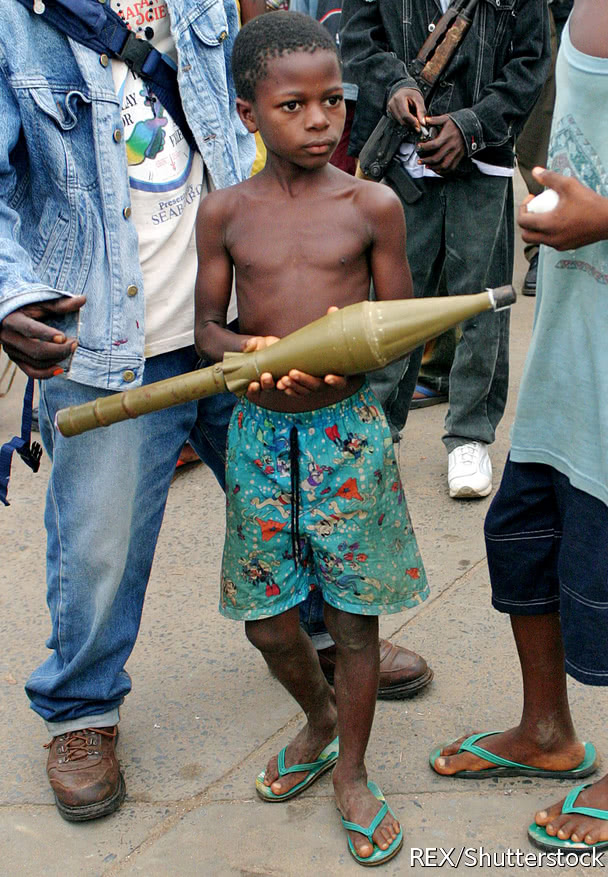
AS A child soldier in Sierra Leone in the 1990s, Eric Wolo smoked a brown powder that made him dizzy during the day, and took cocaine that kept him awake at night when he had to keep watch. When he returned to his home country, Liberia, in 1999, as a rebel fighter in its second civil war in ten years, he took up “Italian white”, a low-grade heroin. Four years later he handed in his AK-47 for $150 and training in how to grow rice and vegetables. But he never became a farmer. When asked, he starts by saying he gave all $150 to his girlfriend to start a business. Then he admits he bought drugs with the money. He now ekes out a living finding passengers for cars going from Ganta, on Liberia’s border with Guinea, to the capital, Monrovia.
Since the late 1980s there have been more than 60 “disarmament, demobilisation and reintegration” (DDR) programmes like Liberia’s, aimed at stopping civil wars reigniting, in dozens of countries. The idea is simple. Part fighters from their weapons. Discharge them from their militias. Help them into civilian life with money and training—or, in the case of children, school.
Aid donors have usually been willing to help pay for the schemes, often as part of a peace deal overseen by the UN. In 2008, the most recent year for which there are comprehensive data, 15 DDR programmes were under way. Their budgets (which covered more than one year) came to $1.6bn.
But the execution is fraught with difficulty. Combatants can be hard to identify. They may be rejected by their families and former neighbours. Their physical and psychological scars may leave them in need of long-term support. If militias are kept together, with former commanders overseeing who takes part and handing out funds, groups can more easily remobilise. But if groups are disbanded, and participation is individual, they may splinter into gangs of drug-traffickers or mercenaries.
Swords into ploughshares
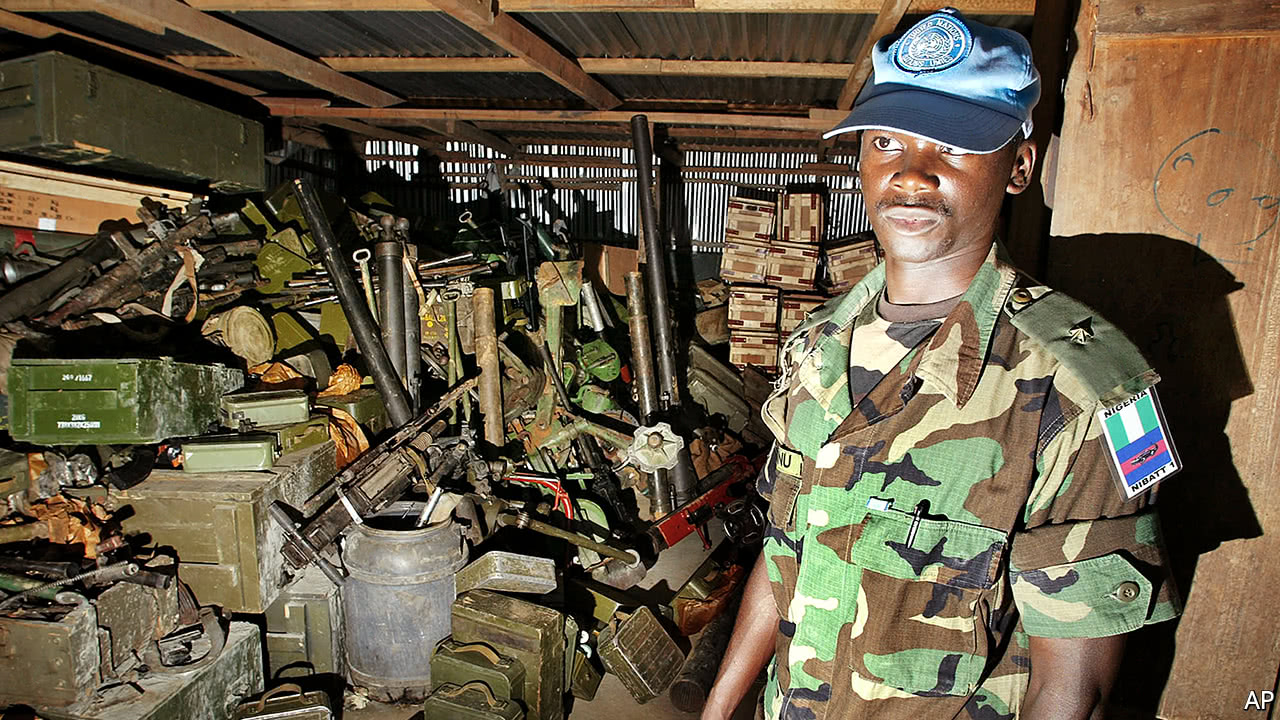
That Liberia is at peace and able to hold a credible election for president is impressive. George Weah, a former footballer, takes office on January 22nd in its first democratic transition since 1944. Almost 250,000 people were killed in its two civil wars. A DDR scheme after the first failed, but one after the second has helped keep the peace. A UN peacekeeping force with a large Nigerian contingent disarmed former combatants and put their weapons beyond use. Liberians still appreciate the role DDR played. But their gratitude is fading, as its limitations become clear.
Many ex-fighters are far from being upstanding members of society. Plenty were unwilling, or perhaps unable, to return to communities they left as children. Like Mr Wolo, many work erratically, in low-skilled jobs. Others do not work at all. Groups congregate to take drugs on the fringes of towns and Monrovia’s slums. William Teage, the chairman of Congo Community on the outskirts of Ganta, where Mr Wolo lives, says its biggest problem is drugs. He estimates that a tenth of the 2,000 residents are ex-combatants. “I have a very negative view concerning [the DDR process],” he says. “It was meant to rehabilitate people. But it did not go on that well.”
A country that has just ended a civil war has a 40% chance of falling back into conflict soon afterwards, says Paul Collier of Oxford University. The risk falls by about a percentage point for each year of peace. Finding ways to lower that risk became even more urgent with the upsurge in internal conflicts that followed the end of the cold war. When the Soviets and Americans stopped funding client states, many belligerents sought other revenue streams, for example smuggling diamonds out of west African war-zones, says Sebastian von Einsiedel of the University of the UN in Tokyo. Such groups were more likely to splinter, because subgroups could fund themselves. The rise of jihadist groups has further complicated matters. Their ideological motivations mean they are harder to negotiate with, and less likely to disarm in return for cash or in-kind benefits.
But even as DDR has got harder, no less is being asked of it. Some successes, and a lack of alternatives, meant it came to be used in circumstances where it was almost bound to fail. The UN attempted a DDR scheme in Haiti in 2004 to disarm drug-traffickers rather than fighters; almost no weapons were handed in. In 2015, 1,775 child soldiers in South Sudan were demobilised, but after it spiralled back into civil war the following year, many rearmed.
Modern DDR programmes were designed in the 1980s and early 1990s for the aftermath of independence wars in southern Africa and civil conflicts in Central America. The belligerent groups were relatively disciplined and hierarchical. More recent schemes have often had to deal with loosely structured outfits. That complicates the most basic task: deciding who should be allowed to take part.
If a weapon must be handed in, fighters who do not have their own will be excluded. Ask only for small arms or some ammunition, and chancers will try their luck. Sometimes, leaders are called upon to identify their underlings. This does not necessarily help. “Nearly every commander I’ve come across had an interest in making the number bigger,” says Paul Jackson of Birmingham University.
Only 150 rounds of small-arms ammunition were needed to take part in Liberia’s second DDR programme. The UN had expected to demobilise 38,000 fighters. In the end the number was more than 100,000—four times as many as the number of weapons handed in. Men were bussed in from Sierra Leone. Children who had not fought were signed up, with commanders taking a cut of the $300 payout. A police ammunition store in Freetown, Sierra Leone’s capital, was raided for ammunition to hand in in Liberia, says Desmond Molloy, who worked on Sierra Leone’s DDR scheme. Riots broke out when at least 12,000 people demanding payment turned up at a centre outside Monrovia. The programme had to be suspended for four months and money flown in from a UN mission in Freetown.
Though DDR is more likely to succeed if the fighting has already stopped, in Colombia it was used with some success as a military tactic. Alvaro Uribe, the president from 2002 to 2010, made a big push against the FARC, a left-wing guerrilla army that had been fighting state forces since 1964. His government encouraged deserters, realising they could provide valuable intelligence. Captured fighters could choose between prison and DDR. But the continuing fighting complicated matters. Some former guerrillas returned to the FARC after failing to find jobs at the end of their programme.
A weakened FARC negotiated a peace deal, which took effect in December 2016. Last August FARC leaders stood with the president, Juan Manuel Santos, and UN representatives, under the scorching sun of the arid north-eastern province of La Guajira, watching the last of their arsenal being carted away. Under the terms of the agreement, the FARC was allowed to organise the reintegration of its fighters collectively. That has helped it transform into a political party: it is putting forward candidates for elections this year.
Many ordinary citizens resent seeing former fighters transformed into political leaders. But the evidence suggests that, when they are, the peace is more likely to hold. Conflict breaks out again in just 21% of cases where peace deals contain provisions for participation in elections, compared with 56% where there are none, according to Aila Matanock of the University of Berkeley, California.
One reason is that politicking may enable mid-level commanders to find an influential role. Individual DDR programmes often lump them in with the rank and file. (The top brass will have ensured special treatment for themselves.) In Liberia Anders Themner of the Nordic Africa Institute, a think-tank based in Uppsala, Sweden, met two ex-commanders with similar backgrounds, both of whom had the chance to mobilise their former fighters as mercenaries in Ivory Coast in 2011. Only one did so. The other saw no need, having become a political power-broker.
The FARC has set up a co-operative to handle the 8m pesos ($2,900) available to each member as startup capital. But its leaders complain they need land to start suitable projects, for example ecotourism ventures, even as the government is confiscating land that FARC leaders held illegally. The impasse, and frustration with the slow pace of reintegration, mean many former guerrillas are leaving the transition camps. According to some estimates only half of the former combatants once living in the camps in Antioquia province remain.
Many have moved to areas with available land to farm. Others have returned to their families. They may not be a problem: research elsewhere shows that former fighters who maintain links with their communities find it easier to reintegrate. But around 1,000 have either refused to disarm or abandoned DDR to join gangs, some of which reportedly offer triple the two-year government stipend of $5,400.
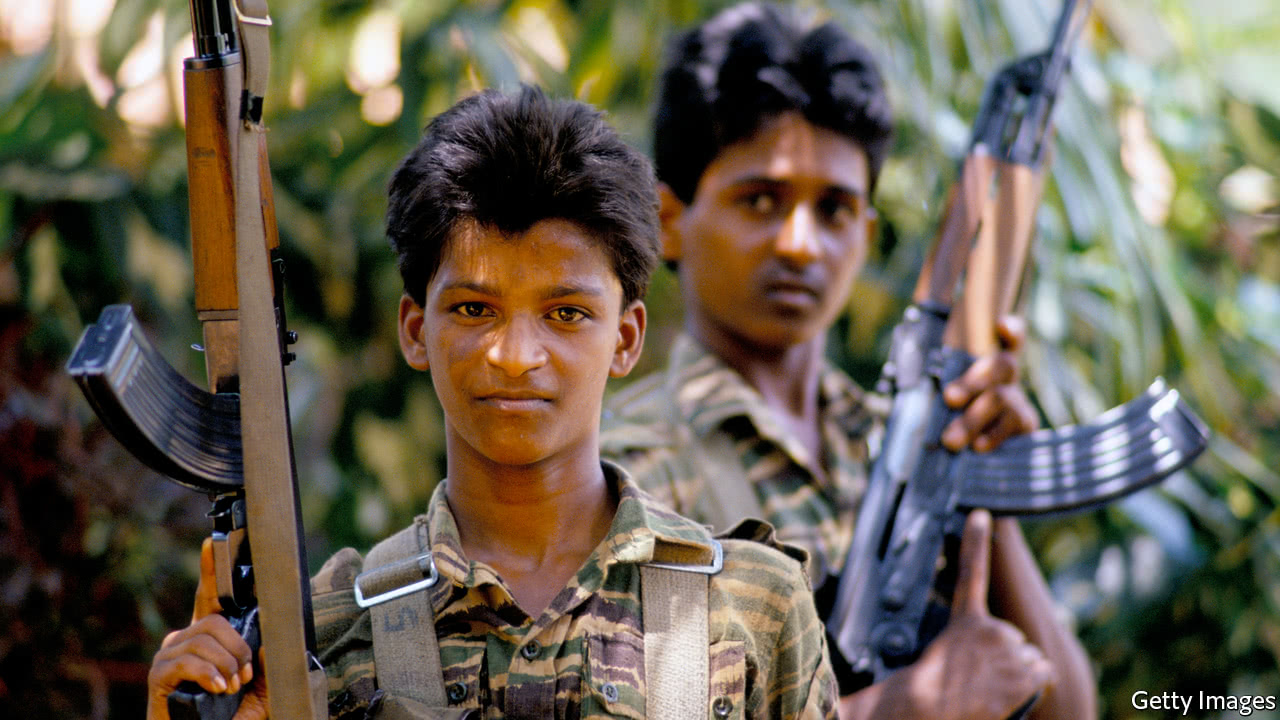
Surplus to requirementsIn Sri Lanka, the biggest problem has been that the government did not really care much about reintegration. In 2009 its army defeated the Liberation Tigers of Tamil Eelam (LTTE; also known as the Tamil Tigers). It was the brutal culmination of 26 years of civil war. The Tigers were trapped in designated no-fire zones, where they were bombed with the civilians they had taken as human shields. The 11,000 surviving fighters, and another 1,000 or so who had surrendered, were forced into rehabilitation, beginning in 2010.
But the programme mainly consisted of a year of internment and indoctrination. Still constantly monitored, the former fighters are isolated from their communities and struggle to find work, since potential employers fear attracting attention from the authorities. Though the army claims it provided training and psychological help, former Tigers say that these mostly focused on attempts to end their devotion to the LTTE. “We were not treated like normal human beings,” says one, who lives in Kilinochchi, a former stronghold of the Tigers in the north of Sri Lanka. “They tried to make us regret having been with the LTTE. But they couldn’t do it.”
The training was often pointless or inappropriate. “Someone [who] used to farm ten or 11 acres, they teach to make handicrafts with coconut shells,” says Vettichelli, who spent 18 years in the Tamil Tigers. She is now studying to become a counsellor and is scathing about the gender stereotypes in the Sri Lankan army’s vocational programmes. “For a woman who has the courage and stamina to keep a gun on her shoulders and shoot enemies, they try to teach her beauty culture and make-up.”
Many ex-fighters clearly require long-term support. But DDR schemes can rarely give it. They are generally run by ex-military types, not specialists in economic development or counselling. And a long-running programme risks turning into a protection racket. In 2009 the Nigerian government offered militants sabotaging oil production in the Niger Delta a monthly stipend of 60,000 naira (about $400 at the time) to disarm. But when payments were slashed in 2016 they returned to blowing up pipelines and other infrastructure. The cut was reversed and attacks subsided.
Bribery or death
At the heart of any DDR programme is a bargain: disarm, cause no more trouble—and you will benefit. Sometimes combatants will pocket the cash and hold themselves ready to remobilise at a moment’s notice. Those who do stand down may be unfit to aid in their country’s reconstruction. Civilians may resent the fighters at whose hands they suffered being paid off. But even a very grubby deal is worth striking if it helps secure lasting peace.
DONALD TRUMP rules over Washington as if he were a king and the White House his court. His displays of dominance, his need to be the centre of attention and his impetuousness have a whiff of Henry VIII about them. Fortified by his belief that his extraordinary route to power is proof of the collective mediocrity of Congress, the bureaucracy and the media, he attacks any person and any idea standing in his way.
Just how much trouble that can cause was on sensational display this week, with his sacking of James Comey—only the second director of the FBI to have been kicked out. Mr Comey has made mistakes and Mr Trump was within his rights. But the president has succeeded only in drawing attention to questions about his links to Russia and his contempt for the norms designed to hold would-be kings in check.
Just as dangerous, and no less important to ordinary Americans, however, is Mr Trump’s plan for the economy. It treats orthodoxy, accuracy and consistency as if they were simply to be negotiated away in a series of earth-shattering deals. Although Trumponomics could stoke a mini-boom, it, too, poses dangers to America and the world.
Trumponomics 101
In an interview with this newspaper, the president gave his most extensive description yet of what he wants for the economy (see article). His target is to ensure that more Americans have well-paid jobs by raising the growth rate. His advisers talk of 3% GDP growth—a full percentage point higher than what most economists believe is today’s sustainable pace.
In Mr Trump’s mind the most important path to better jobs and faster growth is through fairer trade deals. Though he claims he is a free-trader, provided the rules are fair, his outlook is squarely that of an economic nationalist. Trade is fair when trade flows are balanced. Firms should be rewarded for investing at home and punished for investing abroad.
The second and third strands of Trumponomics, tax cuts and deregulation, will encourage that domestic investment. Lower taxes and fewer rules will fire up entrepreneurs, leading to faster growth and better jobs. This is standard supply-side economics, but to see Trumponomics as a rehash of Republican orthodoxy is a mistake—and not only because its economic nationalism is a departure for a party that has championed free trade.
The real difference is that Trumponomics (unlike, say, Reaganomics) is not an economic doctrine at all. It is best seen as a set of proposals put together by businessmen courtiers for their king. Mr Trump has listened to scores of executives, but there are barely any economists in the White House. His approach to the economy is born of a mindset where deals have winners and losers and where canny negotiators confound abstract principles. Call it boardroom capitalism.
That Trumponomics is a business wishlist helps explain why critics on the left have laid into its poor distributional consequences, fiscal indiscipline and potential cronyism. And it makes clear why businessmen and investors have been enthusiastic, seeing it as a shot in the arm for those who take risks and seek profits. Stockmarkets are close to record highs and indices of business confidence have soared.
In the short term that confidence could prove self-fulfilling. America can bully Canada and Mexico into renegotiating NAFTA. For all their sermons about fiscal prudence, Republicans in Congress are unlikely to deny Mr Trump a tax cut. Stimulus and rule-slashing may lead to faster growth. And with inflation still quiescent, the Federal Reserve might not choke that growth with sharply higher interest rates.
Unleashing pent-up energy would be welcome, but Mr Trump’s agenda comes with two dangers. The economic assumptions implicit in it are internally inconsistent. And they are based on a picture of America’s economy that is decades out of date.
Contrary to the Trump team’s assertions, there is little evidence that either the global trading system or individual trade deals have been systematically biased against America (see article). Instead, America’s trade deficit—Mr Trump’s main gauge of the unfairness of trade deals—is better understood as the gap between how much Americans save and how much they invest (see article). The fine print of trade deals is all but irrelevant. Textbooks predict that Mr Trump’s plans to boost domestic investment will probably lead to larger trade deficits, as it did in the Reagan boom of the 1980s. If so, Mr Trump will either need to abandon his measure of fair trade or, more damagingly, try to curb deficits by using protectionist tariffs that will hurt growth and sow mistrust around the world.
A deeper problem is that Trumponomics draws on a blinkered view of America’s economy. Mr Trump and his advisers are obsessed with the effect of trade on manufacturing jobs, even though manufacturing employs only 8.5% of America’s workers and accounts for only 12% of GDP. Service industries barely seem to register. This blinds Trumponomics to today’s biggest economic worry: the turbulence being created by new technologies. Yet technology, not trade, is ravaging American retailing, an industry that employs more people than manufacturing (see article). And economic nationalism will speed automation: firms unable to outsource jobs to Mexico will stay competitive by investing in machines at home. Productivity and profits may rise, but this may not help the less-skilled factory workers who Mr Trump claims are his priority.
The bite behind the bark
Trumponomics is a poor recipe for long-term prosperity. America will end up more indebted and more unequal. It will neglect the real issues, such as how to retrain hardworking people whose skills are becoming redundant. Worse, when the contradictions become apparent, Mr Trump’s economic nationalism may become fiercer, leading to backlashes in other countries—further stoking anger in America. Even if it produces a short-lived burst of growth, Trumponomics offers no lasting remedy for America’s economic ills. It may yet pave the way for something worse.
A complete transcript of The Economist’s interview with Mr Trump is available here
IN 1662 a London haberdasher with an eye for numbers published the first quantitative account of death. John Graunt tallied causes such as “the King’s Evil”, a tubercular disease believed to be cured by the monarch’s touch. Others seem uncanny, even poetic. In 1632, 15 Londoners “made away themselves”, 11 died of “grief” and a pair fell to “lethargy”.
Graunt’s book is a glimpse of the suddenness and terror of death before modern medicine. It came early, too: until the 20th century the average human lived about as long as a chimpanzee. Today science and economic growth mean that no land mammal lives longer. Yet an unintended consequence has been to turn dying into a medical experience.
How, when and where death happens has changed over the past century. As late as 1990 half of deaths worldwide were caused by chronic diseases; in 2015 the share was two-thirds. Most deaths in rich countries follow years of uneven deterioration. Roughly two-thirds happen in a hospital or nursing home. They often come after a crescendo of desperate treatment. Nearly a third of Americans who die after 65 will have spent time in an intensive-care unit in their final three months of life. Almost a fifth undergo surgery in their last month.
Such zealous intervention can be agonising for all concerned (see article). Cancer patients who die in hospital typically experience more pain, stress and depression than similar patients who die in a hospice or at home. Their families are more likely to argue with doctors and each other, to suffer from post-traumatic stress disorder and to feel prolonged grief.
What matters
Most important, these medicalised deaths do not seem to be what people want. Polls, including one carried out in four large countries by the Kaiser Family Foundation, an American think-tank, and The Economist, find that most people in good health hope that, when the time comes, they will die at home. And few, when asked about their hopes for their final days, say that their priority is to live as long as possible. Rather, they want to die free from pain, at peace, and surrounded by loved ones for whom they are not a burden.
Some deaths are unavoidably miserable. Not everyone will be in a condition to toast death’s imminence with champagne, as Anton Chekhov did. What people say they will want while they are well may change as the end nears (one reason why doctors are sceptical about the instructions set out in “living wills”). Dying at home is less appealing if all the medical kit is at the hospital. A treatment that is unbearable in the imagination can seem like the lesser of two evils when the alternative is death. Some patients will want to fight until all hope is lost.
But too often patients receive drastic treatment in spite of their dying wishes—by default, when doctors do “everything possible”, as they have been trained to, without talking through people’s preferences or ensuring that the prognosis is clearly understood. Just a third of American patients with terminal cancer are asked about their goals at the end of life, for example whether they wish to attend a special event, such as a grandchild’s wedding, even if that means leaving hospital and risking an earlier death. In many other countries, the share is even lower. Most oncologists, who see a lot of dying patients, say that they have never been taught how to talk to them.
This newspaper has called for the legalisation of doctor-assisted dying, so that mentally fit, terminally ill patients can be helped to end their lives if that is their wish. But the right to die is just one part of better care at the end of life. The evidence suggests that most people want this option, but that few would, in the end, choose to exercise it. To give people the death they say they want, medicine should take some simple steps.
More palliative care is needed. This neglected branch of medicine deals with the relief of pain and other symptoms, such as breathlessness, as well as counselling for the terminally ill. Until recently it was often dismissed as barely medicine at all: mere tea and sympathy when all hope has gone. Even in Britain, where the hospice movement began, access to palliative care is patchy. Recent studies have shown how wrongheaded that is. Providing it earlier in the course of advanced cancer alongside the usual treatments turns out not only to reduce suffering, but to prolong life, too.
Most doctors enter medicine to help people delay death, not to talk about its inevitability. But talk they must. A good start would be the wider use of the “Serious Illness Conversation Guide” drawn up by Atul Gawande, a surgeon and author. It is a short questionnaire designed to find out what terminally ill patients know about their condition and to understand what their goals are as the end nears. Early research suggests it encourages more, earlier conversations and reduces suffering.
These changes should be part of a broad shift in the way health-care systems deal with serious illness. Much care for the chronically ill needs to move out of hospitals altogether. That would mean some health-care funding being diverted to social support. The financial incentives for doctors and hospitals need to change, too. They are typically paid by insurers and governments to do things to patients, not to try to prevent disease or to make patients comfortable. Medicare, America’s public health scheme for the over-65s, has recently started paying doctors for in-depth conversations with terminally ill patients; other national health-care systems, and insurers, should follow. Cost is not an obstacle, since informed, engaged patients will be less likely to want pointless procedures. Fewer doctors may be sued, as poor communication is a common theme in malpractice claims.
One last thing before I go
Most people feel dread when they contemplate their mortality. As death has been hidden away in hospitals and nursing homes, it has become less familiar and harder to talk about. Politicians are scared to bring up end-of-life care in case they are accused of setting up “death panels”. But honest and open conversations with the dying should be as much a part of modern medicine as prescribing drugs or fixing broken bones. A better death means a better life, right until the end.