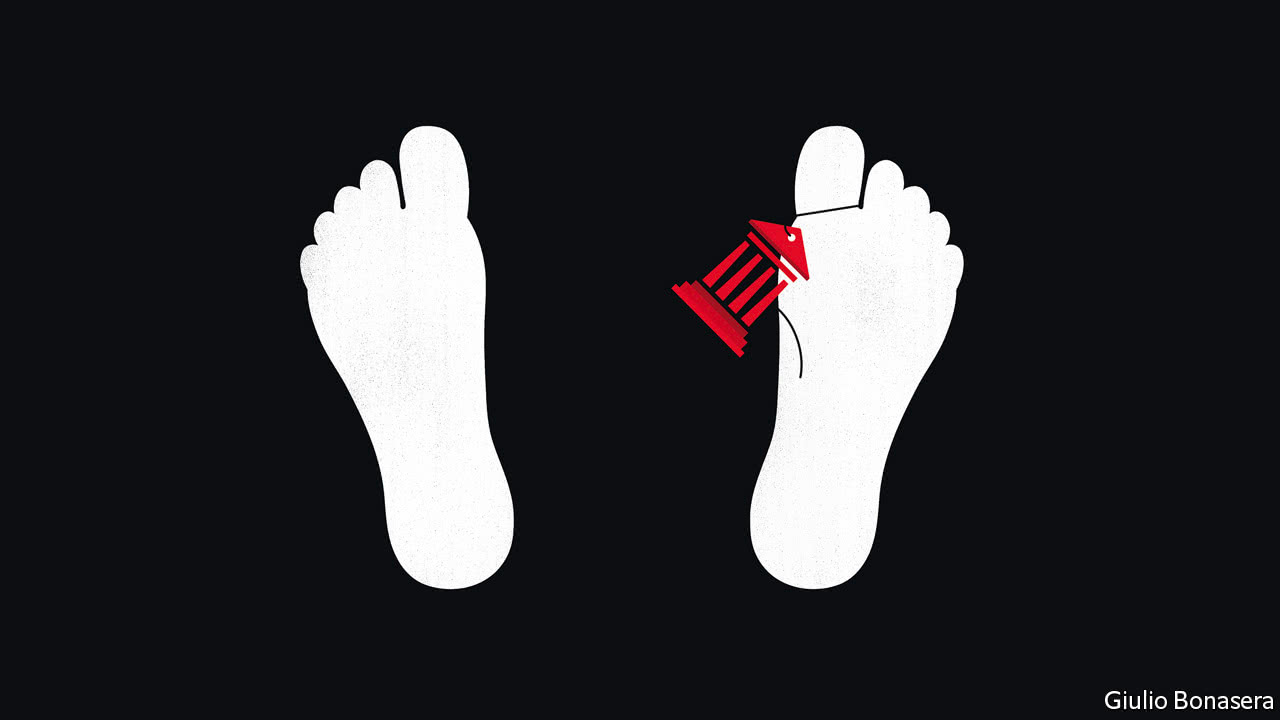
AS EUROPEANS know to their lamentable cost, assassinations can start wars, even world wars. A bullet fired by a Serbian nationalist, killing Austria’s archduke in June 1914, sparked the calamitous first world war which arguably paved the way to the second. Earlier assassinations may have drastically altered the course of history, too. The bomb thrown in 1881 at Tsar Alexander II, who had emancipated the serfs, woefully stymied reform in Russia.
More recently, the murder in 1961 of Patrice Lumumba, the Congolese prime minister, often blamed on the CIA, helped set that country on its path to mayhem. The killing in 1994 of Rwanda’s president, Juvénal Habyarimana, set off Africa’s worst genocide. The murder of Israel’s prime minister, Yitzhak Rabin, by a Jewish fanatic the following year dimmed the prospect of peace between Israelis and Palestinians. The assassination in 2007 of Benazir Bhutto, when she was bidding to become Pakistan’s prime minister, stalled her country’s efforts to build democracy.
These and other cases suggest that Benjamin Disraeli was wrong when, after Abraham Lincoln’s killing, he remarked, “Assassination has never changed the history of the world.” And given its frequency, it would be stranger if it did not. From 1875-2004, 298 assassination attempts on national leaders were reported, according to a paper by Benjamin Jones and Benjamin Olken published by Northwestern University in America in 2007. They count 59 resulting in a leader’s death. Since 1950 a national leader has been assassinated in nearly two out of every three years.
Yet an attack does not have to be on a head of state to prove a political shock. The phenomenon of state-sanctioned attacks on perceived enemies at home, but especially abroad, has recently concentrated the minds of lawyers and policymakers. The neurochemical attack this month on Sergei Skripal, a retired Russian double agent, in Salisbury, a sleepy British cathedral city, is just the latest in a line of brazen incidents. On March 12th Britain’s prime minister, Theresa May, told Parliament that the Russian state was “highly likely” to have been the perpetrator. Two days later she announced the expulsion of 23 Russian diplomats (see article).
If Mrs May is right, the attack in Salisbury would join the list of attempts by the Russian state under Vladimir Putin to kill its enemies. On his own turf journalists, politicians and businessmen have been murdered. But the assassination of enemies on the soil of other countries is more audacious. Russia’s successor to the KGB, the Federal Security Service (FSB), sometimes in cahoots with criminal business networks that have thrived under Mr Putin, has not hesitated to kill perceived enemies of the state abroad, such as Alexander Litvinenko in London in 2006. The targeting of Mr Skripal—presuming he was a victim of the FSB—is not all that unusual.
And Russia is far from the first country to seek out and kill supposed enemies abroad. During the Cold War, military regimes in South America co-operated to kidnap and murder leftists who had sought exile in countries outside their own. Under apartheid, the South African government assassinated members of the now ruling African National Congress in neighbouring countries.
Licences to kill
The state that over the past half-century has most actively pursued a policy of hunting down and killing enemies abroad is surely Israel. According to Ronen Bergman, a prominent Israeli journalist, whose history of the subject, “Rise and Kill First”, was published this year, Israel’s security services have carried out some 2,700 assassinations. After Palestinians began to target Israelis across Europe, notoriously killing 11 members of the Israeli Olympic team in Munich in 1972, Mossad, the Israeli security service, was given a free rein to hunt down such enemies (though Mr Bergman questions whether the Munich attackers were ever killed). From then on, a string of attacks on Palestinian operatives in such places as Jordan, Lebanon, Malta, Tunisia and the United Arab Emirates was carried out.
Assassinations of Palestinians suspected of planning or perpetrating violence against Israelis have been relentlessly conducted also in the West Bank and Gaza, territories controlled by Israel that seek to become an independent Palestinian state. Khaled Meshal, who went on to become leader of Hamas, a Palestinian Islamist group that has carried out myriad suicide attacks, narrowly survived after being poisoned in the ear in Amman, Jordan’s capital, in 1997. Sheikh Ahmed Yassin and Abdel Aziz al-Rantisi, successive leaders of Hamas, were both assassinated by Israel in 2004. According to Mr Bergman, the Israelis assassinated more than 300 Palestinians (and 150-odd bystanders) during the intifada (uprising) of 2000-2005.
What the Israelis have termed “targeted preventions” by snipers, booby-traps, helicopters, F-16 fighter jets and increasingly by armed drones were at first often criticised by Western governments for violating international and humanitarian law. But after Osama bin Laden’s attack on the Twin Towers on September 11th 2001, the American administrations of George W. Bush and then Barack Obama, and more recently the British and French governments, have in some respects followed the example of the Israelis in tracking down and killing enemies abroad, sometimes including their own citizens, by using drones.
A year ago President Donald Trump approved a Pentagon request to designate parts of three unnamed Yemeni provinces as “areas of active hostilities” where suspected enemy fighters could be targeted. The term has no clear legal definition, says Peter Bergen of New America, a think-tank. But it lets armed forces operate as they do in conventional war zones and hit terrorist targets at will. The Trump administration has expanded the area where American forces conduct drone strikes from Pakistan, Yemen and Somalia to include Niger.
Whereas attacks such as the one on Mr Skripal have been almost universally condemned, the use of drones to kill targeted individuals has been more contentious. Many human-rights lawyers see them as unlawful. Agnes Callamard, the UN’s special rapporteur on extrajudicial, summary or arbitrary executions, says that “outside the context of active hostilities, the use of drones for targeted killing is almost never likely to be legal,” adding that lethal force can only be legally used when there is evidence that it would protect against an imminent threat. She also deplores the “kill lists” of what the Americans call “specially designated global terrorists” who, she says, have no way of proving that they are not, for example, helping al-Qaeda, yet in effect face a sentence of death without due process of law.
The Israeli and American authorities dislike the word “assassination” being applied to what they prefer to call “targeted attacks” because it implies a flouting of international law. At the end of 2016, just before he left office, Barack Obama issued a report on the legal framework guiding the United States’ use of force. It says, “Using targeted lethal force against an enemy consistent with the law of armed conflict does not constitute an ‘assassination’.” Assassinations, it notes, are unlawful under an executive order signed by Ronald Reagan in 1981 (which updated those by Gerald Ford and Jimmy Carter). But today there is “a new and different kind of conflict against enemies who do not wear uniforms or respect geographic boundaries and who disregard the legal principles of warfare.”
Broadening the battlefield
By implication this requires more elastic rules to be followed by governments facing such challenges, while broadly invoking the principle of self-defence to apply to enemies in the territory of another state. Due process, it is argued, cannot be applied when responding to an imminent attack or when the capture or extradition of a suspected enemy is not feasible. The report by the Obama administration also notes that it is permissible to “impinge on another state’s sovereignty” if it is unable or unwilling to “mitigate the threat emanating” from its own territory. Witness the case of Pakistan and bin Laden, subjected to a “targeted killing” in 2011.
Those on either side of the debate continue to argue over definitions of “self-defence”, “active hostilities” and “imminent”. For their part the Israelis also posit a “ticking bomb” argument: even if an attack is not imminent, a would-be perpetrator is still a legitimate target, they argue, because he is bent on an eventual attack. Amnesty International, by contrast, has denounced a “policy of assassinating those who do not pose an imminent threat to lives”. It is, says the human-rights organisation, “unlawful and should be stopped.” The Israelis have also been criticised for disproportionality, particularly regarding the deaths of bystanders. When in 2002 another Hamas leader, Salah Shehadeh, was killed by a one-tonne bomb dropped on his house, 16 civilians, including nine children, were also killed, according to a report by Amnesty International.
Philippe Sands, a lawyer who has charged both the American and British governments with violations of the laws of war, writes: “It’s a series of binaries. The first is whether a situation of armed conflict (war) exists. If it doesn’t, extrajudicial executions are a total no-no in all circumstances. If armed conflict exists, then every case turns on the facts.” The snag here, in the Israelis’ view, is that they are locked in what they call “an armed conflict short of war”, and that their survival as a nation cannot depend on the niceties of the law.
Other scholars note that the norms around state-sanctioned killings have long shifted. Writing in 1516, Thomas More, the theologian-cum-politician, argued that assassination was a way of keeping ordinary citizens off the battlefield. But by 1789 Thomas Jefferson could write to James Madison that “assassination, poison, perjury” were “held in just horror in the 18th century”. In 1806, Britain’s foreign secretary not only blocked a plot to kill Napoleon but informed the French. Yet as the litany of assassinations in the 20th century suggests, its use as a weapon of war returned to popularity soon enough.
But whether you call it assassination or targeted killing, is it effective? In the Russian case, the motive is mainly to instil fear into prominent people who dare to contest the current establishment and to punish traitors, whether they are no longer Russian citizens or reside abroad. Mr Putin, already widely considered a pariah in terms of international law, may think he has nothing to lose by arousing Western hostility still more. In Israel’s case it is to keep its enemies militarily on the back foot and force them into concessions, though it may conversely make them less minded to seek a lasting peace.
No end in sight
What is certain is that the practice of states killing prominent or particular individuals without recourse to the law will persist. Indeed, advances in toxicology and in the technology of drones may make it even more attractive as a weapon in the hands of governments who want to wage war without actually declaring it—and without sending armies across borders.
Europe and America made mistakes, but the misery of the Arab world is caused mainly by its own failures
WHEN Sir Mark Sykes and François Georges-Picot secretly drew their
lines on the map of the Levant to carve up the Ottoman empire in May
1916, at the height of the first world war, they could scarcely have
imagined the mess they would set in train: a century of imperial
betrayal and Arab resentment; instability and coups; wars, displacement,
occupation and failed peacemaking in Palestine; and almost everywhere
oppression, radicalism and terrorism.
In the euphoria of the uprisings in 2011, when one awful Arab
autocrat after another was toppled, it seemed as if the Arabs were at
last turning towards democracy. Instead their condition is more
benighted than ever. Under Abdel-Fattah al-Sisi, Egypt is even more
wretched than under the ousted dictator, Hosni Mubarak. The state has
broken down in Iraq, Syria, Libya and Yemen. Civil wars rage and
sectarianism is rampant, fed by the contest between Iran and Saudi
Arabia. The jihadist “caliphate” of Islamic State (IS), the grotesque
outgrowth of Sunni rage, is metastasising to other parts of the Arab
world.
Bleak as all this may seem, it could become worse still. If the
Lebanese civil war of 1975-90 is any gauge, the Syrian one has many
years to run. Other places may turn ugly. Algeria faces a leadership
crisis; the insurgency in Sinai could spread to Egypt proper; chaos
threatens to overwhelm Jordan; Israel could be drawn into the fights on
its borders; low oil prices are destabilising Gulf states; and the proxy
conflict between Saudi Arabia and Iran might lead to direct fighting.
Advertisement
All this is not so much a clash of civilisations as a war within Arab
civilisation. Outsiders cannot fix it—though their actions could help
make things a bit better, or a lot worse. First and foremost, a
settlement must come from Arabs themselves.
Beware of easy answers
Arab states are suffering a crisis of legitimacy. In a way, they have
never got over the fall of the Ottoman empire. The prominent
ideologies—Arabism, Islamism and now jihadism—have all sought some
greater statehood beyond the frontiers left by the colonisers. Now that
states are collapsing, Arabs are reverting to ethnic and religious
identities. To some the bloodletting resembles the wars of the former
Yugoslavia in the 1990s. Others find parallels with the religious strife
of Europe’s Thirty Years War in the 17th century. Whatever the
comparison, the crisis of the Arab world is deep and complex. Facile
solutions are dangerous. Four ideas, in particular, need to be
repudiated.
First, many blame the mayhem on Western powers—from Sykes-Picot to
the creation of Israel, the Franco-British takeover of the Suez Canal in
1956 and repeated American interventions. Foreigners have often made
things worse; America’s invasion of Iraq in 2003 released its sectarian
demons. But the idea that America should turn away from the region—which
Barack Obama seems to embrace—can be as destabilising as intervention,
as the catastrophe in Syria shows.
Lots of countries have blossomed despite traumatic histories: South
Korea and Poland—not to mention Israel. As our special report (see article)
sets out, the Arab world has suffered from many failures of its own
making. Many leaders were despots who masked their autocracy with the
rhetoric of Arab unity and the liberation of Palestine (and realised
neither). Oil money and other rents allowed rulers to buy loyalty, pay
for oppressive security agencies and preserve failing state-led economic
models long abandoned by the rest of the world.
A second wrong-headed notion is that redrawing the borders of Arab
countries will create more stable states that match the ethnic and
religious contours of the population. Not so: there are no neat lines in
a region where ethnic groups and sects can change from one village or
one street to the next. A new Sykes-Picot risks creating as many
injustices as it resolves, and may provoke more bloodshed as all try to
grab land and expel rivals. Perhaps the Kurds in Iraq and Syria will go
their own way: denied statehood by the colonisers and oppressed by later
regimes, they have proved doughty fighters against IS. For the most
part, though, decentralisation and federalism offer better answers, and
might convince the Kurds to remain within the Arab system. Reducing the
powers of the central government should not be seen as further dividing a
land that has been unjustly divided. It should instead be seen as the
means to reunite states that have already been splintered; the
alternative to a looser structure is permanent break-up.
A third ill-advised idea is that Arab autocracy is the way to hold
back extremism and chaos. In Egypt Mr Sisi’s rule is proving as
oppressive as it is arbitrary and economically incompetent. Popular
discontent is growing. In Syria Bashar al-Assad and his allies would
like to portray his regime as the only force that can control disorder.
The contrary is true: Mr Assad’s violence is the primary cause of the
turmoil. Arab authoritarianism is no basis for stability. That much, at
least, should have become clear from the uprisings of 2011.
The fourth bad argument is that the disarray is the fault of Islam.
Naming the problem as Islam, as Donald Trump and some American
conservatives seek to do, is akin to naming Christianity as the cause of
Europe’s wars and murderous anti-Semitism: partly true, but of little
practical help. Which Islam would that be? The head-chopping sort
espoused by IS, the revolutionary-state variety that is decaying in Iran
or the political version advocated by the besuited leaders of Ennahda
in Tunisia, who now call themselves “Muslim democrats”? To demonise
Islam is to strengthen the Manichean vision of IS. The world should
instead recognise the variety of thought within Islam, support moderate
trends and challenge extremists. Without Islam, no solution is likely to
endure.
Reform or perish
All this means that resolving the crisis of the Arab world will be
slow and hard. Efforts to contain and bring wars to an end are
important. This will require the defeat of IS, a political settlement to
enfranchise Sunnis in Iraq and Syria, and an accommodation between Iran
and Saudi Arabia. It is just as vital to promote reform in countries
that have survived the uprisings. Their rulers must change or risk being
cast aside. The old tools of power are weaker: oil will remain cheap
for a long time and secret policemen cannot stop dissent in a networked
world.
Kings and presidents thus have to regain the trust of their people.
They will need “input” legitimacy: giving space to critics, whether
liberals or Islamists, and ultimately establishing democracy. And they
need more of the “output” variety, too: strengthening the rule of law
and building productive economies able to thrive in a globalised world.
That means getting away from the rentier system and keeping cronies at
bay.
America and Europe cannot impose such a transformation. But the West
has influence. It can cajole and encourage Arab rulers to enact reforms.
And it can help contain the worst forces, such as IS. It should start
by supporting the new democracy of Tunisia and political reforms in
Morocco—the European Union should, for example, open its markets to
north African products. It is important, too, that Saudi Arabia opens
its society and succeeds in its reforms to wean itself off oil. The big
prize is Egypt. Right now, Mr Sisi is leading the country to disaster,
which would be felt across the Arab world and beyond; by contrast,
successful liberalisation would lift the whole region.
Without reform, the next backlash is only a matter of time. But there
is also a great opportunity. The Arabs could flourish again: they have
great rivers, oil, beaches, archaeology, youthful populations, a
position astride trade routes and near European markets, and rich
intellectual and scientific traditions. If only their leaders and
militiamen would see it.