Biodun Iginla, BBC News

Biodun Iginla, BBC News
Showing posts with label Trump presidency. Show all posts

Thursday, January 11, 2018

The one-year-old Trump presidency--analysis

American politics


Is it really this bad?
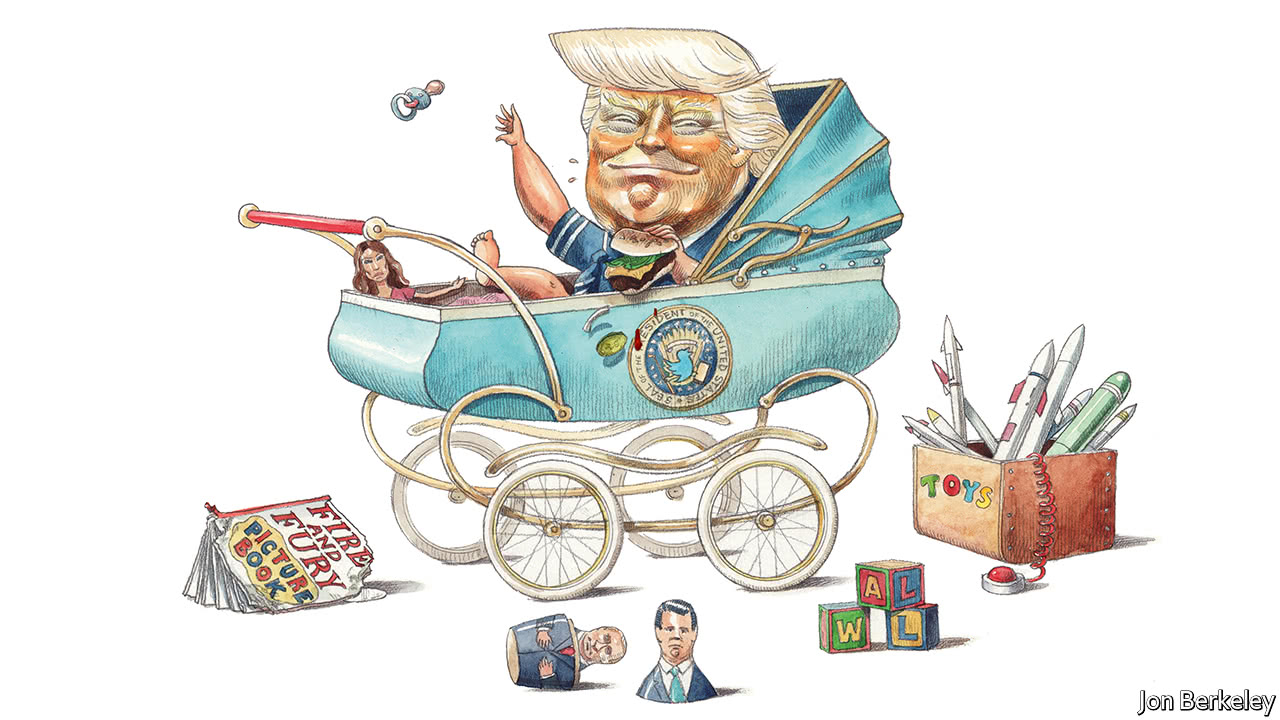
ALMOST one year into Donald Trump’s presidency, you have to pinch yourself to make sense of it all. In “Fire and Fury”, Michael Wolff’s gossipy tale of the White House, which did not welcome Mr Trump’s anniversary so much as punch it in the face, the leader of the free world is portrayed as a monstrously selfish toddler-emperor seen by his own staff as unfit for office (see article). America is caught up in a debate about the president’s sanity. Seemingly unable to contain himself, Mr Trump fans the flames by taking to Twitter to crow about his “very stable genius” and, in a threat to North Korea, to boast about the impressive size of his nuclear button.
Trump-watching is compulsive—who hasn’t waited guiltily for the next tweet with horrified anticipation? Given how much rests on the man’s shoulders, and how ill-suited he is to the presidency, the focus on Mr Trump’s character is both reasonable and necessary. But, as a record of his presidency so far, it is also incomplete and a dangerous distraction.

Latest updates

See all updates


Many happy retweets
To see why it is incomplete, consider first that the American economy is in fine fettle, growing by an annualised 3.2% in the third quarter (see article). Blue-collar wage growth is outstripping the rest of the economy. Since Barack Obama left, unemployment has continued to fall and the stockmarket to climb. Mr Trump is lucky—the world economy is enjoying its strongest synchronised upswing since 2010. But he has made his luck by convincing corporate America that he is on its side. For many Americans, especially those disillusioned with Washington, a jeremiad over the imminent threat to all of America from Mr Trump simply does not ring true.
Despite his grenade-throwing campaign, Mr Trump has not carried out his worst threats. As a candidate he spoke about slapping 45% tariffs on all Chinese goods and rewriting or ditching the North American Free-Trade Agreement with Canada and Mexico. There may soon be trouble on both those fronts, but not on that original scale (see article). He also branded NATO as obsolete and proposed the mass deportation of 11m illegal immigrants. So far, however, the Western alliance holds and the level of deportations in the 12 months to September 2017 was not strikingly different from earlier years.
In office Mr Trump’s legislative accomplishments have been modest, and mixed. A tax reform that cut rates and simplified some of the rules was also regressive and unfunded. His antipathy to regulation has invigorated animal spirits, but at an unknown cost to the environment and human health. His proposed withdrawal from the Paris climate agreement and the fledgling Trans-Pacific Partnership was, in our view, foolish, but hardly beyond the pale of Republican thinking.
His opportunism and lack of principle, while shameful, may yet mean that he is more open to deals than most of his predecessors. Just this week, he combined a harsh plan to deport Salvadoreans who have temporary rights to live and work in America with the suggestion of a broad reform to immigration (see article). He also said that he will be going to Davos, where he will rub shoulders with the globalists.
The danger of the Trump character obsession is that it distracts from deeper changes in America’s system of government. The bureaucracy is so understaffed that it is relying on industry hacks to draft policy. They have shaped deregulation and written clauses into the tax bill that pass costs from shareholders to society. Because Senate Republicans confirmed so few judges in Mr Obama’s last two years, Mr Trump is moving the judiciary dramatically to the right (see article). And non-stop outrage also drowns out Washington’s problem: the power of the swamp and its disconnection from ordinary voters.
Covfefe and other mysteries
As we have written repeatedly over the past year, Mr Trump is a deeply flawed man without the judgment or temperament to lead a great country. America is being damaged by his presidency. But, after a certain point, raking over his unfitness becomes an exercise in wish-fulfilment, because the subtext is so often the desire for his early removal from office.
For the time being that is a fantasy. The Mueller probe into his campaign’s dealings with Russia should run its course. Only then can America hope to gauge whether his conduct meets the test for impeachment. Ousting Mr Trump via the 25th Amendment, as some favour, would be even harder. The type of incapacity its authors had in mind was a comatose John F. Kennedy had he survived his assassination. Mr Trump’s mental state is impossible to diagnose from afar, but he does not appear to be any madder than he was when the voters chose him over Hillary Clinton (see article). Unless he can no longer recognise himself in the mirror (which, in Mr Trump’s case, would surely be one of the last powers to fade) neither his cabinet nor Congress will vote him out.
Neither should they. Alarm at Mr Trump’s vandalism to the dignity and norms of the presidency cuts both ways. Were it easy for a group of Washington insiders to remove a president using the 25th Amendment, American democracy would swerve towards oligarchy. The rush to condemn, or exonerate, Mr Trump before Mr Mueller finishes his inquiry politicises justice. Each time Mr Trump’s critics put their aim of stopping him before their means of doing so, they feed partisanship and help set a precedent that will someday be used against a good president fighting a worthy but unpopular cause.
That logic holds for North Korea, too. Mr Trump is not the first president to raise questions about who is fit to control nuclear weapons—consider Richard Nixon’s drinking or Kennedy’s reliance on painkillers, anti-anxiety drugs and, during the Cuban Missile Crisis, an antipsychotic. Ousting Mr Trump on the gut feeling that he might be mentally unstable smacks of a coup. Would you then remove a hawk for being trigger-happy or an evangelical for believing in the Rapture?
Mr Trump has been a poor president in his first year. In his second he may cause America grave damage. But the presidential telenovela is a diversion. He and his administration need to be held properly to account for what they actually do.

Friday, May 12, 2017

Trump presidency in peril after tumultuous week--an analysis


by Suzanne Gould and Biodun Iginla, Political News Analysts, France24, Washington DC


    © AFP / by Andrew BEATTY | US President Donald Trump's decision to summarily fire FBI director James Comey set off a chain of events that has put his White House on perilous ground

    WASHINGTON - 
    Another self-inflicted crisis has left Donald Trump's critics outraged and some of his Republican allies dismayed, but a bedrock of support for the billionaire US leader means the political endgame is far in the distance.
    A few weeks ago, only Trump's most rabid opponents would have predicted an early demise for his presidency.
    But by Friday, the possibility of impeachment was being floated -- albeit very cautiously -- by an increasing number of people in Washington's corridors of power.
    Trump's decision to summarily fire FBI director James Comey on Tuesday -- an act virtually unprecedented in US history -- set off a chain of events that has put his White House on perilous ground.
    Trump's professed rationale -- a recommendation from the Justice Department -- quickly unravelled, when he admitted he always intended to fire Comey.
    Trump then added fuel to the fire when he admitted the FBI's investigation into his campaign's possible collusion with the Kremlin was a factor in his thinking.
    There is still no firm evidence that Trump or any of his surrogates colluded with Russia to win the election. But the very fact that an investigation is ongoing is intolerable to a president who values his image above most things.
    "When (former director of national intelligence) James Clapper himself, and virtually everyone else with knowledge of the witch hunt, says there is no collusion, when does it end?" Trump said Friday in a furious tweetstorm.
    - 'A little dismayed' -
    As exhausted staff tried to clean up the Comey mess, Trump took to Twitter and went a step further, impugning his own staff's credibility and warning the ex-FBI director not to leak information to the media -- and suggesting there could be secret tapes of their conversations.
    "As a very active President with lots of things happening, it is not possible for my surrogates to stand at podium with perfect accuracy!" he said.
    Embattled White House spokesman Sean Spicer told reporters on Friday that Trump was "a little dismayed" by the negative media frenzy around his actions, adding: "The notion that there's collusion is a hoax."
    But by week's end, legal scholars wondered out loud whether Trump may be guilty of obstruction of justice -- a charge that featured in the articles of impeachment against Richard Nixon and Bill Clinton.
    "He may not have intended to commit anything like obstruction, or any other crime, but has instead blundered into this position because he does not recognize or respect norms and does not appreciate legal process or institutional boundaries," Bob Bauer, White House counsel to Trump's predecessor Barack Obama, wrote in a Lawfare blog post.
    Max Boot, a former foreign policy adviser to Republican presidential hopefuls John McCain and Mitt Romney, called Trump's firing of Comey a "flagrant assault on the rule of law."
    And Trump's political foes, like Connecticut Senator Chris Murphy, dispensed with the last remnants of political decorum to describe Trump's behavior as "unhinged."
    On Friday, Spicer, already publicly humiliated by his boss, was left unable to confirm or deny whether the president was recording Oval Office conversations, copies of which Democrats promptly demanded.
    - Reluctant allies -
    Throughout Trump's many controversies, his safety net has always been the Republican-controlled Congress, which forecloses any talk of impeachment or censure.
    But his relationship with the GOP has always been a shotgun marriage.
    Until now, the prospect of passing transformative tax reform or unraveling Obama's health care reforms was enough to keep the partnership together.
    As the Comey news broke, sure enough, Senate leader Mitch McConnell and House Speaker Paul Ryan resolutely opposed any calls for an independent investigator.
    But with Trump's legislative agenda on the rocks and his handling of the Comey crisis in question, the honeymoon appears to be nearing its end.
    Republicans privately express concern that the White House is careening out of control and are becoming more critical in public too.
    The normally cautious Senate Intelligence Chairman Richard Burr declared himself "troubled by the timing and reasoning of Director Comey's termination."
    - Red flags? -
    With several Trump aides still under investigation, many express concern about supporting Trump and being exposed if another shoe drops down the line.
    As ever in Washington politics, self-interest comes first.
    Many Republicans are eying the 2018 midterm elections, which will put control of the House of Representatives and potentially the Senate up for grabs.
    Trump's 36 percent approval rating -- according to a Quinnipiac University Poll -- gives lawmakers in closely contested districts little incentive to stay on the Trump train.
    And Trump's core of support no longer seems quite as firm.
    According to Quinnipiac's Tim Malloy, Trump is losing ground with white men, white voters without college degrees and independent voters.
    "The declaration by voters that President Donald Trump?s first 100 days were mainly a failure and deepening concerns about Trump?s honesty, intelligence and level headedness are red flags that the administration simply can't brush away," Malloy added.
    They are also red flags that if raised higher, may be impossible for the Republican Party to ignore too.

    Tuesday, April 4, 2017

    Highlights: The Trump presidency on April 5 at 01H:48 GMT/UTC/ZULU TIME

    Wed  Apr 5, 2017 |  01H:49 GMT/UTC/ZULU TIME
    Highlights of the day for U.S. President Donald Trump's administration on Tuesday:
    SENATE SHOWDOWN ON GORSUCH
    The U.S. Senate moves toward ramming through approval of Trump's Supreme Court nominee this week, as its top Republican says he has the votes to wipe away Democratic roadblocks but vows to preserve the minority party's ability to hold up legislation.
    HEALTHCARE OR TAX OVERHAUL?
    Trump and Republicans in Congress lurch between repealing Obamacare or rewriting the U.S. tax code as their top priority, with House of Representatives Speaker Paul Ryan dampening White House hopes for a quick vote on healthcare legislation.
    SYRIAN CHEMICAL WEAPONS ATTACK
    Trump condemns a Syrian chemical weapons attack that killed dozens and blames Syrian President Bashar al-Assad, but does not say how he will respond despite calls from France for stronger U.S. leadership.
    NORTH KOREA
    North Korea fires a ballistic missile from its east coast into the sea, South Korea's military says, ahead of a summit between U.S. and Chinese leaders who are set to discuss Pyongyang's nuclear program.
    CHINA SUMMIT
    Although worried about the prospect of a trade war, American businesses operating in China nonetheless want Trump to wring some concessions on market access from China's leader Xi Jingping when the two meet this week.
    KUSHNER IN IRAQ
    Trump's son-in-law, Jared Kushner, voices optimism about the long-term U.S. alliance with Iraq's military and its campaign to retake Mosul from Islamic State, as he visits a base about 10 miles (16 km) from the city.
    In its first official remarks on Trump since he became president, Islamic State says the United States is drowning and "being run by an idiot."

    INFRASTRUCTURE
    Trump vows to cut red tape to speed approval of infrastructure projects and says his overhaul could top $1 trillion on roads, tunnels and bridges, one of his 2016 election campaign promises.
    ENVIRONMENT
    Some big American coal companies have advised Trump's administration to break his promise to pull the United States out of the Paris Climate Agreement –- arguing that the accord could provide their best forum for protecting their global interests.
    NEXT SEC HEAD
    The Senate Banking Committee votes to advance Jay Clayton's nomination as the next chief of the Securities and Exchange Commission to the full Senate for approval.
    DODD-FRANK 'HAIRCUT'
    Trump says his administration is working on changes to Dodd-Frank banking regulations that will make it easier for banks to lend money.

    Thursday, March 30, 2017

    The Trump presidency is in a hole--an analysis

    The White House
    by Melissa Gruz and Biodun Iginla, Political News Analysts,  The Economist Intelligence Unit, Washington DC

    And that is bad for America—and the world
    DONALD TRUMP won the White House on the promise that government is easy. Unlike his Democratic opponent, whose career had been devoted to politics, Mr Trump stood as a businessman who could Get Things Done. Enough voters decided that boasting, mocking, lying and grabbing women were secondary. Some Trump fans even saw them as the credentials of an authentic, swamp-draining saviour.
    After 70 days in office, however, Mr Trump is stuck in the sand. A health-care bill promised as one of his “first acts” suffered a humiliating collapse in the—Republican-controlled—Congress (see Lexington). His repeated attempts to draft curbs on travel to America from some Muslim countries are being blocked by the courts. And suspicions that his campaign collaborated with Russia have cost him his national security adviser and look likely to dog his administration (see article). Voters are not impressed. No other president so early in his first term has suffered such low approval ratings.

    Latest updates

    See all updates
    It is tempting to feel relief that the Trump presidency is a mess. For those who doubt much of his agenda and worry about his lack of respect for institutions, perhaps the best hope is that he accomplishes little. That logic is beguiling, but wrong. After years of gridlock, Washington has work to do. The forthcoming summit with Xi Jinping, China’s president, shows how America is still the indispensable nation. A weak president can be dangerous—picture a trade war, a crisis in the Baltics or conflict on the Korean peninsula.
    The business of government
    Mr Trump is hardly the first tycoon to discover that business and politics work by different rules. If you fall out over a property deal, you can always find another sucker. In politics you cannot walk away so easily. Even if Mr Trump now despises the Republican factions that dared defy him over health care, Congress is the only place he can go to pass legislation.
    The nature of political power is different, too. As owner and CEO of his business, Mr Trump had absolute control. The constitution sets out to block would-be autocrats. Where Mr Trump has acted appropriately—as with his nomination of a principled, conservative jurist to fill a Supreme Court vacancy—he deserves to prevail. But when the courts question the legality of his travel order they are only doing their job. Likewise, the Republican failure to muster a majority over health-care reflects not just divisions between the party’s moderates and hardliners, but also the defects of a bill that, by the end, would have led to worse protection, or none, for tens of millions of Americans without saving taxpayers much money.
    Far from taking Washington by storm, America’s CEO is out of his depth. The art of political compromise is new to him. He blurs his own interests and the interests of the nation. The scrutiny of office grates. He chafes under the limitations of being the most powerful man in the world. You have only to follow his incontinent stream of tweets to grasp Mr Trump’s paranoia and vanity: the press lies about him; the election result fraudulently omitted millions of votes for him; the intelligence services are disloyal; his predecessor tapped his phones. It’s neither pretty nor presidential.
    That the main victim of these slurs has so far been the tweeter-in-chief himself is testament to the strength of American democracy. But institutions can erode, and the country is wretchedly divided (see article). Unless Mr Trump changes course, the harm risks spreading. The next test will be the budget. If the Republican Party cannot pass a stop-gap measure, the government will start to shut down on April 29th. Recent jitters in the markets are a sign that investors are counting on Mr Trump and his party to pass legislation.
    More than anything, they are looking for tax reform and an infrastructure plan. There is vast scope to make fiscal policy more efficient and fairer (see article). American firms face high tax rates and have a disincentive to repatriate profits. Personal taxes are a labyrinth of privileges and loopholes, most of which benefit the well-off. Likewise, the country’s cramped airports and potholed highways are a drain on productivity. Sure enough, Mr Trump has let it be known that he now wants to tackle tax. And, in a bid to win support from Democrats, he may deal with infrastructure at the same time.
    Yet the politics of tax reform are as treacherous as the politics of health care, and not only because they will generate ferocious lobbying. Most Republican plans are shockingly regressive, despite Mr Trump’s blue-collar base. To win even a modest reform, Mr Trump and his team will have to show a mastery of detail and coalition-building that has so far eluded them. If Mr Trump’s popularity falls further, the job of winning over fractious Republicans will only become harder.
    Were he frustrated in Congress, the president would surely fall back on areas where he has a free hand. He has already made full-throated use of executive orders and promises to harness the bureaucracy to force through his agenda. In theory he could deregulate parts of the economy, such as finance, where the hand of government is sometimes too heavy. Yet his executive orders so far have been crudely theatrical—as with this week’s repeal of Barack Obama’s environmental rules, which will not lead to the renaissance of mining jobs that he has disingenuously promised coal country (see article). It is the same with trade. Mr Trump could work through the World Trade Organisation to open markets. More probably, the economic nationalists on his team will have the upper hand. If so, America will take a bilateral approach, trade protection will grow and foreign policy will become more confrontational.
    The character question
    The Americans who voted for Mr Trump either overlooked his bombast, or they saw in him a tycoon with the self-belief to transform Washington. Although this presidency is still young, that already seems an error of judgment. His policies, from health-care reform to immigration, have been poor—they do not even pass the narrow test that they benefit Trump voters. Most worrying for America and the world is how fast the businessman in the Oval Office is proving unfit for the job.
    View comments
    Reuse this content