Biodun Iginla, BBC News

Biodun Iginla, BBC News
Showing posts with label British politics. Show all posts

Friday, May 24, 2019

ANALYSIS: British politics after Theresa May

Brexit chaos
by Emily Straton and Biodun Iginla, The Economist Intelligence Unit News Analysts, London

The prime minister admits defeat. But her successor will face the same forces that destroyed her
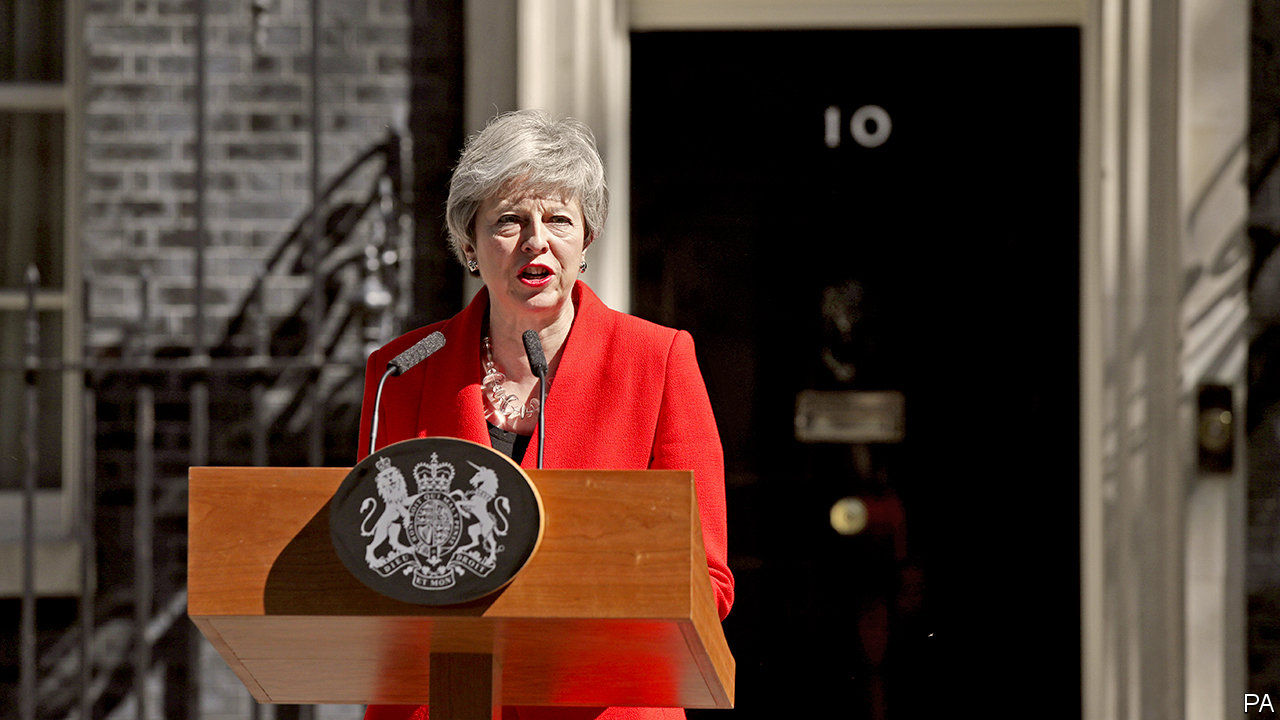
THERESA MAY strode out of the door of 10 Downing Street in a crimson business suit and bowed to the inevitable. Having failed three times to get her Brexit deal through a hopelessly divided parliament, and confronted with a Tory insurrection over her proposed fourth attempt, she announced on May 24th that she would step down as leader of the Conservative Party and Britain’s prime minister.
“It is and will always remain a matter of deep regret for me that I have not been able to deliver Brexit,” she declared. She then urged MPs to find the spirit of compromise. Had she left it there it might have been remembered as a dignified exit at the end of her dogged prime ministership. Instead she tried to set out her legacy—listing, among other things, measures to limit plastic waste—and only highlighted how little she managed to do. Then, as she gave thanks for the “honour of my life”, a prime minister often derided as “Maybot” shed a tear and left.

Read the rest of the story here.

Thursday, July 12, 2018

Analysis: Just another week in British politics

by Emily Straton and Biodun Iginla, News Analysts, The Economist Intelligence Unit, London

A new Brexit plan creates fresh depths of chaos

And the worst is yet to come
A REALLY sensible government would have drawn up a plan for how to leave the European Union before calling a referendum on whether to do so. A sane one would have devised a strategy before triggering exit negotiations. Britain, by contrast, announced its departure plan on July 6th, when three-quarters of the time it has for talking to Brussels had already been used up. And even then the long-overdue reckoning with reality sent the government reeling.
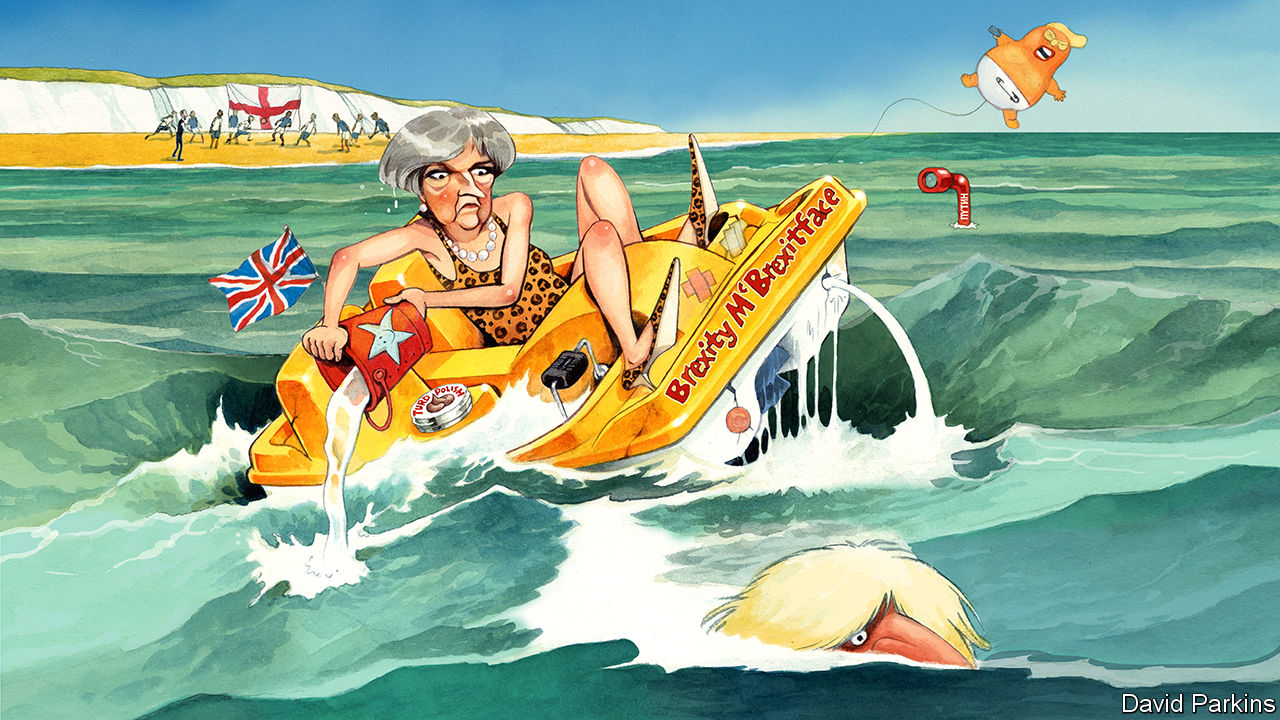
Two cabinet ministers and two Conservative Party vice-chairmen have quit; the foreign secretary, Boris Johnson, said in his resignation letter that the Brexit “dream is dying”. Those abandoning ship are furious that Theresa May has dropped a hard separation from the EU for a softer deal, preserving many legal and economic ties. For now, the prime minister seems unsinkable (wooden objects tend to be). But her belated move towards a realistic Brexit has just begun. As the truth sinks in, more turmoil is in store. The task for Mrs May and the EU is to ensure that the Brexit project does not descend into anarchy.

Latest stories

See more
Men overboard
Mrs May’s Brexit plan marks a decisive shift. Her approach had previously consisted mainly of ruling things out: no single-market membership, no free movement of labour, no obedience to foreign judges. Now she has said what she wants. She proposes that Britain remain, in effect, in the single market for goods, and in a looser system of mutual recognition for services. In return she promises not to undercut EU standards for the environment, social policies or state aid. She proposes a dispute-resolution mechanism that implies a role for the European Court of Justice. And she suggests that Britain stay in a customs union with the EU until a clever new tariff-collection mechanism can be set up (which may well mean for ever).
This is Mrs May’s most realistic plan so far, and yet European leaders will demand that she go further. They say she has still not made clear how Britain plans to avoid a hard border in Ireland, something they insist is settled before any deal can be signed. Britain is likely to be told that, if it wants the benefits of the single market for goods, it must seek membership of the whole thing—which in turn means observing other rules, including free movement of labour. The EU will probably want ongoing payments into its budget, too (see article).
This will lead to a Brexit that satisfies almost nobody. Hardline Brexiteers already feel betrayed. This week Mr Johnson complained that Britain would be subject to EU laws without having a say in how they were made, and that obeying these rules would make it harder to do trade deals with other countries. That is true, and adding in budget payments and free movement will surely prompt further cabinet resignations and backbench rebellions.
Remainers are hardly jubilant, either. Many, including this newspaper, see ending up in a situation similar to Norway, bound to the EU but with little say in how it works, as the best Brexit possible—and certainly less bad than the hard sort, which would cause enduring harm to the country’s prosperity. But a soft Brexit is so obviously worse than what Britain has today as a member of the EU that it would underline more clearly than ever the folly of leaving.
As a result Mrs May might struggle to get a deal through Parliament, even though most MPs probably favour a soft Brexit. Although pragmatic Brexiteers and Remainers may back her, hardliners may be tempted to hold out for either a harder deal or for stopping Brexit altogether. Her task will be further complicated by Labour under Jeremy Corbyn, which has yet to produce its own coherent plan. It is likely to put party before country by voting against whatever deal Mrs May brings home, in the hope of bringing down the government. That means even a small rebellion by Tory hardliners could be enough to defeat the plan.
Where does this leave Britain? Do not look to Brexiteers for answers. Although they complain that the people have been betrayed, they have still not explained how Britain could cut all ties with the EU while preserving trade links to what is by far Britain’s largest market. Mr Johnson did not even mention Ireland in his resignation letter this week. It is as if Brexiteers have spent so many years in opposition attacking the EU that they are flummoxed by the idea of coming up with a workable plan. While Mrs May at last faces up to the painful trade-offs that Brexit always required, those who condemned her this week prefer to indulge their fantasies.
The EU could help—and has reason to. It is reluctant to give Britain a bespoke deal, for fear that its other restless members will angle for special treatment, too. This is why Eurocrats solemnly vow that nothing must undermine the single market.
But if the Brexit negotiations fail, and Britain crashes out without any deal at all, it would cause grave damage across Europe and beyond. And in some areas the EU has an incentive to offer concessions. The most glaring is security, where its hardline position is self-defeating. Britain is one of Europe’s two big military and intelligence powers. Limiting its role in projects such as the Galileo geolocation system, at a time when America is wavering on its NATO commitments and Russia is stirring up trouble, endangers all Europeans. Bending rules such as freedom of movement is harder. But the EU can help give Mrs May the cover she needs to sell the deal at home. If she wants to replace free movement with a “mobility framework” that does much the same thing, let her. If she wants market alignment on goods but not on services, so what?
Throw her a lifebelt
And if Mrs May cannot win a Brexit vote? Then the EU should be prepared to grant Britain more time, to avoid it crashing out without a deal. To break the parliamentary impasse, Mrs May might have to go back to the people, either with yet another election or even a second referendum, setting out a concrete plan for Brexit rather than the vague, incompatible promises put before voters the last time round.
That Britain has at last set a course for a soft Brexit is welcome. Getting there will be a very rough crossing indeed.
This article appeared in the Leaders section of the print edition under the headline "Just another week in British politics"

Friday, June 2, 2017

The British election--analysis


by Emily Straton and Biodun Iginla, Political News Analysts, The Economist Intelligence Unit, London
The middle has fallen out of British politics

The leaders of both main parties have turned away from a decades-old vision of an open, liberal country

BRITAIN last voted in a general election just two years ago. Back then, the country was a bridge between the European Union and Barack Obama’s America. Its economy was on the mend after years of squeezed living standards. Scottish independence had just been ruled out. Labour’s most controversial policy was a plan to cap energy prices, denounced as “Marxist” by the Tories, who went on to win.
Today Britain finds itself in a different era. The vote for Brexit has committed it to leaving its biggest trading partner and snuggling closer to others, including a less-welcoming America. The economy has held up better than many feared but growth is slowing; investors are jittery. The union is fraying again. Real wages have stagnated. Public services are stretched.

Latest updates

See all updates
Political parties have responded in radically different ways. All have replaced their leaders. Jeremy Corbyn has taken Labour to the loony left, proposing the heaviest tax burden since the second world war. The Conservative prime minister, Theresa May, promises a hard exit from the EU. The Liberal Democrats would go for a soft version, or even reverse it.
The party leaders could hardly differ more in their style and beliefs. And yet a thread links the two possible winners of this election. Though they sit on different points of the left-right spectrum, the Tory and Labour leaders are united in their desire to pull up Britain’s drawbridge to the world. Both Mrs May and Mr Corbyn would each in their own way step back from the ideas that have made Britain prosper—its free markets, open borders and internationalism. They would junk a political settlement that has lasted for nearly 40 years and influenced a generation of Western governments (see article). Whether left or right prevails, the loser will be liberalism.
Labour, the conservative party
Mr Corbyn poses as a radical but is the most conservative—and the most dangerous—candidate of the lot. He wants to take the railways, water and postal service back into public ownership. He would resurrect collective pay-bargaining and raise the minimum wage to the point where 60% of young workers’ salaries are set by the state. His tax plan takes aim at high earners and firms, who would behave in ways his costings ignore. University would be free, as it was until the 1990s—a vast subsidy for the middle class and a blow to the poor, more of whom have enrolled since tuition fees helped create more places.
On Brexit, Labour sounds softer than the Tories but its policy comes to much the same. It would end free movement of people, precluding membership of the single market. Mr Corbyn is more relaxed than Mrs May about migration, which might open the door to a slightly better deal on trade. But his lifelong opposition to globalisation hardly makes him the man to negotiate one.
No economic liberal, Mr Corbyn does not much value personal freedom either. An avowed human-rights campaigner, he has embraced left-wing tyrants such as Hugo Chávez and Fidel Castro (a “champion of social justice”), who locked up opponents and muzzled the press. Mr Corbyn has spent a career claiming to stand for the oppressed while backing oppressors.
Candidate of nowhere
The Tories would be much better than Labour. But they, too, would raise the drawbridge. Mrs May plans to leave the EU’s single market, once cherished by Tories as one of Margaret Thatcher’s greatest achievements. Worse, she insists on cutting net migration by nearly two-thirds. Brexit will make this grimly easier, since Britain will offer fewer and worse jobs. Even then, she will not meet the target without starving the economy of the skills it needs to prosper—something she ought to know, having missed it for six years as home secretary.
Her illiberal instincts go beyond her suspicion of globally footloose “citizens of nowhere”. Like Mr Corbyn she proposes new rights for workers, without considering that it would make firms less likely to hire them in the first place. She wants to make it harder for foreign companies to buy British ones. Her woolly “industrial strategy” seems to involve picking favoured industries and firms, as when unspecified “support and assurances” were given to Nissan after the carmaker threatened to leave Britain after Brexit. She has even adopted Labour’s “Marxist” policy of energy-price caps.
And though she is in a different class from Mr Corbyn, there are also doubts about her leadership. She wanted the election campaign to establish her as a “strong and stable” prime minister. It has done the opposite. In January we called her “Theresa Maybe” for her indecisiveness. Now the centrepiece of her manifesto, a plan to make the elderly pay more for social care, was reversed after just four days. Much else is vague: she leaves the door open to tax increases, without setting out a policy. She relies on a closed circle of advisers with an insular outlook and little sense of how the economy works. It does not bode well for the Brexit talks. A campaign meant to cement her authority feels like one in which she has been found out.
It is a dismal choice for this newspaper, which sees little evidence of our classical, free-market liberal values in either of the main parties. We believe that, as it leaves the EU, Britain should remain open: to business, investment and people. Brexit will do least damage if seen as an embrace of the wider world, not simply a rejection of Europe. We want a government that maintains the closest ties with the EU while honouring the referendum, and that uses Brexit to reassert the freedom of Britain’s markets and society—the better to keep dynamic firms and talented people around. In their different ways, both Labour and the Tories fail this test.
No party passes with flying colours. But the closest is the Liberal Democrats. Brexit is the main task of the next government and they want membership of the single market and free movement. (Their second referendum would probably come to nothing, as most voters are reconciled to leaving the EU.) They are more honest than the Tories about the need to raise taxes for public services; and more sensible than Labour, spreading the burden rather than leaning only on high-earners. Unlike Labour they would reverse the Tories’ most regressive welfare cuts. They are on the right side of other issues: for devolution of power from London, reform of the voting system and the House of Lords, and regulation of markets for drugs and sex.
Like the other parties, they want to fiddle with markets by, say, giving tenants first dibs on buying their property. Their environmentalism is sometimes knee-jerk, as in their opposition to new runways and fracking. The true liberals in the party jostle with left-wingers, including Tim Farron, who is leading them to a dreadful result. But against a backward-looking Labour Party and an inward-looking Tory party about to compound its historic mistake over Brexit, they get our vote.
Backing the open, free-market centre is not just directed towards this election. We know that this year the Lib Dems are going nowhere. But the whirlwind unleashed by Brexit is unpredictable. Labour has been on the brink of breaking up since Mr Corbyn took over. If Mrs May polls badly or messes up Brexit, the Tories may split, too. Many moderate Conservative and Labour MPs could join a new liberal centre party—just as parts of the left and right have recently in France. So consider a vote for the Lib Dems as a down-payment for the future. Our hope is that they become one element of a party of the radical centre, essential for a thriving, prosperous Britain.

This article appeared in the Leaders section of the print edition under the headline "Britain’s missing middle"

View comments
Reuse this content


Thursday, January 5, 2017

Theresa Maybe, Britain’s indecisive premier--an analysis

British politics


After six months, what the new prime minister stands for is still unclear—perhaps even to her


WITHIN hours of the Brexit referendum last summer David Cameron had resigned, and within three weeks Theresa May had succeeded him as prime minister. The speed of her ascent to power, on July 13th 2016, without a general election or a full-blown Tory leadership contest, meant that Mayism was never spelt out in any manifesto or endorsed by the electorate. Yet the new prime minister soon made clear the scale of her ambitions for Britain. Not only would she make a success of Brexit, she would also set in motion a sea-change in social mobility to correct the “burning injustices” faced by the downtrodden, and reshape “the forces of liberalism and globalisation which have held sway...across the Western world.” Her allies talked of an epochal moment, comparable to Margaret Thatcher’s break with the past in 1979. The feeble condition of the Labour opposition gave Mrs May control of a one-party state. As for her mandate, she cited the referendum: a “quiet revolution” by people “not prepared to be ignored any more”. 
Yet after half a year in office there is strikingly little to show for this May revolution (see Briefing). The strategy for Brexit, which is due to be triggered in less than three months, remains undefined in any but the vaguest terms, and seems increasingly chaotic. At home, the grand talk about transforming society and taming capitalism has yielded only timid proposals, many of which have already been scaled down or withdrawn. The growing suspicion is that the Sphinx-like prime minister is guarded about her plans chiefly because she is still struggling to draw them up.
The emperor’s new trousers
Mrs May built a reputation for dogged competence during six years at the Home Office, a tricky beat that has wrecked many political careers. She skilfully survived the Brexit referendum despite backing the losing side. In the abbreviated Conservative leadership race she stood out as the only grown-up; few Tories regret plumping for her over the unprepared and unserious other contenders. In negotiating Brexit, the hardest task for any prime minister since the second world war, she faces a powerful drain on political capital and governmental capacity. Half the country is against the idea and the rest may sour once its drawbacks materialise. Most of the civil servants implementing Brexit think it a mistake. If Britain’s next few years will be about avoiding traps, then the wary tenacity of Mrs May could be just what the country needs.
Yet caution has started to look like indecision. Her most senior official in Brussels has just resigned, saying that the government does not have a clear Brexit plan (see article). After six months it is hard to name a single signature policy, and easy to cite U-turns. Some are welcome: a silly promise to put workers on company boards, for instance, was abandoned; a dreadful plan to make firms list their foreign employees lasted less than a week; and hints at curbing the Bank of England’s independence were quietly forgotten. Selective “grammar” schools will be resurrected—but only on a small scale, and perhaps not at all, given how many Tory MPs oppose the idea. Other reversals smack of dithering. The construction of a new nuclear plant at Hinkley Point was put in doubt, then given the go-ahead; a new runway at Heathrow airport was all but agreed on, then deferred until a parliamentary vote next year. “Just-about-managing” households were the prime minister’s lodestar for a week or so, then dropped. So were suggestions that Britain would seek a transitional deal with the EU after Brexit—until they were recirculated a few weeks later when Mrs May apparently changed her mind once again.
The cause of this disarray could be that Mayism itself is muddled. While vowing to make Britain “the strongest global advocate for free markets”, the prime minister has also talked of reviving a “proper industrial strategy”. This is not about “propping up failing industries or picking winners”, she insists. Yet unspecified “support and assurances” to Nissan to persuade the carmaker to stay in Sunderland after Brexit amount to more or less that. Her enthusiasm for trade often sits uncomfortably with her scepticism of migration. Consider the recent trip to India, where her unwillingness to give way on immigration blocked progress on a free-trade agreement.
A citizen of nowhere
There is one lesson in the overdone comparison of Mrs May to Thatcher. The woman who really did transform Britain had a shambolic first term; privatisation and union reform, with which she is now associated, did not really get going until after 1983. Angela Merkel also made a shaky start as Germany’s chancellor. Mrs May could yet find her feet—and given the state of Labour, she will have time to do so, if Brexit does not provide her own party with a reason to oust her.
Yet Mrs May could turn out to resemble another, less obvious predecessor: Gordon Brown. He, too, was thin-skinned. Like her, he moved into Downing Street without an election, in 2007. He also started with a fearsome reputation and big promises. And when it became clear he had little idea what to do with the job he had so coveted, he flopped. The financial crisis paralysed his government because of his desire to micromanage every decision.
There is more than a little of this in Mrs May. One person can just about run the Home Office single-handed. But being prime minister requires delegation—especially when Brexit looms so large. Care for the elderly is fraying. The National Health Service is running out of money. A housing shortage is worsening. Scotland and Northern Ireland are raising awkward constitutional questions. As long as every proposal has to be pored over by the prime minister, radical decisions of the sort needed to solve these problems will not be taken. To get a grip on Britain, Mrs May must learn to loosen hers.
For this, she must decide what the grand promises of her government actually amount to. The need for every policy to be agonised over in Downing Street, the secrecy over Brexit and the silence on the government’s broader plans for Britain all point to the same problem: Theresa Maybe does not really know what she wants.